commercial kitchen quartz flooring · 14 min read ·
The Ultimate Safety Checklist for Slip Resistant Quartz Flooring in BC (2026)
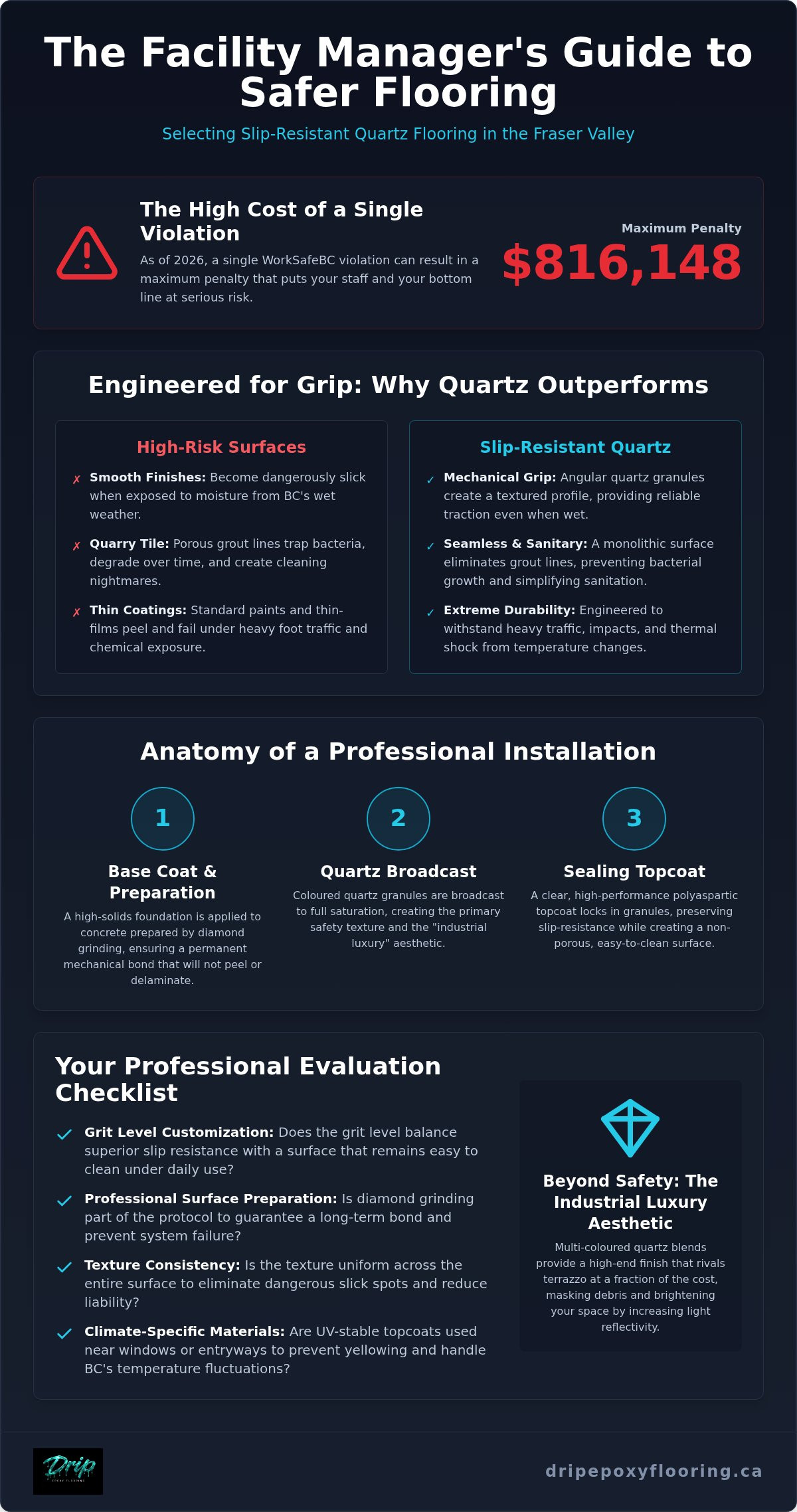
As of 2026, a single WorkSafeBC violation can carry a maximum penalty as high as $816,148, a sobering reality for any facility manager in the Fraser Valley. You likely recognize that maintaining a safe environment is you
By Drip Epoxy Flooring · Chilliwack, BC
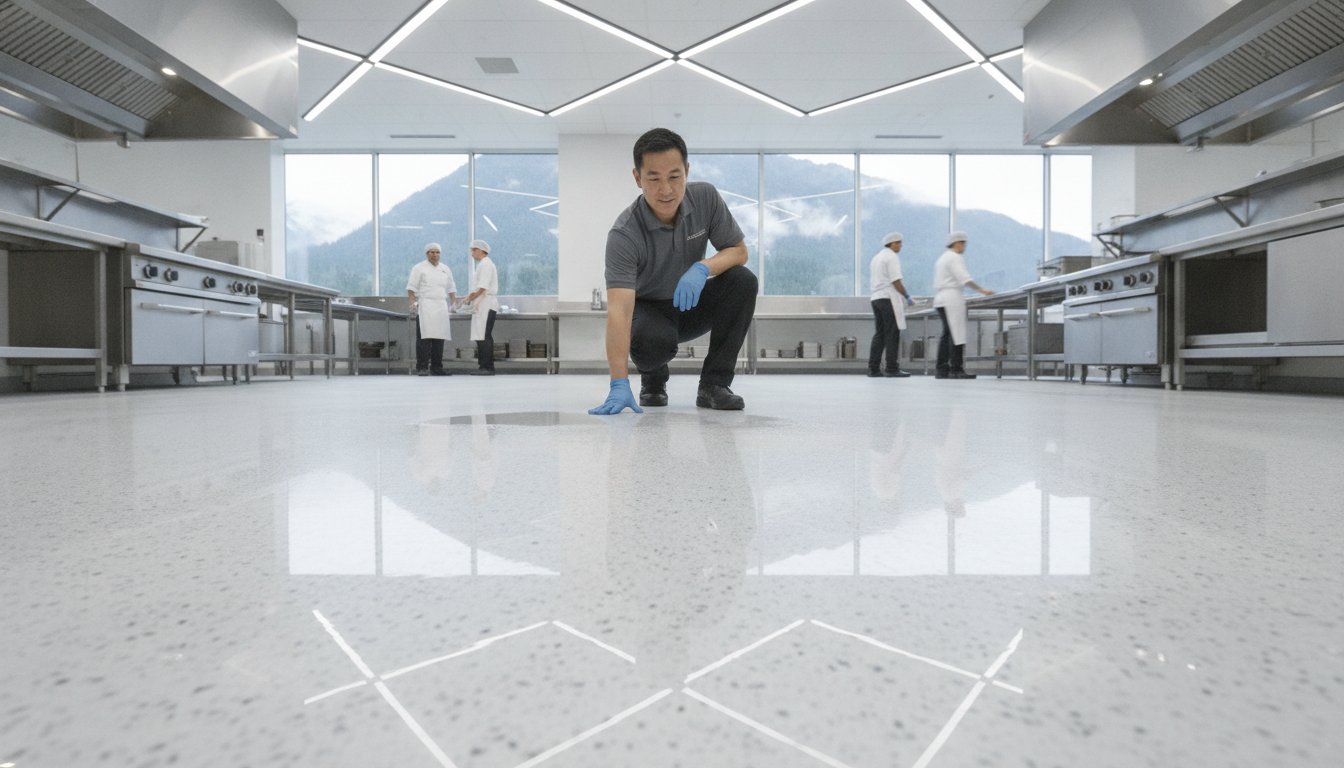
As of 2026, a single WorkSafeBC violation can carry a maximum penalty as high as $816,148, a sobering reality for any facility manager in the Fraser Valley. You likely recognize that maintaining a safe environment is your top priority, especially when BC’s persistent wet weather turns standard surfaces into high-risk zones. Selecting the right commercial kitchen quartz flooring isn't just about aesthetics; it's about protecting your staff and your bottom line from the catastrophic costs of a slip-and-fall accident.
It's frustrating to invest in a safety floor only to find it degrades under heavy foot traffic or becomes a nightmare to clean because of poorly designed texture. We realize you need a solution that balances industrial-grade traction with a high-end, professional finish. This guide provides a comprehensive checklist to help you select the most durable slip-resistant quartz flooring for your facility. We'll examine the technical balance of grit and resin, current BC safety standards, and the meticulous installation protocols that ensure your floor remains a long-term asset rather than a liability.
Key Takeaways
- Understand the science of mechanical grip and how the angular shape of quartz granules provides reliable traction even in wet Lower Mainland environments.
- Discover how to customize your commercial kitchen quartz flooring to meet specific WorkSafeBC safety standards while maintaining a sophisticated, high-end aesthetic.
- Learn to select the ideal grit level to balance superior slip resistance with a surface that remains easy to clean and maintain under heavy daily use.
- Identify the critical role of professional surface preparation, such as diamond grinding, in ensuring the long-term bond and durability of your resinous flooring system.
- Gain a professional checklist for evaluating texture consistency to eliminate dangerous slick spots and significantly reduce liability risks in your facility.
Table of Contents
Understanding Slip Resistant Quartz Flooring: Safety Meets Style
Resinous flooring isn't merely a decorative coating; it's a high-performance, multi-layered system engineered for the most demanding environments. In a professional setting, commercial kitchen quartz flooring consists of specialized coloured quartz granules broadcast into a high-solids resinous binder. This process creates a surface that is as resilient as it is visually striking, offering a level of durability that standard paints or thin-film coatings simply can't match. To understand the material's inherent strength, it helps to look at What is Engineered Quartz and how its mineral composition provides exceptional hardness and chemical resistance.
The science of slip resistance in these systems relies on mechanical friction. Unlike smooth epoxy finishes that become dangerously slick when wet, the angular, crystalline shape of the quartz granules provides consistent grip. These granules create a textured profile that breaks the surface tension of liquids, allowing footwear to maintain contact with the floor even during spills. Many BC businesses are transitioning away from traditional quarry tile because tiles have porous grout lines that trap bacteria and eventually degrade. A seamless quartz system eliminates these failure points, providing a monolithic surface that is easier to sanitize and maintain over time.
The Anatomy of a Quartz Broadcast System
A professional installation involves three distinct stages to ensure the floor performs under pressure:
- Base coat: This high-solids foundation is applied to concrete that has been meticulously prepared via diamond grinding, ensuring a permanent mechanical bond that won't peel.
- Quartz broadcast: Coloured granules are distributed until the resin is fully saturated, providing the primary safety texture and the "industrial luxury" aesthetic.
- Sealing coat: A clear, high-performance topcoat locks the granules in place. This layer is critical because it preserves the slip-resistant texture while ensuring the floor remains non-porous and easy to clean.
Why Local BC Climate Demands Better Traction
In the Fraser Valley, the "wet-entry" problem is a constant operational challenge. During the heavy rainy seasons in Chilliwack and Abbotsford, moisture is tracked deep into retail and food service facilities. High humidity in the Lower Mainland also leads to condensation on cold concrete slabs, creating invisible slip hazards that standard floors can't handle. We utilize UV-stable polyaspartic topcoats for areas near large windows or transition zones like patios. These coatings don't yellow under the sun and they maintain their structural integrity against the thermal shock caused by BC’s frequent temperature fluctuations. You can explore our full range of resinous flooring services to see how these systems are customized for local conditions.
The Industrial Luxury Aesthetic: Why Quartz is Trending in 2026
In 2026, the demand for commercial kitchen quartz flooring has evolved beyond simple utility. Business owners no longer settle for the dull, monolithic "industrial grey" of the past. Instead, they're embracing a design philosophy known as industrial luxury. This approach integrates high-performance resilience with a sophisticated visual finish that rivals natural stone. By utilizing multi-coloured quartz blends, facilities can achieve a depth of colour that masks minor debris while projecting a clean, high-end image to both clients and staff. This is particularly vital for open-concept facilities where the kitchen or production area is visible to patrons.
Natural light is often a scarce resource during a Fraser Valley winter. The crystalline nature of quartz granules increases light reflectivity, which can significantly brighten a large warehouse or retail space. This doesn't just improve the atmosphere; it enhances visibility for workers. Such improvements serve as a proactive measure aligned with broader Workplace Safety Standards regarding environmental hazards and visibility. Traditional terrazzo is beautiful, but it requires a massive investment in both time and capital. Quartz broadcast systems provide a similar speckled, high-end aesthetic at a fraction of the cost and installation time.
Seamless Design for High-End Commercial Spaces
Eliminating grout lines does more than just modernize a room. It creates an expansive, uninterrupted floor plane that makes smaller spaces feel significantly larger. In high-traffic environments, these seamless surfaces are far more hygienic because there are no crevices for moisture or bacteria to hide. This aesthetic versatility is why quartz is frequently chosen for showroom floor coatings in car dealerships. The floor must be tough enough for vehicles but elegant enough for a luxury sales environment. If you're ready to upgrade your facility, you can request a professional flooring assessment to find the right blend for your brand.
Durability That Maintains Its Finish
A floor's beauty is only as valuable as its longevity. In busy hallways across Langley or Surrey, traditional vinyl or tile often develops "traffic patterns" where the finish wears away in high-use centres. Commercial kitchen quartz flooring is incredibly resistant to this type of localized wear. Because the colour is consistent throughout the quartz granules, the floor doesn't show white scratch marks or dull spots. The system's impact resistance also ensures that dropped tools or heavy equipment won't cause the unsightly chipping often seen with ceramic tiles. It's a specialized solution that maintains its "new floor" look with very little professional intervention over time.
Safety Checklist: Evaluating Slip Resistant Quartz Flooring
Evaluating the safety of a resinous system requires moving beyond visual inspections. In British Columbia, the primary metric for traction is the Coefficient of Friction (COF). A high-performance commercial kitchen quartz flooring system should consistently meet or exceed the R10 to R12 rating, which is the industry benchmark for environments prone to grease and moisture. However, safety is not a static measurement; it must be maintained. You should verify that the slip resistance will not degrade when exposed to harsh sanitizing agents or hot oils. If a system's texture is compromised by chemical exposure, the initial safety rating becomes irrelevant.
Consistency is equally critical. During the installation, the quartz broadcast must be distributed to rejection to ensure there are no "slick spots" where resin has pooled over the grit. This uniformity is a hallmark of professional application. We recommend reviewing the CCOHS guidelines on flooring safety to understand how floor selection acts as a primary engineering control against workplace falls. Finally, cleanability must be balanced with grip. If the grit is too aggressive for your existing scrubbing equipment, the floor will trap dirt; if it's too fine, it won't provide the necessary traction when wet.
Industry-Specific Safety Requirements
Safety needs vary significantly by sector. For instance, our checklist for veterinary clinics focuses on balancing "paw-grip" for animal stability with the non-porous nature required for clinical hygiene. In retail spaces across Langley and Mission, the priority is managing "wet-entry" hazards from rain-soaked footwear. Conversely, industrial kitchens require aggressive slip-reduction and high heat resistance to handle boiling liquids and heavy grease loads. Tailoring the grit level to these specific contaminants is the only way to ensure long-term compliance and safety.
The Concrete Preparation Factor
A safe floor is only as stable as the bond to the substrate. We always verify the use of mechanical diamond grinding to open the concrete's pores, creating a superior, long-lasting mechanical bond. Before the quartz is applied, the slab must be tested for Moisture Vapor Transmission (MVT) to prevent future delamination. A professional installer will also evaluate the Concrete Surface Profile (CSP) and perform necessary crack repairs using high-modulus epoxies. This meticulous preparation ensures the slip-resistant surface remains intact for years. For facilities in high-traffic zones, choosing commercial epoxy flooring in Chilliwack provides the structural reliability needed to meet these rigorous standards.
Choosing the Right Grit: Customizing Your Traction
Selecting the correct grit level is a technical decision that determines the floor's long-term functionality. For commercial kitchen quartz flooring, we typically recommend a coarser broadcast to manage the high volume of organic fats and liquids common in food preparation. Traction isn't a one-size-fits-all specification; it's a spectrum that must be matched to the specific contaminants your floor will face. The final topcoat thickness is the deciding factor in this equation. It acts as the "buffer" that determines how much of the quartz's angularity remains exposed to provide mechanical grip. A topcoat that is too thick will bury the texture, while one that is too thin may leave the floor difficult to sanitize.
Loading docks and heavy manufacturing zones require a rugged, high-build system. For these environments, we install industrial epoxy flooring with a heavy-duty grit that can withstand the shear forces of forklifts and pallet jacks. Conversely, for facilities like spas, locker rooms, or pool surrounds, we utilize what we call the "barefoot test." The goal here is to provide enough traction to prevent slips on wet surfaces without being abrasive to skin. This delicate balance ensures safety in high-moisture zones where footwear isn't always worn.
Balancing Safety and Maintenance
A common concern for facility managers is that aggressive textures are difficult to clean. It's true that a very coarse floor requires more effort with a traditional string mop. In high-grease environments, we suggest using mechanical power scrubbers to ensure contaminants are lifted from the valleys between the quartz granules. For retail spaces, we often target a "sweet spot" where the texture is sufficient for rain-soaked footwear but smooth enough for staff to clean efficiently during a quick shift change. If you aren't sure which profile fits your specific workflow, request a customized grit sample to test in your facility.
Transitions and Zoning
Smart facility design uses texture to communicate safety through zoning. You don't necessarily need the same grit level across your entire building. We often install higher traction systems in entryways and back-of-house areas while using a slightly smoother finish in customer-facing showrooms. Visual safety cues, such as colour-coded quartz borders, can alert staff to potential hazards like ramps or stairs. Ensuring consistent safety across sloped floors is essential, as these areas require a more concentrated broadcast to maintain the required coefficient of friction against gravity.
Professional Installation in the Fraser Valley
Achieving a resilient, slip-resistant surface requires more than just high-quality resins; it demands an installation process that accounts for the specific environmental conditions of the Lower Mainland. In cities like Chilliwack and Abbotsford, high water tables and seasonal humidity can lead to significant moisture vapour transmission within concrete slabs. Drip Epoxy Flooring addresses these challenges through a methodical preparation phase that begins with professional diamond grinding. This mechanical process removes laitance and opens the concrete's capillary structure, ensuring the quartz system achieves a permanent bond that won't delaminate under the thermal shock or heavy traffic of a busy kitchen.
Our multi-stage application involves a high-solids base coat, a full broadcast of coloured quartz to rejection, and a high-performance polyaspartic topcoat. This meticulous approach ensures your commercial kitchen quartz flooring adheres to the 2024 BC Building Code and current WorkSafeBC safety standards. We realize that regulatory compliance is a non-negotiable aspect of facility management. By prioritizing technical precision, we provide a floor that meets the rigorous sanitation and traction requirements mandated for food service and industrial operations in British Columbia. Every step of our process is designed to deliver a result that balances industrial-grade reliability with a premium visual finish.
The Importance of Local Service
Minimizing operational downtime is a primary concern for businesses in Langley, Surrey, and Mission. Because we're based in the Fraser Valley, we offer faster turnaround times and more responsive project management than national contractors. Our on-site evaluations are conducted by specialists who understand the unique challenges of local concrete, from varying slab ages to previous coating failures. Supporting a locally owned and operated business ensures a higher level of accountability and a partnership rooted in the long-term success of your facility's commercial epoxy flooring project.
Next Steps for Your Facility
Transforming your space begins with selecting a system that aligns with both your safety needs and your brand's aesthetic. You can review our epoxy floor samples to explore various quartz blends and textures. We suggest scheduling a professional site assessment to evaluate your current floor's safety profile and moisture levels. If you're ready to upgrade your facility with a durable, slip-resistant solution, contact our team for a free consultation to receive a tailored project scope and safety evaluation.
Securing the Future of Your Facility Floors
Investing in a high-performance floor is a strategic decision that impacts workplace safety and long-term maintenance costs. By selecting the correct grit level and ensuring meticulous surface preparation, you transform a standard slab into a durable, non-slip asset. We've explored how commercial kitchen quartz flooring provides the ideal balance of industrial luxury and regulatory compliance, particularly when installed by specialists who understand the unique moisture challenges of the Fraser Valley.
Drip Epoxy Flooring remains the local authority on high-performance resinous systems, incorporating professional diamond grinding into every project to ensure a permanent mechanical bond. We provide customizable safety textures tailored to the specific needs of your industry, whether you operate a high-volume restaurant or a clinical facility. Taking a proactive approach to your flooring today prevents costly liabilities and ensures a safer environment for your staff and patrons alike.
Request a Free Safety Evaluation for Your Fraser Valley Facility
We look forward to helping you realize a safer, more professional space for your business.
Frequently Asked Questions
Is slip resistant quartz flooring hard to clean?
No, quartz flooring isn't inherently difficult to clean if the texture is balanced correctly with the topcoat. While the grit provides essential traction, a high-performance polyaspartic seal prevents contaminants from penetrating the surface. For commercial kitchen quartz flooring, we recommend using a mechanical power scrubber or a stiff-bristled brush to lift organic fats from the textured profile. Regular maintenance ensures the floor remains sanitary without compromising its slip-resistant characteristics.
Can quartz flooring be installed over existing tile or concrete?
Quartz flooring must be installed over a properly prepared concrete substrate to ensure a permanent mechanical bond. We don't recommend installing resinous systems directly over existing tile, as the grout lines and glazed surfaces often lead to delamination. Our process involves diamond grinding the concrete to a specific profile, which removes old coatings and contaminants. This meticulous preparation is the only way to guarantee the long-term durability required for high-traffic BC facilities.
How long does a professional quartz flooring installation take?
A typical professional installation generally requires three to four days, depending on the size of the facility and the condition of the concrete. The process involves one day for diamond grinding and repairs, followed by the application of the base coat and quartz broadcast. The final day is dedicated to recovering excess quartz and applying the high-performance topcoats. We prioritize efficiency to minimize downtime for businesses in Langley and Chilliwack while maintaining our strict quality standards.
Is quartz flooring suitable for outdoor use in the Fraser Valley?
Yes, quartz flooring is an excellent choice for outdoor transition areas and patios when paired with a UV-stable polyaspartic topcoat. These systems are engineered to withstand the thermal shock and persistent moisture common in the Fraser Valley climate. The slip-resistant texture is particularly beneficial on rain-soaked ramps and entryways. Unlike standard epoxies that may yellow or chalk under direct sunlight, our UV-stable systems maintain their structural integrity and aesthetic appeal year-round.
What is the difference between quartz flooring and standard flake systems?
The primary difference lies in the shape and hardness of the broadcast media. Standard flake systems use flat, decorative vinyl chips, whereas quartz systems utilize angular, crystalline granules. This angularity provides a much higher level of mechanical grip, making it the preferred choice for commercial kitchen quartz flooring and industrial zones. While flake systems offer excellent aesthetics for garages, quartz is specifically engineered for environments where superior slip resistance and impact durability are the top priorities.
How often does a quartz floor need to be resealed?
A professionally installed quartz floor typically requires a fresh topcoat every five to seven years, depending on the volume of foot traffic and the aggressiveness of the cleaning regimen. High-traffic hallways in Surrey or Langley may require more frequent attention than low-use storage areas. Periodic resealing restores the floor's chemical resistance and ensures the slip-resistant texture remains easy to sanitize. This preventative maintenance extends the system's lifespan and preserves the industrial luxury finish.
Is quartz flooring safe for pets and animals in a clinic setting?
Quartz flooring is highly recommended for veterinary clinics because it provides essential "paw-grip" for animal stability. The textured surface prevents pets from sliding on wet floors, which reduces stress and the risk of injury during examinations. Additionally, the seamless, non-porous nature of the resinous system ensures that biological fluids cannot penetrate the substrate. This makes it much easier to maintain the rigorous hygiene standards required in clinical environments across the Lower Mainland.