commercial kitchen epoxy flooring Surrey · 13 min read ·
Commercial Kitchen Epoxy Flooring in Surrey: How to Choose a Suitable System
The coating label alone can’t tell you whether a kitchen floor will suit the work happening on it. Choosing commercial kitchen epoxy flooring in Surrey means looking beyond epoxy, quartz or a polyaspartic topcoat to the
By Drip Epoxy Flooring · Chilliwack, BC
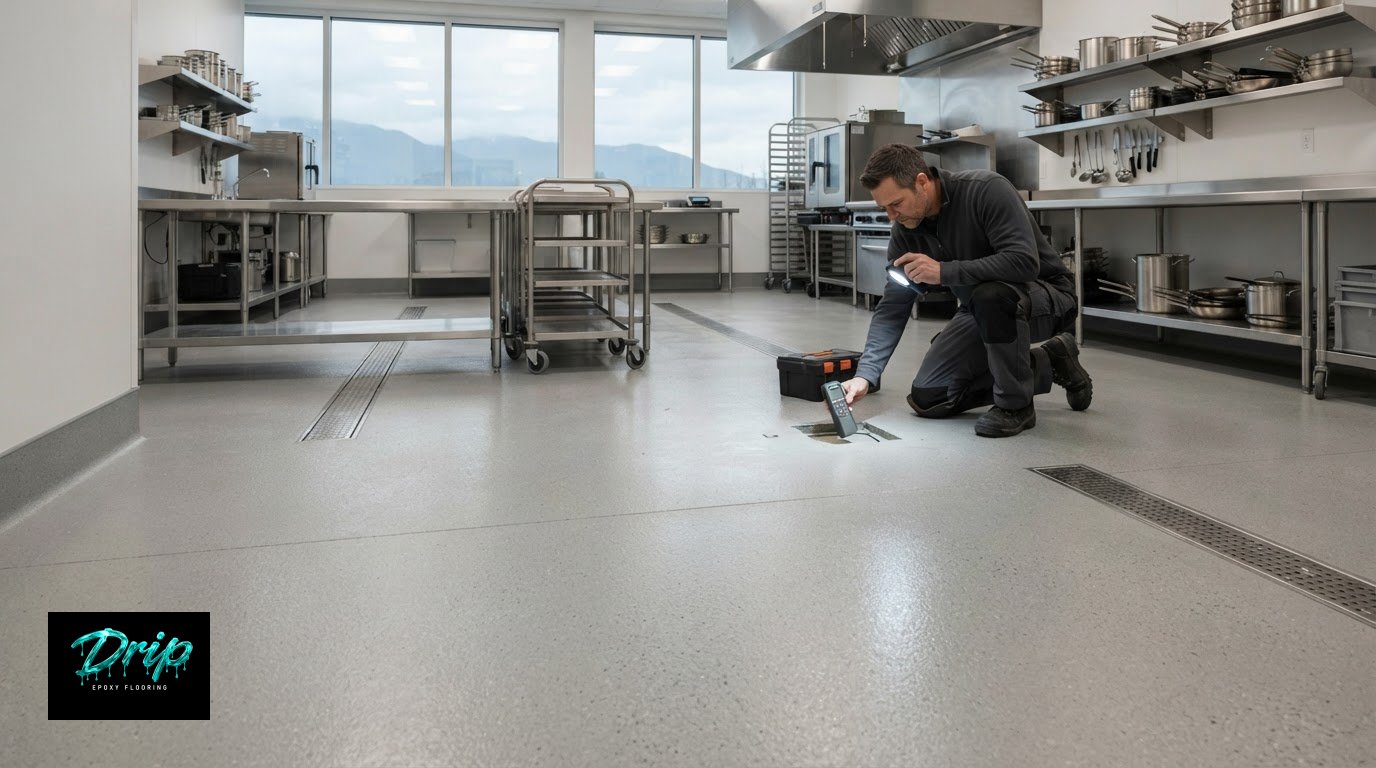
The coating label alone can’t tell you whether a kitchen floor will suit the work happening on it. Choosing commercial kitchen epoxy flooring in Surrey means looking beyond epoxy, quartz or a polyaspartic topcoat to the concrete beneath and the demands of each work area.
Spills, frequent cleaning, rolling carts and steady staff movement put different stresses on a floor. The right system depends on how those conditions interact with the slab, including its surface profile and any signs of moisture that could affect adhesion.
This guide explains what a site assessment should cover, how surface texture and system layers relate to kitchen use, and what to ask a Surrey contractor before requesting a quote. You’ll also learn how to discuss cleaning methods, temperature changes, concrete preparation and project sequencing so the work can be planned around kitchen operations. With those details in hand, you can compare recommendations based on their suitability for your space, not just the coating name.
Key Takeaways
- For commercial kitchen epoxy flooring Surrey projects, match system recommendations to kitchen activity, cleaning routines and the conditions in each work area.
- Ask how the contractor will inspect the concrete, assess moisture and address previous coatings before applying a resinous floor system.
- Compare epoxy, quartz and polyaspartic options by their documented suitability and available texture, not by the system name alone.
- Request details about surface preparation, system layers and product documentation for your kitchen’s cleaning methods and operating conditions.
- Discuss project sequencing before work is scheduled, and consider a site-specific review from a local contractor serving Surrey.
Table of Contents
- Commercial Kitchen Epoxy Flooring in Surrey: Start With the Conditions on Site
- How Concrete Preparation and Moisture Affect Kitchen Epoxy Flooring
- Epoxy, Quartz, and Polyaspartic Options for a Surrey Commercial Kitchen
- Questions to Ask Before Scheduling Commercial Kitchen Floor Work
- Plan Commercial Kitchen Epoxy Flooring in Surrey With a Site-Specific Review
Commercial Kitchen Epoxy Flooring in Surrey: Start With the Conditions on Site
A compact commercial kitchen can combine staff movement, carts, spills, cleaning and fixed equipment in a tight footprint. Each zone puts different demands on the floor. A dishwashing area may see frequent wet cleaning, while a cook line may be exposed to oils, heat and equipment that concentrates loads on small areas. Commercial kitchen epoxy flooring Surrey recommendations should reflect these actual conditions and documented system suitability, not just a product label.
A commercial kitchen floor assessment reviews how the space operates and the condition of the concrete substrate beneath the proposed coating. That distinction matters because the epoxy resins used in flooring systems are only one part of the selection decision. Traffic, cleaning methods, substrate condition and system specifications all need to be considered together.
Which kitchen conditions affect flooring selection?
Map staff routes, cart travel, equipment locations and areas exposed to spills. Note where water, oils or frequent washdowns occur, and discuss whether those conditions call for a particular surface texture. Texture selection involves balancing grip with the cleaning routine. Ask the installer to explain how the proposed finish suits the observed use.
- Identify repeated travel paths and cart turning points.
- Record fixed equipment and concentrated point loads.
- Separate observed wet or oily areas from conditions that still need inspection or confirmation.
- Describe cleaning products, washdown practices and temperature changes the floor may encounter.
If quartz is being considered, ask how its texture options relate to your kitchen’s operating and cleaning needs. Drip Epoxy Flooring lists its quartz flooring systems as an option to discuss. Confirm suitability against the site conditions and product documentation.
What should a Surrey site review establish?
Ask the contractor to record the concrete’s visible condition, including cracks, surface contamination and previous coatings. These observations help identify what needs closer inspection and what preparation may be required. A visual review alone shouldn’t be treated as proof of underlying moisture conditions. Clarify how moisture will be assessed before a system is specified.
The review should also establish operational access constraints: which areas must remain available, where equipment or staff routes restrict the work area, and what project sequencing may be needed. Distinguish confirmed site findings from assumptions. A generic epoxy label can’t establish whether a system suits your slab, cleaning routine or kitchen zones. Request a site-specific recommendation supported by relevant product documentation before deciding.
How Concrete Preparation and Moisture Affect Kitchen Epoxy Flooring
Resinous coatings bond to prepared concrete, so substrate condition and surface profile are part of system selection. Dust, grease, residual coatings and other contaminants can affect how the surface needs to be prepared. Before approving a specification, ask the contractor to explain what the site review found and how those findings shape the preparation scope.
Substrate assessment informs the preparation plan, and suitable preparation helps establish conditions for coating adhesion. The proposed work should account for the concrete and follow the product’s documented installation requirements. It can’t guarantee a particular result.
What does mechanical diamond grinding do?
Mechanical diamond grinding removes surface contaminants and opens concrete pores to help prepare the surface for coating adhesion. It creates a profile for resin bonding. The work required depends on the existing surface, so ask how the contractor will identify and address failed coatings, cracks, grease or other visible substrate concerns before application.
Review the contractor’s service information and ask how the proposed preparation scope relates to your slab. Clarify what will be removed, what profile the coating system requires, and how the prepared surface will be checked before the next installation step.
When should moisture vapour transmission be assessed?
Moisture vapour transmission is the movement of moisture through concrete, which can contribute to bubbling and delamination in floor coatings. Ask how moisture conditions will be assessed and compared with the selected product’s documented requirements. IFTI’s ASTM concrete moisture testing guide describes concrete moisture testing methods.
A moisture vapour barrier may be considered as a system layer when site findings and product specifications support its use. It isn’t a universal remedy. Ask the contractor to explain what the assessment indicates, whether a barrier is specified and how it fits into the proposed system.
- What preparation does the existing surface require?
- How will moisture findings inform the system recommendation?
- Which product documents support the proposed preparation and coating sequence?
For a Surrey kitchen project, share your site conditions and request a project quote to discuss the slab assessment and preparation scope.
Epoxy, Quartz, and Polyaspartic Options for a Surrey Commercial Kitchen
These terms describe different parts or types of flooring systems, not a guarantee that a particular floor will suit every kitchen. Epoxy is a coating-system category; the finished system depends on its layers, surface texture, substrate preparation and product specifications. Quartz flooring embeds quartz grains in resin to create a hard, slip-resistant surface. A polyaspartic topcoat is a UV-stable, fast-curing clear coat applied over epoxy or base layers.
System suitability depends on documented specifications matched to your kitchen’s actual conditions. Use the comparison as a starting point, then ask the contractor to confirm the proposed system against your concrete, cleaning routine, spills and traffic.
| System type | Texture options | Conditions to assess | Specification questions |
|---|---|---|---|
| Epoxy coating system | Finish and texture depend on the specified layers and application. | Substrate condition, staff and cart traffic, spills, cleaning methods and temperature changes. | Which product and layers are proposed? Do the product documents address your use conditions? |
| Quartz flooring | Quartz broadcast can create a slip-resistant texture; confirm the available finish and texture with the installer. | Wet or oily zones, washdown routines and the balance between grip and cleanability. | How is the texture specified, and how does it relate to your cleaning routine? |
| Epoxy or base layers with a polyaspartic topcoat | The topcoat is clear; the finished texture depends on the full system. | Confirm intended use and conditions against the product documentation. | What does the topcoat add to this specific system, and what are its documented limits? |
When might a quartz system merit consideration?
A quartz broadcast may be worth discussing for areas exposed to water or oils, but texture selection needs to account for both traction and the kitchen’s cleaning practices. Ask the contractor to explain the proposed texture and verify its suitability for the site. Drip Epoxy Flooring’s commercial quartz flooring systems page can help you understand this system category.
What role can a polyaspartic topcoat play?
A polyaspartic topcoat may be specified over epoxy or another base layer. Assess the polyaspartic advantage through product-specific documentation, including comparisons relevant to the proposed system, rather than assuming it from the material name. For commercial kitchen epoxy flooring Surrey, ask for the system details and confirm they address your operating conditions before choosing between options.
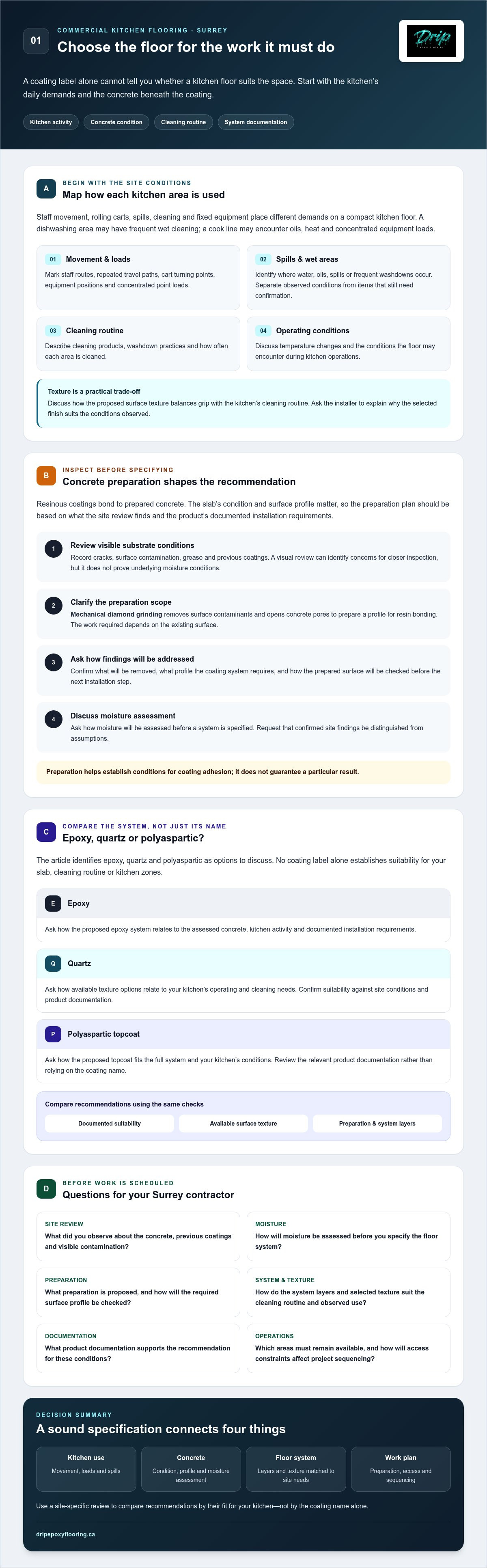
Questions to Ask Before Scheduling Commercial Kitchen Floor Work
A clear scope helps you compare proposals and plan around kitchen operations. For commercial kitchen epoxy flooring Surrey, ask the contractor to connect each recommendation to the slab, intended use and product documentation. Use this checklist to establish what has been inspected, what work is proposed and what needs confirmation before scheduling.
- What did you find during the site review? Ask how the contractor will assess the concrete’s visible condition, moisture, cracks, contamination and previous coatings. Confirm which findings are verified and which need further assessment.
- What preparation is included? Request a written scope describing how the existing surface will be prepared, how previous or failed coatings will be handled, and what profile is needed for the specified coating system.
- Which system and layers are proposed? Ask for the system specifications and product documents. Confirm that the proposed layers and texture suit your kitchen’s traffic, spills, cleaning routine and temperature changes.
- How will slip-resistant texture and cleaning needs be balanced? Ask how the proposed finish addresses wet or oily areas and how its texture relates to your cleaning practices.
- What credentials and safety practices apply? Request information about the installers’ relevant credentials and the safety practices planned for the work. Ask for details rather than assuming a particular certification or compliance claim.
- How will work affect access and operations? Identify equipment that must be moved, staff routes that need to stay open and areas that can be taken out of use. Ask for a project-specific sequence and timing.
How should the project be sequenced around kitchen operations?
Before work begins, identify work zones, equipment movement, staff access and operational restrictions. Ask the contractor to explain the proposed sequence, including how each area will be prepared and coated. Confirm product-specific curing requirements and when each zone can be accessed again. Don’t rely on a general downtime estimate; request timing based on the selected system and your site conditions.
What documentation should you request?
Ask for the system specifications, preparation scope and written information about suitability for your intended conditions. The proposal should explain how the selected texture relates to wet areas and cleaning requirements, and identify any limits in the product documentation. Review the details before agreeing to a schedule, and clarify unanswered questions about the substrate or installation sequence.
With those points documented, you can compare proposals on scope and suitability, not just system names. Request a project quote and discuss your kitchen’s site conditions before scheduling work.
Plan Commercial Kitchen Epoxy Flooring in Surrey With a Site-Specific Review
A practical selection process starts with the kitchen, not a coating label. Document how each area is used, inspect the existing concrete, assess moisture conditions, then compare systems supported by relevant product specifications. For commercial kitchen epoxy flooring Surrey projects, that sequence helps you discuss the floor in terms of its operating demands and substrate rather than relying on assumptions.
What information should you prepare for a quote?
Before requesting a quote, gather details that help the contractor understand the space and identify questions for the site review. Include:
- The Surrey site address and approximate work area.
- A description of kitchen operations, including wet or oily zones, cleaning routines and temperature changes.
- Any existing coating concerns, visible concrete damage, cracks or signs of moisture.
- Equipment locations, cart routes, staff access needs and areas that may have to remain available.
- Scheduling constraints that could affect work zones or project sequencing.
These details don’t replace an inspection. They give the contractor a clearer starting point for discussing concrete preparation, texture balance and the information needed to specify a suitable system.
How can a local flooring assessment help?
A site-specific assessment can connect the visible condition of your slab and the way your kitchen operates to system options that merit further review. Ask how the contractor will assess the concrete and moisture, explain the proposed preparation, and relate the selected texture and system layers to your cleaning methods. Any recommendation should be supported by product documentation for the conditions you’ve described.
Drip Epoxy Flooring is a locally owned and operated contractor based in Chilliwack, serving Surrey and communities across the Fraser Valley and Lower Mainland, including Abbotsford, Mission, Langley, Coquitlam, Burnaby, Hope, Harrison Hot Springs and Agassiz. The company provides epoxy and polyaspartic floor coating installations, including quartz, solid-colour and decorative flake systems. If installer credentials matter to your project, ask which credentials apply and request details you can verify. Discuss project sequencing directly as well: access requirements and product-specific curing instructions need to be confirmed for your site, not assumed from a general schedule.
With your site details organized, you can have a more focused conversation about the assessment and proposed scope. Share your kitchen conditions and request a quote from Drip Epoxy Flooring.
Move Forward With a Kitchen-Specific Flooring Plan
A well-informed choice starts with how your kitchen operates and what the existing concrete can support. For commercial kitchen epoxy flooring Surrey, document traffic, spills, cleaning routines and access needs, then use the site review to assess the slab and moisture conditions before comparing system specifications. Discuss texture and project sequencing in relation to your work zones and the selected products, rather than treating them as standard features with guaranteed results.
Drip Epoxy Flooring is a locally owned and operated contractor based in Chilliwack, serving Surrey and other Fraser Valley and Lower Mainland communities. Ask which installer credentials apply to your project and how the proposed texture is supported by the system documentation.
Bring your site details and questions into the next conversation. Request a site-specific commercial flooring quote to discuss your kitchen’s concrete condition, preparation needs and operating constraints. A clear assessment gives you a practical basis for choosing a system that fits your facility.
Frequently Asked Questions
Is epoxy flooring suitable for a commercial kitchen?
Epoxy flooring may suit a commercial kitchen if the complete system is specified for the concrete and the conditions it will face. Before choosing, consider traffic, spills, cleaning methods, wet areas and temperature changes, then review product documentation for the intended use. A coating label alone doesn’t establish suitability. Ask the contractor to explain how the proposed system, surface preparation and texture relate to your kitchen’s operating conditions.
Can epoxy flooring provide slip resistance in a wet kitchen?
It can be specified with a slip-resistant texture, but the finish needs to suit both the wet areas and your cleaning routine. Quartz grains embedded in resin can create a textured surface. Ask how the proposed texture balances grip with cleanability for your kitchen. Confirm that the product documentation and contractor’s recommendation address conditions in specific zones, such as dishwashing areas or locations where spills are common.
What should be assessed before installing commercial kitchen epoxy flooring?
Assess the kitchen’s use and the existing concrete before selecting a system. For commercial kitchen epoxy flooring Surrey, document staff and cart routes, equipment locations, spills, cleaning practices and temperature changes. Ask the contractor to inspect visible cracks, contamination and previous coatings, and to explain how moisture conditions will be evaluated. These findings inform the preparation scope and help determine which system options merit comparison.
How does moisture vapour transmission affect an epoxy floor?
Moisture vapour transmission is moisture moving through concrete. If it isn’t accounted for in the system selection, it can contribute to bubbling or delamination. Ask how moisture will be assessed and how the results relate to the proposed product specifications. A moisture vapour barrier may be considered if site findings and system documentation support it, but it shouldn’t be treated as a universal remedy or a substitute for assessment.
What is the difference between epoxy and quartz flooring for a commercial kitchen?
Epoxy describes a resinous coating-system category, while quartz flooring embeds quartz grains in resin to create a hard, slip-resistant surface. A quartz system can therefore include resin layers with a textured finish; it isn’t a separate alternative to resin in every sense. Compare the proposed layers, available texture and documented intended conditions. Ask how the finish will suit your wet or oily areas and cleaning routine.
Can a polyaspartic topcoat be used over an epoxy floor?
Yes, a polyaspartic topcoat may be applied over epoxy or other base layers when the products are specified as a compatible system. It’s a UV-stable, fast-curing clear coat, but the suitability and role of a particular topcoat depend on its documentation and the full installation specification. Ask which products are proposed, whether they’re approved for use together, and what cure requirements apply before kitchen access resumes.
How should commercial kitchen floor work be sequenced around business operations?
Plan the work around defined zones, staff access, equipment movement and areas that need to remain available. Before scheduling, review the proposed sequence with the contractor and identify when equipment must be moved and which routes may be affected. Confirm product-specific application and curing requirements, plus when each area can be accessed and cleaned. Don’t rely on a generic downtime estimate; request timing based on the selected system and site conditions.