commercial epoxy burnaby · 12 min read ·
Commercial Epoxy Flooring in Burnaby: A Buyer’s Guide
For commercial epoxy Burnaby projects, the toughest-looking finish isn’t automatically the right floor for your facility. A coating that suits a dry showroom may not provide the texture, chemical resistance or cleaning p
By Drip Epoxy Flooring · Chilliwack, BC
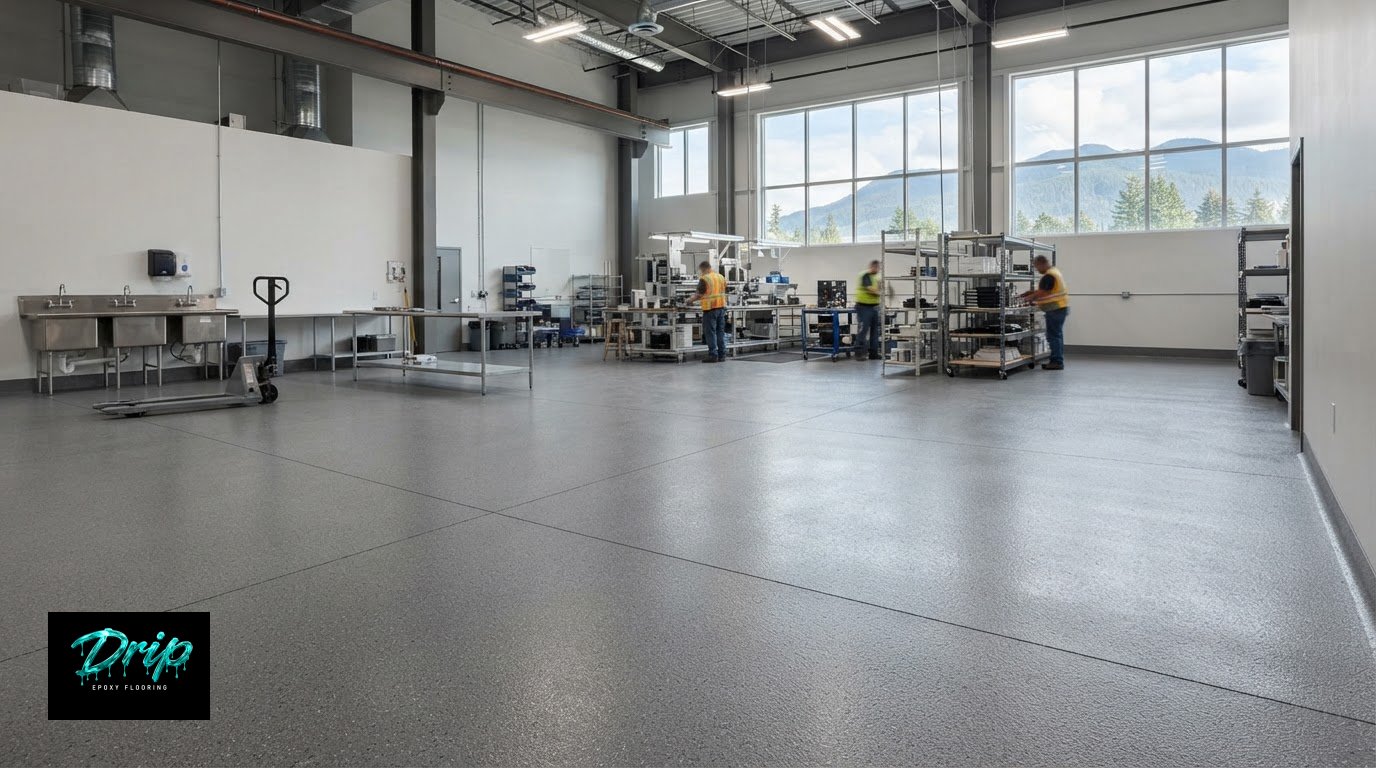
For commercial epoxy Burnaby projects, the toughest-looking finish isn’t automatically the right floor for your facility. A coating that suits a dry showroom may not provide the texture, chemical resistance or cleaning performance needed in a busy production area.
You need a system that fits your traffic, equipment, concrete condition and operating schedule, not just a colour or finish that looks right. Existing cracks, coatings or moisture vapour transmission can also affect preparation and adhesion, so assess the slab before selecting a system.
This buyer’s guide explains how to match solid-colour epoxy, decorative flake, quartz and polyaspartic topcoats to your facility’s demands. You’ll also learn what professional concrete preparation involves and how project sequencing helps plan the work around staff, equipment and daily operations. Drip Epoxy Flooring is locally owned and operated in Chilliwack, serving commercial spaces in Burnaby and across Chilliwack, Abbotsford, Mission, Langley, Surrey, Coquitlam, Burnaby, Hope, Harrison Hot Springs and Agassiz. With a clear understanding of the available options and installation process, you can plan a floor system around your site conditions.
Key Takeaways
- Choose a floor system around your facility’s traffic, equipment, cleaning routines and concrete condition, not appearance alone.
- Compare epoxy, quartz flooring and decorative flake as floor systems, and distinguish them from a polyaspartic topcoat applied over a base layer.
- For commercial epoxy burnaby projects, document how each area is used before selecting a finish and planning the work.
- Understand how slab assessment, mechanical diamond grinding, repairs and coating layers fit into the installation sequence.
- Prepare details about facility use, floor area, concrete condition and operational needs to help frame a project quote.
Table of Contents
- Commercial Epoxy Flooring in Burnaby: What Should Your Facility Expect?
- How to Choose Commercial Epoxy in Burnaby for Your Site Conditions
- Commercial Epoxy vs. Quartz, Flake and Polyaspartic Systems in Burnaby
- Concrete Preparation and Project Sequencing for a Burnaby Commercial Floor
- Plan Your Commercial Epoxy Flooring Project in Burnaby with Drip
Commercial Epoxy Flooring in Burnaby: What Should Your Facility Expect?
Commercial epoxy flooring is a resinous coating system applied over prepared concrete. It bonds to the slab and creates a finished surface that can be specified for the way a space is used. Epoxy is a family of materials used in coatings and adhesives; this overview of epoxy resins explains the basic chemistry.
The right system depends on more than the room’s appearance. Repeated foot traffic, rolling carts, equipment, cleaning products and the condition of the existing concrete all inform system selection. A retail aisle with regular customer movement has different demands from a back-of-house area where carts and equipment travel along set routes. Start a commercial epoxy Burnaby project by documenting those operating conditions, not by choosing a colour alone.
What makes a commercial floor different from a residential coating?
A decorative residential finish may see lighter or less frequent use. In a commercial space, repeated traffic and routine cleaning can put greater demands on the surface. The coating, texture and finish need to suit those activities, and the concrete beneath must be suitable for preparation and bonding. There isn’t one coating that fits every commercial environment, so specify the system for the actual use of each area.
Which Burnaby businesses may consider resinous flooring?
Showrooms, retail spaces, offices and selected commercial interiors may suit a resinous floor when the concrete and operating requirements are appropriate. A seamless surface has no grout lines for dirt to collect in and can support routine cleaning. That feature alone doesn’t guarantee sanitation or compliance with facility-specific requirements.
For example, a showroom may prioritize a consistent appearance, while a retail space may need a finish suited to regular foot traffic and cleaning. Operational areas may face different demands from carts, equipment or frequent spills. Identify these differences before choosing the finish and texture, rather than applying the same specification throughout the facility.
Drip Epoxy Flooring is locally owned and operated in Chilliwack, with service coverage extending to Burnaby and communities across the Fraser Valley and Lower Mainland. For an overview of available systems and applications, see commercial epoxy flooring services.
How to Choose Commercial Epoxy in Burnaby for Your Site Conditions
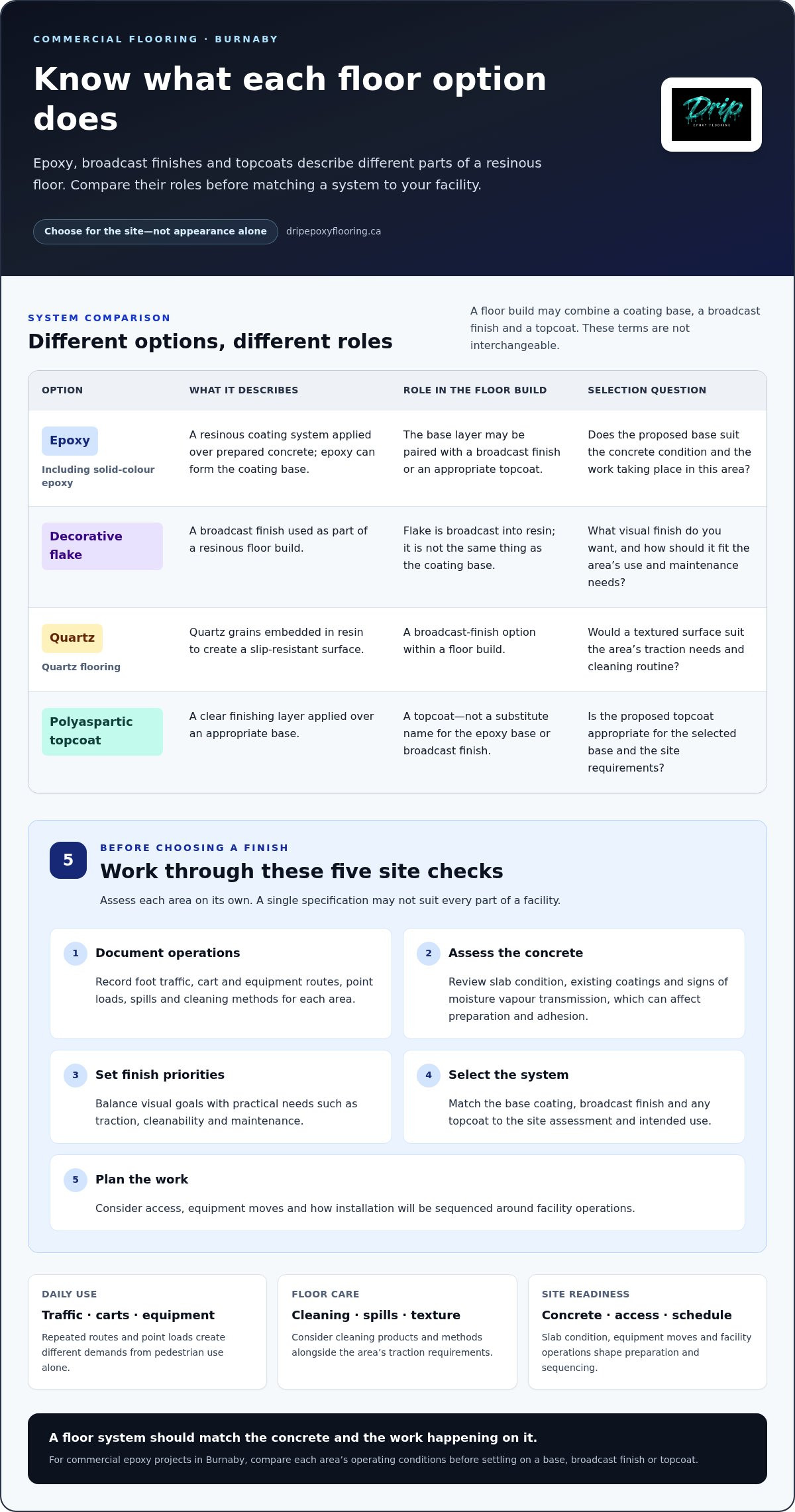
Epoxy isn’t automatically the right system for every commercial site. The coating must suit both the concrete and the work taking place on it. Use this selection process before settling on a finish:
- Document operations. Record foot traffic, cart and equipment routes, point loads, spills and cleaning methods for each area.
- Assess the concrete. Review the slab’s condition, existing coatings and signs of moisture vapour transmission, which can affect coating adhesion.
- Set finish priorities. Identify visual goals alongside practical needs such as traction, cleanability and maintenance.
- Select the system. Match the base coating, broadcast finish and any topcoat to the site assessment and intended use.
- Plan the work. Consider access, equipment moves and how installation will be sequenced around facility operations.
Traffic, loads, cleaning and concrete condition all influence what a floor must withstand. A space with frequent cart travel, for example, presents different demands from an area used mainly by pedestrians. Assess the slab for its specific conditions: moisture vapour transmission and concrete defects can affect preparation and the suitability of a coating system.
Which operating conditions should guide system selection?
Include more than general traffic levels in your review. Note where equipment turns, where point loads occur, how often carts follow the same route and which cleaning products or methods are used. These details help define the requirements for each zone. Don’t assume one specification will fit every part of a facility.
How should you balance appearance, traction and maintenance?
A smooth, uniform finish may suit a customer-facing area, while a work zone may call for a more textured surface. Texture can support traction, but it also affects cleaning, so balance the two according to how the area is used. Quartz flooring embeds quartz grains in resin to create a slip-resistant surface. Explore commercial quartz flooring as one broadcast-finish option.
Cleaning and floor condition also matter for workplace safety. The US Occupational Safety and Health Administration’s walking-working surface standard provides a reference for keeping surfaces clean and orderly, but it isn’t a substitute for applicable requirements in British Columbia. For a project discussion, share your facility’s use, concrete condition and operating constraints through the commercial flooring quote form.
Commercial Epoxy vs. Quartz, Flake and Polyaspartic Systems in Burnaby
These terms describe different parts or styles of a resinous floor, not interchangeable complete systems. Epoxy can form the coating base; quartz and decorative flake are broadcast into resin as part of a floor build; a polyaspartic topcoat is a clear finishing layer over an appropriate base. For commercial epoxy Burnaby projects, choose the system build according to the concrete condition and how the facility operates.
| Option | Role in the floor | Selection consideration |
|---|---|---|
| Epoxy | A resinous coating system applied over prepared concrete; it can also serve as a base layer. | Match the system to slab condition, traffic, equipment and cleaning routines. |
| Quartz flooring | A floor system that embeds quartz grains in resin. | Useful where a textured, slip-resistant surface is part of the specification. |
| Decorative flake | A broadcast finish that incorporates decorative flakes into the resinous floor. | Consider colour and appearance alongside the space’s day-to-day use. |
| Polyaspartic topcoat | A UV-stable, fast-curing clear coat applied over epoxy or another suitable base layer. | Selected as a top layer, not as a stand-alone floor system. |
When might a solid-colour, flake or metallic finish fit?
A solid-colour finish creates a consistent visual field for selected commercial settings. Decorative flake adds a broadcast finish that may suit commercial interiors when the desired appearance and cleaning routine are compatible. Metallic epoxy is a design-led option for feature spaces and showrooms, where the floor’s distinctive appearance is part of the interior design. Every option still depends on suitable concrete preparation and the facility’s operating demands.
What does a polyaspartic topcoat contribute?
A polyaspartic topcoat is a clear layer applied over an appropriate epoxy or base-layer system. Its UV stability and faster-curing characteristics may suit projects where those properties matter, but the full system and installation conditions determine its role. It doesn’t replace a suitable base or proper concrete preparation. Explore polyaspartic flooring details for more on this coating category.
Preparation also has a safety dimension. Concrete grinding can create silica dust; the Canadian Centre for Occupational Health and Safety explains the dangers of silica dust exposure. The final specification should account for the slab, installation process and operating conditions, rather than relying on a finish label alone.
Concrete Preparation and Project Sequencing for a Burnaby Commercial Floor
A commercial epoxy Burnaby project depends on more than the coating selected. Assess and prepare the existing slab so the resin system can bond to a suitable surface. A clear installation sequence also helps coordinate the work with facility access, staff movement and equipment needs.
The work generally follows these stages:
- Assess the slab. Review concrete condition, existing coatings and areas that may need repair.
- Prepare the surface. Use mechanical diamond grinding to remove surface contaminants and open concrete pores, creating a suitable profile for resin bonding.
- Address repairs. Correct relevant surface defects during preparation, before applying coating layers.
- Install the coating layers. Apply the specified system in sequence over the prepared concrete.
- Inspect the finished work. Review the completed floor before planning its return to facility use.
Preparation sets the foundation for the coating build. For more detail on this stage, see this guide to professional flooring services.
Why does mechanical diamond grinding matter?
Mechanical diamond grinding removes surface contaminants and opens concrete pores for better coating adhesion. It also creates a suitable profile for resin bonding. If the concrete isn’t properly prepared, the coating layers above it may be affected, regardless of the finish selected.
Resin bonding starts with a properly prepared concrete surface. Slab assessment and preparation are essential steps, not details to leave until after system selection.
How can project sequencing reduce operational disruption?
Project sequencing means planning the order of work steps to minimize disruption to facility operations. Before work begins, consider staff movement, equipment locations, access routes and cleaning routines. These inputs help organize work areas and fit installation stages around facility needs. The sequence must account for the actual project and site conditions, rather than assume a fixed schedule.
Clear planning gives facility teams a practical basis for coordinating access and preparing affected areas. Share the floor area, concrete condition and operational constraints to request a Burnaby commercial flooring quote.
Plan Your Commercial Epoxy Flooring Project in Burnaby with Drip
A well-planned commercial epoxy Burnaby project begins with the facility, not a finish chart. Document how each area is used, assess the concrete, compare suitable finishes, then plan preparation and installation around the site’s operating needs. This gives system selection a practical basis and connects it to real conditions.
Drip Epoxy Flooring is locally owned and operated in Chilliwack, serving Burnaby and communities across the Fraser Valley and Lower Mainland. Project recommendations are based on the floor and the work it needs to support.
What information helps start a commercial floor project?
Share the facility type, floor area and concrete condition, along with details that shape daily use. A useful project brief can include:
- Main foot-traffic patterns, cart routes, equipment and point loads.
- Cleaning routines and regular exposure to spills or cleaning products.
- Access constraints, staff movement and areas that need to remain operational during the work.
- Preferred finish characteristics, such as a solid colour, decorative flake or textured quartz surface.
These details help frame the site assessment and system recommendation. Consider the appearance you want alongside the space’s traffic and cleaning demands. Concrete condition matters too, since preparation requirements depend on the slab being coated.
What should you expect from Drip’s installation approach?
Professional concrete preparation comes before coating layers are applied. The installation sequence accounts for the existing slab, surface preparation and any repairs needed before the selected system goes down. Planning also considers facility access and operational requirements, so project sequencing reflects the site rather than relying on an assumed schedule.
The owner completed in-person flooring installation training and certification through XPS Canada. That training informs a methodical approach to concrete preparation and coating installation, with system selection based on project conditions.
Ready to discuss your facility use, floor area, concrete condition and operating needs? Request a commercial flooring quote for Burnaby.
Start Planning Your Burnaby Commercial Floor
The right commercial floor starts with the concrete and the demands placed on it. Traffic, equipment, cleaning routines and moisture conditions help determine whether an epoxy, quartz or decorative flake system, with an appropriate topcoat, suits your facility. Careful preparation and project sequencing matter as much as the finish you select.
For commercial epoxy Burnaby projects, Drip Epoxy Flooring provides professional concrete preparation, including mechanical diamond grinding, for commercial spaces in Burnaby and the Lower Mainland. Drip is locally owned and operated from Chilliwack, and the owner completed in-person flooring installation training and certification through XPS Canada.
Share your facility use, floor area, concrete condition and operating needs to begin a project discussion. Request a commercial flooring quote for your Burnaby facility to start planning a floor system around your site.
Frequently Asked Questions
Is commercial epoxy flooring a good choice for every Burnaby business?
Commercial epoxy can suit many commercial interiors, but no single floor system fits every facility. Traffic, equipment, cleaning routines, concrete condition and moisture vapour transmission all influence which coating build and finish may be suitable. A site assessment connects those factors to the floor’s intended use. For regulated environments, confirm facility-specific flooring requirements with the appropriate authority, inspector or project specifier before selecting a system.
How do I choose a commercial epoxy floor system?
Start by documenting how each area operates, including foot traffic, cart routes, equipment, cleaning methods and appearance goals. For commercial epoxy Burnaby projects, assess the concrete before comparing options such as solid-colour epoxy, decorative flake or quartz flooring. Consider the finish after identifying the facility’s practical requirements. Concrete preparation and project sequencing also belong in the selection process because they affect how the work is planned and carried out.
Can commercial epoxy flooring be slip-resistant?
Slip resistance depends on the system and surface texture selected for the area. Quartz flooring embeds quartz grains in resin to create a slip-resistant surface, with texture specified according to how people and equipment move through the space. Texture also affects routine cleaning, so consider it alongside traffic and maintenance needs. No floor finish should be described as slip-proof; the appropriate surface profile is a project-specific choice.
Why is mechanical diamond grinding used before epoxy flooring?
Mechanical diamond grinding removes surface contaminants and opens concrete pores to create a suitable profile for resin bonding. Coating adhesion depends in part on preparing the slab before applying the first layer, so assess the concrete rather than make assumptions. Existing coatings, surface defects and other slab conditions can affect the preparation and repair sequence. A professional review identifies the work required for the actual floor and proposed coating system.
Can a commercial epoxy floor project be planned around business operations?
Yes. Project sequencing can account for facility access, staff movement, equipment locations and cleaning routines. The work plan depends on site conditions and the coating system, so don’t assume a fixed installation schedule before the project is assessed. Share operational constraints early, including areas that need access or equipment that must be moved. This helps shape a practical sequence without promising a specific completion time.
What is the difference between epoxy flooring and a polyaspartic topcoat?
Epoxy can form the resinous coating system or serve as a base layer in a floor build. A polyaspartic topcoat is a clear layer applied over suitable epoxy or other base layers, not necessarily a complete flooring system by itself. Its characteristics include UV stability and faster curing. Choose the full build according to the concrete, facility operations and intended finish, rather than considering the topcoat in isolation.
Does commercial epoxy flooring meet food-safety or inspection requirements?
A coating shouldn’t be assumed to carry food-safety certification or guarantee inspection approval. Drip installs flooring systems in restaurants, commercial kitchens and food-processing environments, but suitability depends on facility-specific requirements and the complete installation. Seamless, non-porous surfaces that are easy to clean can be relevant to sanitation-focused flooring plans, but they don’t establish compliance on their own. Confirm requirements with the appropriate authority, inspector or project specifier.