commercial epoxy coquitlam · 12 min read ·
Commercial Epoxy Coquitlam: Flooring Planned Around Your Facility
The coating that looks right on a sample may not suit the way your facility works. A commercial epoxy Coquitlam project should start with the concrete slab and daily operations, not a generic product label. A warehouse w
By Drip Epoxy Flooring · Chilliwack, BC

The coating that looks right on a sample may not suit the way your facility works. A commercial epoxy Coquitlam project should start with the concrete slab and daily operations, not a generic product label. A warehouse with equipment traffic, a retail space with steady foot traffic and a kitchen with frequent cleaning place different demands on a floor.
To select a system, consider the slab’s condition, possible moisture vapour transmission, the required surface texture and the work sequence. Epoxy, decorative flake, quartz and other commercial coating systems each have different uses, so the right choice depends on your space. The coating layers and preparation method also need to suit the concrete and the demands placed on the finished floor.
This article explains how facility activity and concrete conditions guide system selection, what professional preparation involves, and how project sequencing can help you plan around operations. Use these considerations to clarify the decisions to make before work begins and develop a site-specific flooring plan for your Coquitlam facility.
Key Takeaways
- Match the floor system to your facility’s traffic, equipment, spills and cleaning routines, not appearance alone.
- Compare epoxy, polyaspartic, quartz, flake and solid-colour options by their intended use, finish and texture needs.
- Assess concrete condition and contaminants before preparation. Diamond grinding creates a suitable profile for resin bonding.
- Plan project sequencing around access, equipment relocation, active work zones and operating hours to manage disruption.
- A site-specific commercial epoxy Coquitlam plan accounts for facility operations, slab condition, preparation and system requirements.
Table of Contents
- Commercial epoxy flooring in Coquitlam: start with the facility’s demands
- Compare commercial epoxy and coating systems by performance needs
- Why concrete preparation matters for Coquitlam commercial epoxy
- Plan commercial epoxy installation around Coquitlam operations
- Commercial epoxy Coquitlam projects: how Drip moves from assessment to quote
Commercial epoxy flooring in Coquitlam: start with the facility’s demands
Choose a commercial floor by how the space operates, not by appearance alone. A customer-facing retail area may need a consistent finish for regular foot traffic, while a workshop or warehouse must account for carts, equipment, repeated travel and point loads. Spills and cleaning routines matter too. The coating and surface texture should suit the substances that may reach the floor and the methods staff use to clean it.
A commercial floor system is more than its base material. The concrete substrate, coating layers and finish all affect how the installed surface suits its intended use. Drip Epoxy Flooring installs commercial epoxy flooring in Coquitlam as part of its service coverage across the Lower Mainland and Fraser Valley, from its locally owned and operated base in Chilliwack.
Which commercial spaces need different flooring considerations?
Customer-facing retail and service areas often have different priorities from back-of-house zones. A sales floor may call for a consistent finish across open walking areas, while a service bay, workshop or storage room may see equipment movement, concentrated loads, spills or demanding cleaning. Consider these conditions when selecting finish and system details instead of assuming one specification fits every room.
Adjoining areas can also have different needs. A transition between a public corridor and a work area, for example, may call for a change in texture or finish to reflect how each area is used and cleaned. Consider how people, carts and equipment move across the transition.
What should a Coquitlam site review establish?
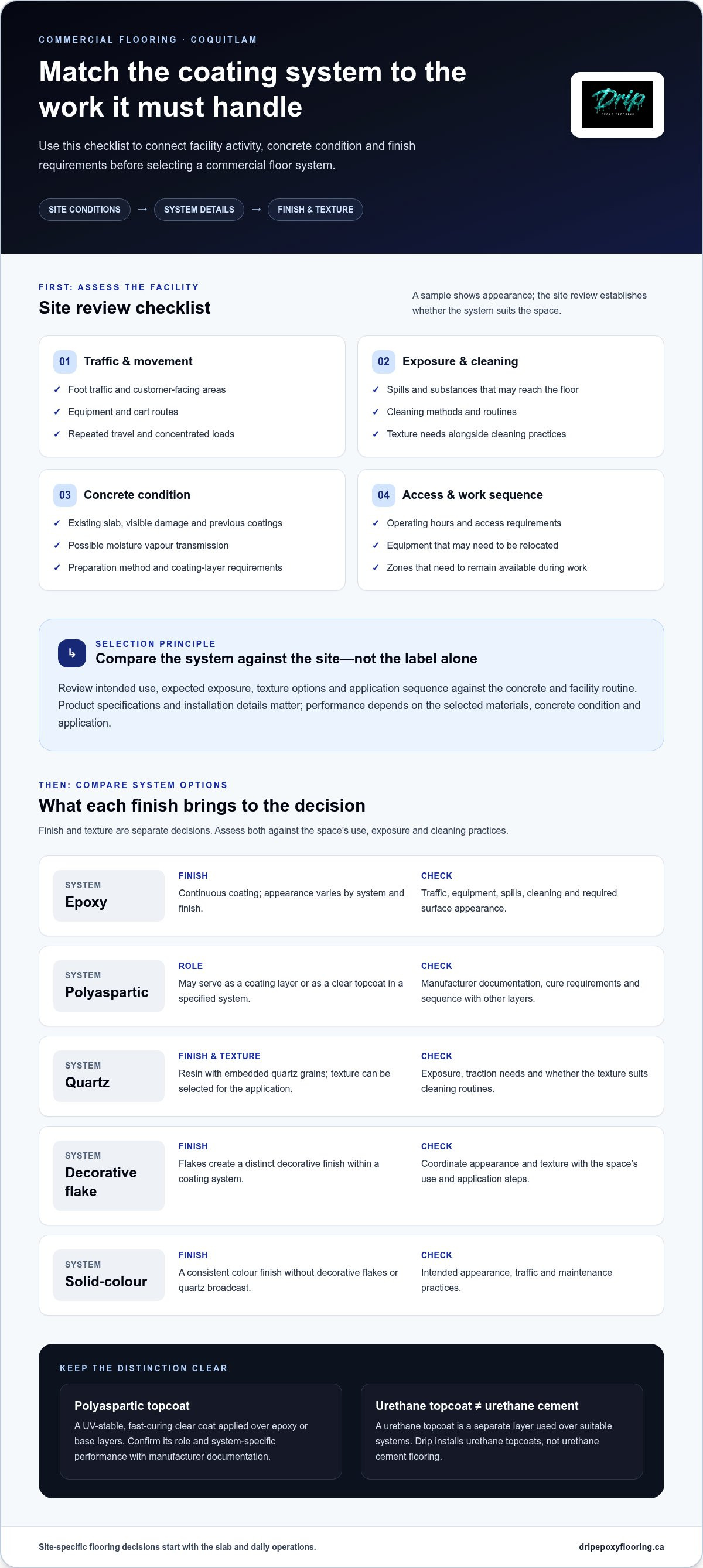
A useful review records the existing slab, previous coatings, visible damage and the planned use of each area. It should also capture equipment and cart routes, point loads, repeated travel, spills and cleaning routines. Finally, record operating schedules, access requirements and which zones need to remain available while work is planned.
- Identify areas with distinct traffic, exposure or cleaning demands.
- Note access routes and equipment that may need to be relocated.
- Record operating hours and spaces that must stay accessible.
Facility use and concrete condition guide system selection. Start a commercial epoxy Coquitlam plan by documenting how the space works, then match the coating details to the slab and day-to-day demands.
Compare commercial epoxy and coating systems by performance needs
System names describe materials or finishes, but they don’t determine suitability on their own. For commercial epoxy Coquitlam planning, compare each system’s intended use, expected exposure, texture options and application sequence with the slab and facility routine. Product specifications and installation details matter. Performance depends on the materials selected, concrete condition and application.
| System | Finish and texture | Typical planning considerations |
|---|---|---|
| Epoxy | Continuous coating; appearance varies by system and finish. | Consider traffic, equipment, spills, cleaning and the required surface appearance. |
| Polyaspartic | May serve as a coating layer or a clear topcoat in a specified system. | Review manufacturer documentation, cure requirements and sequence with other layers. |
| Quartz | Resin with embedded quartz grains; texture can be selected for the application. | Assess exposure, traction needs and whether the texture suits cleaning routines. |
| Decorative flake | Flakes create a distinct decorative finish within a coating system. | Coordinate the chosen appearance and texture with the space’s use and application steps. |
| Solid-colour | A consistent colour finish without decorative flakes or quartz broadcast. | Consider the intended appearance, traffic and maintenance practices. |
When might an epoxy system suit a commercial floor?
Epoxy is an option for commercial and industrial concrete floors when the system is matched to the slab and operating conditions. A customer area, workshop and storage zone may need different finishes or system details because traffic, equipment, cleaning and exposure vary. Compare the selected system’s manufacturer specifications with those conditions rather than assuming one epoxy formulation suits every facility.
How do quartz, flake, and polyaspartic options differ?
Quartz flooring embeds quartz grains in resin to create a hard, slip-resistant surface. Consider its texture alongside substances that may reach the floor and the facility’s cleaning practices. Decorative flake offers a distinct visual finish, while solid-colour systems provide a more uniform appearance. Finish and texture are separate decisions, so assess both against the space’s use.
A Polyaspartic topcoat is a UV-stable, fast-curing clear coat applied over epoxy or base layers. Check its role and system-specific performance against manufacturer documentation. Urethane topcoats are a separate layer used over suitable systems, not urethane cement. Drip installs urethane topcoats, not urethane cement flooring.
For slip-resistance planning, the National Floor Safety Institute is a reference point for floor-safety information. A textured finish still needs to suit site conditions and cleaning routines. Compare commercial epoxy flooring options for your facility, then request a project quote.
Why concrete preparation matters for Coquitlam commercial epoxy
A coating bonds to the concrete beneath it, so assess and prepare the slab before applying the selected system. A practical sequence is to inspect the surface, identify existing coatings or contaminants, determine the preparation required, then apply the specified system. Skipping the assessment can leave conditions undiscovered until they affect the application.
Coating adhesion depends on suitable concrete preparation because the resin must bond to a sound, properly profiled surface. For commercial epoxy Coquitlam projects, preparation should reflect the actual slab, not just the intended finish. Industry guidance such as SSPC-SP13/NACE No. 6 addresses concrete surface preparation before coating application. Drip provides concrete floor preparation as part of its preparation-first installation process.
What does concrete assessment look for?
The review considers existing coatings, possible contaminants, cracks, surface condition and visible signs of moisture. Oil, residue or a previous coating may affect which preparation steps are appropriate. Cracking or other visible damage should also be understood before selecting the coating system. An initial visual review identifies conditions to account for, but it doesn’t establish every property of the slab or diagnose moisture concerns remotely.
Assessment findings guide preparation and system choices for the project. Moisture vapour transmission is the movement of moisture through concrete. Depending on slab conditions and selected materials, moisture can contribute to bubbling or delamination in a floor coating. Any response should follow assessment and applicable product requirements rather than assuming the same solution suits every floor.
How does mechanical diamond grinding prepare a floor?
Mechanical diamond grinding removes surface contaminants and opens concrete pores to create a suitable profile for resin bonding. The grinding method and extent depend on the slab and coating requirements. Dust and preparation residue must also be managed so the surface is ready for the next application step.
Diamond grinding is an important preparation method, but it doesn’t resolve every concrete or moisture condition on its own. A moisture concern, damaged area or existing coating may call for additional assessment or project-specific preparation. The sequence is to understand the slab, prepare it for the selected system, then apply the coating according to its requirements.
Plan commercial epoxy installation around Coquitlam operations
Good project sequencing starts before materials reach the floor. For commercial epoxy Coquitlam work, plan from site review and system selection through preparation, coating application and handover. Each step should account for facility operations, which areas can be made unavailable and when the coated surface can return to service.
Cure and return-to-service timing depend on the selected system, application details and project conditions. Follow the applicable product requirements rather than relying on a general estimate. Reviewing the commercial epoxy flooring systems Drip installs can help you compare system types before planning the work sequence.
What information helps plan project sequencing?
Project sequencing means arranging work steps to minimize disruption to facility operations. Start by recording the facility schedule, work areas, access routes and operational constraints. Note customer and staff entry points, deliveries, equipment travel paths and any functions that can’t pause while work is underway.
Where the layout and operating needs allow, the work plan may divide the project into separate areas or stages. Phasing depends on the project, selected system and site conditions; it isn’t a fixed feature or a promise that every area can remain active. Establish which zones can be isolated and how people and equipment will move around the work area.
How can a facility prepare the work area?
Before preparation begins, identify equipment, stored materials and access needs in each work zone. Decide what must be relocated, who will coordinate the move and which routes should stay clear. Clear communication between facility staff and the installation team helps reduce conflicting activity and supports an orderly work area.
- Mark the areas included in the work and any adjacent spaces affected by access.
- Plan relocation of movable equipment, stock and stored materials.
- Share operating schedules and site restrictions that affect access or work order.
- Agree on how completion and return-to-service instructions will be communicated.
Handover should clarify which areas are complete and the system-specific requirements for use. Don’t assume the floor is ready for foot traffic, carts or equipment immediately after application. Appropriate timing depends on product instructions and installation conditions. To plan a coating system and work sequence around your facility, request a project quote.
Commercial epoxy Coquitlam projects: how Drip moves from assessment to quote
Drip Epoxy Flooring is locally owned and operated from Chilliwack, with service coverage that includes Coquitlam and other Lower Mainland and Fraser Valley communities. Each commercial epoxy Coquitlam project starts with the facility’s requirements and existing concrete, not a predetermined coating choice. The owner completed in-person flooring installation training and certification through XPS Canada.
What should you include in a commercial flooring enquiry?
Share the facility type, approximate work area, current floor condition and intended use. Describe the traffic, equipment, carts, spills and cleaning routines the surface must accommodate. Include scheduling constraints, access requirements and any areas that need to remain available. These details help frame a useful, site-specific discussion before selecting a system.
What happens after you request a quote?
Project details help establish what the facility does, how the floor is used and what is known about the concrete. Relevant site conditions, existing coatings and visible damage inform the preparation plan. System recommendations account for the slab and operational requirements, with the coating and application sequence considered as parts of one project plan.
For example, a space with repeated equipment travel may need different system details from a customer-facing area with primarily foot traffic. Cleaning routines, access and work scheduling also affect how the project is planned. A site-specific assessment connects these practical demands with the concrete preparation and commercial coating system suited to the facility.
To discuss your Coquitlam facility and request a project-specific quote, request a commercial flooring quote.
Plan a commercial floor around your facility
A suitable commercial floor starts with the way your space operates and the condition of its concrete. Traffic, equipment, spills and cleaning routines guide system selection, while assessment and preparation establish the right foundation for application. Project sequencing then organizes the work around access, active areas and return-to-service requirements.
For commercial epoxy Coquitlam projects, Drip Epoxy Flooring brings a preparation-first approach from its locally owned and operated base in Chilliwack, with service coverage in Coquitlam. The owner completed in-person flooring installation training and certification through XPS Canada.
Share your facility type, current floor condition, intended use and scheduling needs to begin a project-specific discussion. Request a commercial flooring quote and plan a floor around your operations.
Frequently Asked Questions
Can commercial epoxy flooring handle heavy foot traffic?
It can be suitable, depending on the selected system, concrete preparation and the facility’s actual traffic. Pedestrian movement differs from carts, equipment, repeated travel and concentrated point loads, and each affects system requirements. A staff corridor, for example, has different demands from a warehouse aisle with regular equipment movement. Include these conditions in the site review instead of treating every commercial floor as equivalent.
How do you choose between epoxy and polyaspartic for a commercial floor?
Compare epoxy and polyaspartic options against the intended use, exposure, appearance and project sequence, then review the relevant manufacturer specifications. A Polyaspartic topcoat may be applied over appropriate epoxy or base layers, but the complete system’s performance depends on the products and their application. Neither coating is universally better for every facility. Consider slab condition and operating requirements before selecting materials or planning return to service.
Does commercial epoxy flooring require Diamond grinding?
Not every floor has the same preparation requirements. The appropriate plan depends on the concrete slab, existing coatings, contamination and selected coating system. Diamond grinding is mechanical preparation that opens concrete pores and creates a suitable profile for resin bonding. Site conditions determine whether it is required and how it fits into preparation. Grinding alone doesn’t resolve every concrete or moisture concern, so assess the slab before choosing a preparation method.
Can commercial epoxy flooring be installed in an operating business?
Project sequencing can account for your facility schedule, access routes, equipment and work zones. Depending on the site and selected system, the plan may divide work into separate areas, but uninterrupted operations can’t be assumed. Identify which spaces must remain accessible, what equipment needs moving and when staff or deliveries use the area. Sharing these constraints during planning helps determine a suitable work sequence and which zones need to be unavailable.
Is epoxy flooring suitable for a commercial kitchen in Coquitlam?
Resinous flooring may be used in commercial kitchens, but the system needs to suit cleaning routines, spills, slip-resistance needs and facility requirements. Consider texture alongside cleanability and the substances the floor may encounter. No coating should be represented as automatically meeting every facility’s requirements or guaranteeing inspection results. Confirm site-specific requirements with the appropriate authority, inspector or project specifier before selecting a flooring system.
What causes commercial floor coatings to bubble or delaminate?
Moisture vapour transmission through concrete can contribute to bubbling or delamination, while surface contamination or unsuitable preparation may affect coating adhesion. The cause can’t be confirmed without assessing the floor. A site review considers slab condition, existing coatings and visible concerns, then informs preparation and system selection before application. This process supports informed planning, but outcomes depend on the specific slab, products and installation conditions.
Does Drip Epoxy Flooring serve commercial properties in Coquitlam?
Yes. Drip Epoxy Flooring is based in Chilliwack and serves Coquitlam as part of its Lower Mainland and Fraser Valley coverage, including Abbotsford, Mission, Langley, Surrey, Burnaby, Hope, Harrison Hot Springs and Agassiz. Commercial and industrial coating projects are planned around facility operations, concrete condition and preparation requirements. Share your facility type, floor condition and intended use to start the discussion. Request a commercial flooring quote.