Langley commercial flooring solutions · 12 min read ·
Langley Commercial Flooring Solutions: 2026 Resinous Systems Guide
The traditional modular tile or paint-grade sealer on your concrete slab might be the single largest operational liability in your facility. If you manage an active commercial workspace, you already know the persistent h
By Drip Epoxy Flooring · Chilliwack, BC
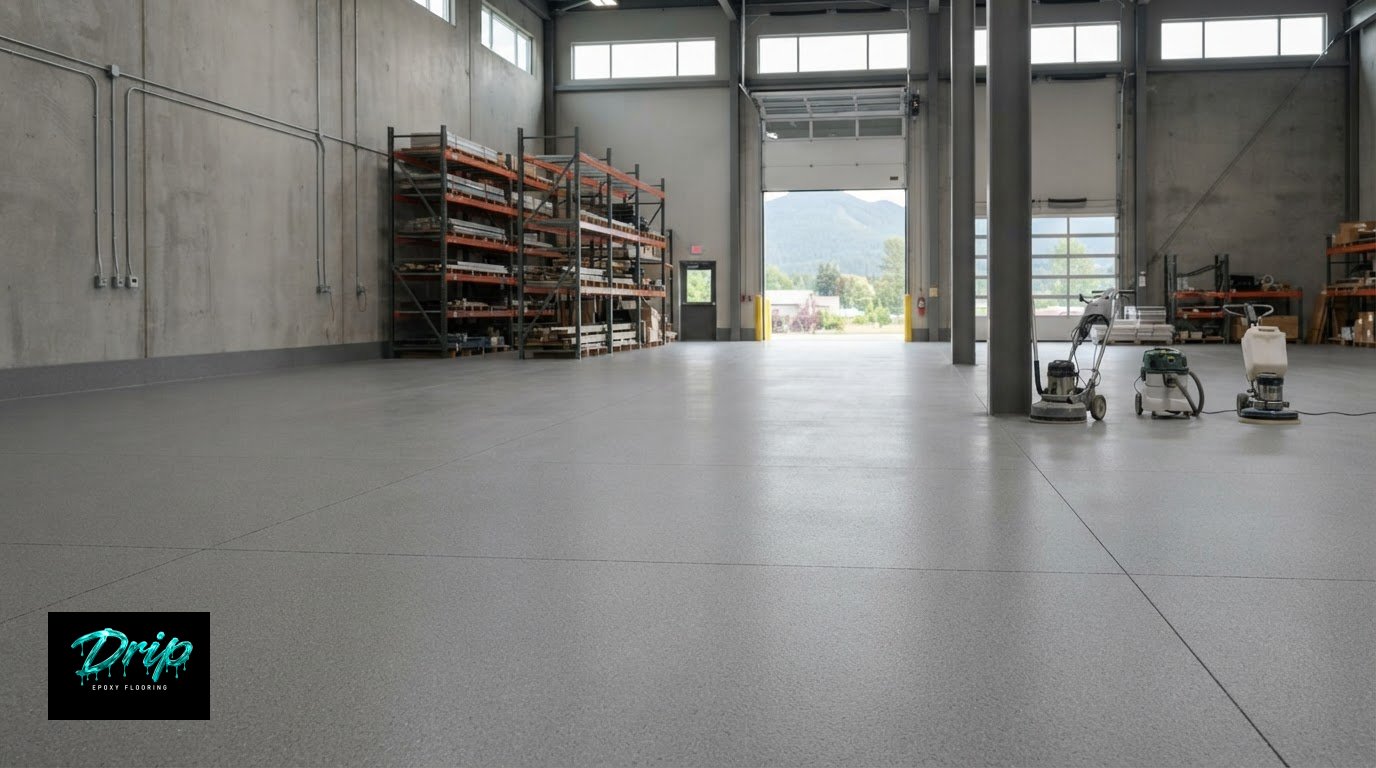
The traditional modular tile or paint-grade sealer on your concrete slab might be the single largest operational liability in your facility. If you manage an active commercial workspace, you already know the persistent headache of scrubbing degraded grout lines, patching blisters caused by high slab moisture, and managing wet-floor slip hazards under WorkSafeBC safety standards. Costly operational shutdowns for floor repairs only compound the problem. Upgrading to engineered Langley commercial flooring solutions eliminates these vulnerable joints and failing adhesives by transforming bare concrete into a continuous, fluid-applied barrier built for relentless traffic.
Discover how industrial epoxy, slip-resistant quartz flooring, and fast-curing commercial polyaspartic systems deliver durable, seamless surfaces tailored specifically to Fraser Valley conditions. You'll learn how proper mechanical diamond grinding, moisture vapour barrier protection, and strategic project sequencing work together to protect your concrete, satisfy health regulations, and keep your facility running without costly delays.
Key Takeaways
- Evaluate engineered Langley commercial flooring solutions to select the ideal balance of compressive strength, rapid curing, and abrasion resistance for your facility.
- Learn why mechanical diamond grinding and moisture vapour barrier primers are critical to prevent delamination caused by high Fraser Valley slab moisture.
- Discover how slip-resistant quartz flooring eliminates failing grout joints while maintaining traction that meets rigorous WorkSafeBC safety standards.
- Pinpoint specific system requirements for specialized spaces, from thermal shock resistance in food preparation areas to chemical resilience in automotive service bays.
- Review the technical credentials, surface profiling standards, and project sequencing protocols required when vetting certified installers.
Table of Contents
- Demands on Commercial Floors Across Langley Facilities
- Commercial Coating Systems: Epoxy, Polyaspartic, and Quartz Compared
- Concrete Surface Preparation: Diamond Grinding and Moisture Control
- Facility Requirements for Langley Commercial Operations
- Selecting Certified Langley Commercial Floor Coating Installers
Demands on Commercial Floors Across Langley Facilities
Commercial facilities face structural punishment that standard retail floor coverings simply cannot endure. When you evaluate Langley commercial flooring solutions, your primary consideration must be how the material handles mechanical loading, moisture migration, and aggressive chemical exposure. Poured-in-place commercial epoxy floors chemically bond directly to prepared concrete, establishing a non-porous working surface that won't separate under heavy traffic.
Fraser Valley soil conditions present unique subterranean challenges. High seasonal water tables produce substantial capillary moisture pressure beneath ground-level slabs. Without proper mitigation, moisture vapour transmission forces water through concrete pores, creating osmotic blisters that destroy unbonded floor coverings. Combining proper slab profiling with a dedicated moisture vapour barrier stops water ingress before it compromises your working floor.
Operational Stresses in Langley Industrial and Retail Hubs
Logistics hubs in Gloucester Industrial Estates and high-volume retail centres along the Langley Bypass present harsh operating environments. Untreated concrete slabs crack under relentless point loads. You can see this degradation wherever heavy machinery operates:
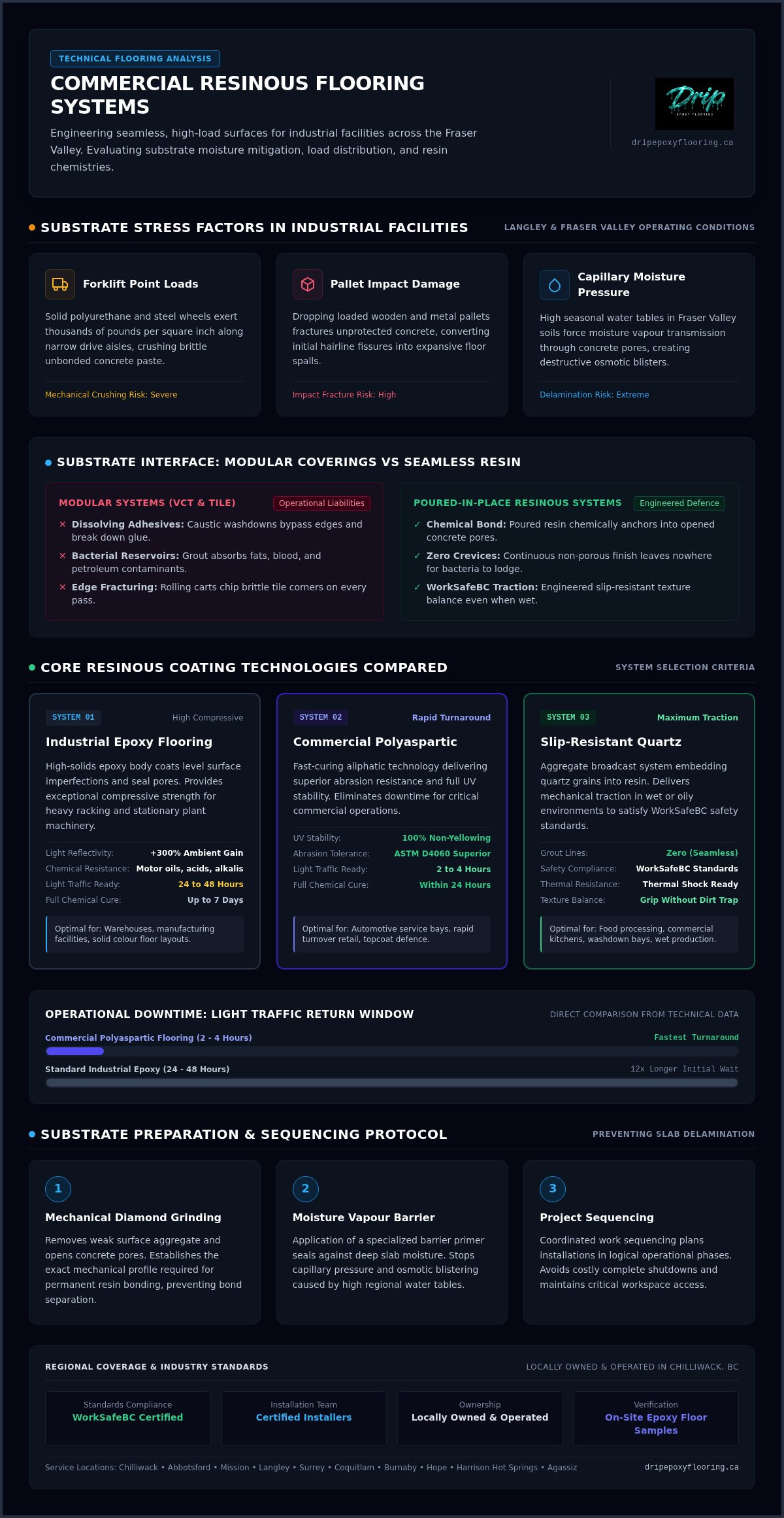
- Forklift point loads: Solid polyurethane and steel wheels exert thousands of pounds per square inch along narrow drive aisles, crushing brittle surface paste.
- Pallet staging impact: Dropping loaded wooden and metal pallets fractures bare concrete, turning hairline cracks into expanding spalls.
- Repetitive rolling friction: Continuous cart traffic wears down weak surface aggregate, producing airborne concrete dust that settles on machinery and inventory.
The Vulnerability of Modular Seams and Grout Lines
Modular materials like vinyl composition tile (VCT) and commercial quarry tile fail along their joints. When your sanitation staff washes down a workspace with caustic degreasers or hot water, liquids bypass the tile edges. Chemical washdowns dissolve the underlying adhesives, turning vinyl planks into loose, bubbling trip hazards.
In processing areas, damaged grout creates sanitation liabilities. Porous grout lines absorb animal fats, blood, milk solids, and petroleum, creating damp pockets where bacteria colonize. Heavy rolling carts chip brittle tile corners on every pass, accelerating grout loss. Selecting seamless commercial floor systems removes these failure points, eliminating the crevices that trap dirt and harbor contaminants.
Commercial Coating Systems: Epoxy, Polyaspartic, and Quartz Compared
Selecting the right resin chemistry determines how effectively your surface withstands impact, chemical washdowns, and thermal shifts. Modern Langley commercial flooring solutions rely on three proven systems: high-build industrial epoxy, fast-curing polyaspartics, and aggregate-filled quartz. Commercial facilities frequently layer these chemistries, combining an epoxy primer for substrate penetration with an aliphatic polyaspartic topcoat for maximum surface defence. Reviewing physical epoxy floor samples on site allows you to evaluate thickness, colour, and texture before scheduling your installation.
Industrial Epoxy Flooring and Solid Colour Coatings
High-solids epoxy body coats level surface imperfections and seal concrete pores against aggressive industrial fluids. Applied as solid color epoxy coatings, they resist transmission fluid, motor oil, dilute acids, and alkaline detergents. In warehousing and production facilities, high-gloss finishes increase ambient light reflectivity by up to 300 percent, lowering energy requirements. Facilities with relentless heavy traffic often turn to industrial epoxy flooring solutions for high compressive strength under heavy racking and stationary machinery.
Commercial Polyaspartic Flooring and Fast-Cure Technology
The polyaspartic advantage centres on cure speed and wear tolerance. Standard epoxies require 24 to 48 hours before accepting light foot traffic and up to seven days for full chemical cure. In contrast, commercial polyaspartic flooring accepts light traffic in two to four hours and achieves full cure within 24 hours, minimizing operational downtime. Under ASTM D4060 Taber abrasion testing, polyaspartics record just 15 to 30 milligrams of mass loss per 1,000 cycles compared to 60 to 90 milligrams for standard epoxy. Polyaspartic topcoats are completely UV-stable, meaning they won't amber or chalk when exposed to sunlight around exterior bay doors.
Slip-Resistant Quartz Flooring for High-Traction Demands
A double-broadcast quartz flooring system embeds graded ceramic quartz aggregate between epoxy base coats before receiving a clear protective topcoat. This matrix creates a durable slip-resistant texture engineered to maintain mechanical grip in wet, oily environments. While smooth resin floors drop below a 0.30 Dynamic Coefficient of Friction (DCOF) when wet, quartz broadcast surfaces consistently exceed 0.42 to 0.55 wet DCOF under ANSI/NFSI B101.3 standards. Reviewing technical quartz flooring specifications ensures your facility strikes the right balance between cleanability and slip resistance. If you need assistance matching resin systems to your facility's daily traffic, request a tailored technical assessment for your space.
Concrete Surface Preparation: Diamond Grinding and Moisture Control
The performance of resinous Langley commercial flooring solutions depends almost entirely on the quality of substrate preparation. Liquid polymer resins require an open, porous, and uncontaminated concrete profile to establish permanent mechanical adhesion. Skipping or rushing substrate preparation leads directly to delamination, edge curling, and finish failures. Professional concrete preparation follows a strict five-step technical sequence:
- Step 1: Test slab moisture levels: Conduct in-situ relative humidity testing (ASTM F2170) or calcium chloride testing (ASTM F1869) across the concrete slab to measure moisture emission rates.
- Step 2: Profile through mechanical diamond grinding: Run commercial grinding heads equipped with diamond tooling to remove surface laitance and establish an open pore structure.
- Step 3: Vacuum concrete dust: Use industrial HEPA-filtered vacuum extractors connected directly to the machinery to eliminate micro-dust that prevents resin bonding.
- Step 4: Repair structural imperfections: Chase and fill slab fractures, joint spalls, and surface divots with high-strength epoxy patching mortars.
- Step 5: Install moisture mitigation: Apply a dedicated epoxy moisture vapour barrier when slab moisture testing reveals elevated vapor drive.
Mechanical Diamond Grinding and Profile Creation
Acid etching cannot produce the concrete surface profile (CSP) needed for high-traffic industrial applications. Acid washes react unpredictably with slab minerals, fail to penetrate dense hardeners, and introduce unwanted moisture. In contrast, mechanical diamond grinding uniformly cuts away weak laitance, curing compounds, and old sealers. This process opens the aggregate matrix to achieve a CSP 2 to CSP 3 profile for thin coatings or CSP 3 to CSP 5 for heavy-build systems. Review the exact profiling standards detailed in concrete floor preparation services to understand how proper surface roughness guarantees pull-off bond strengths exceeding 250 psi.
Mitigating Moisture Vapour Transmission in Local Concrete
Fraser Valley facilities frequently battle moisture vapour transmission due to high regional water tables. As water vapor travels upward through slab capillaries, it carries dissolved alkali salts. When moisture encounters an impermeable floor coating without an adequate base layer, vapor pressure causes osmotic blister formation. Applying a 100 percent solids epoxy moisture vapour barrier directly over diamond-ground concrete blocks transmission up to 100 percent relative humidity, protecting your decorative and working layers from premature failure.
Facility Requirements for Langley Commercial Operations
Different industries subject concrete substrates to vastly different mechanical and chemical stresses. Matching Langley commercial flooring solutions to your specific operational environment ensures your investment holds up under strict regulatory scrutiny and daily physical abuse. Facility managers must look closely at exposure to thermal cycling, corrosive fluids, and production schedules.
Commercial Kitchens, Craft Breweries, and Food Processing
Food and beverage operations face intense scrutiny under Fraser Health and CFIA hygiene standards. Commercial kitchens, butcheries, and craft breweries require seamless surfaces that leave no room for bacterial harbourage around wash basins, kettles, and trench drains. High-temperature washdowns cause rapid expansion and contraction of concrete substrates. Floors engineered with high thermal shock resistance prevent debonding and cracking when subjected to boiling water, cooking oil splatters, and steam sanitation. Installing an integral 100 mm (4-inch) cove base creates a smooth, curved transition up the wall base, eliminating 90-degree corners that trap organic matter.
Automotive Facilities, Service Bays, and Warehouses
Service bays and commercial garages along the Langley Bypass require resilient surfaces capable of withstanding aggressive automotive fluids. Hydraulic fluids, brake cleaner, motor oils, and corrosive battery acid will soften low-grade acrylics or seep into bare concrete. resinated surfaces also resist hot tyre pickup, preventing hot radial tyres from pulling coatings off the slab. For showroom floors and customer greeting areas, broadcast decorative flake systems deliver an attractive, textured surface that resists scuff marks and hides tracked-in road grime while maintaining high light reflectivity for working bays.
Strategic Project Sequencing to Minimize Operational Downtime
Halting commercial operations for floor installations directly impacts your bottom line. Successful installations rely on meticulous project sequencing, breaking your floor plan into phased zones so production continues elsewhere in the building. Applying fast-curing commercial polyaspartic flooring during scheduled weekend shutdowns or overnight shifts allows light foot traffic in as little as four hours. Heavy rolling loads and vehicle staging can resume within 24 hours. To plan a phased installation that protects your workflow, schedule your facility site evaluation.
Selecting Certified Langley Commercial Floor Coating Installers
Installing industrial resinous systems requires heavy machinery, strict chemical handling, and precise environmental monitoring. When vetting providers for Langley commercial flooring solutions, your first step is verifying that the contractor employs factory-certified installers rather than general labourers. Liquid-applied polymer floors are unforgiving; improper mixing ratios or incomplete mechanical preparation will quickly trigger adhesive failure. Working with a dedicated Fraser Valley specialist guarantees direct accountability and regional expertise, avoiding the communication gaps and subcontractor markups common with out-of-province retail chains.
WorkSafeBC Compliance and Certified Contractor Standards
Resinous flooring applications involve aggressive mechanical grinding and chemical cross-linking that demand strict workplace safety measures. Always confirm that your contractor carries active WorkSafeBC coverage and full commercial general liability protection. Under WorkSafeBC OHS guidelines, mechanical diamond grinding requires heavy industrial vacuum units with multi-stage HEPA filtration to eliminate respirable crystalline silica dust. Beyond dust control, certified installers understand stoichiometric two-component mixing ratios and monitor the ambient dew point margin, ensuring condensation never interferes with inter-coat bonding.
Securing a Dedicated On-Site Consultation and Project Scope
A proper flooring specification cannot be generated through a generic online form. Reliable contractors conduct a hands-on slab assessment to evaluate joint deterioration, chemical contamination, and concrete hardness. They perform moisture testing to determine whether your slab requires a dedicated epoxy moisture vapour barrier before topcoat application. During this walkthrough, you can review cured samples to establish the ideal slip-resistant texture balance for your facility's daily washdowns and traffic patterns. Take the first step toward protecting your concrete by choosing to book an on-site commercial quote. When you schedule your commercial flooring consultation, local specialists will outline exact preparation protocols and project sequencing tailored to your operating hours.
Protect Your Concrete Slab with Long-Term Resinous Performance
Upgrading to engineered Langley commercial flooring solutions replaces failure-prone modular tiles with fluid-applied systems built for severe daily abuse. A successful floor installation relies on concrete surface profiling, verified moisture mitigation, and resin chemistry tailored to your traffic demands. Working with a locally owned and operated contractor based in Chilliwack serving Langley and the Fraser Valley guarantees that your facility benefits from certified installers who execute precise mechanical diamond grinding with dustless HEPA extraction.
From seamless quartz broadcasts that meet WorkSafeBC slip-resistance standards to fast-curing polyaspartics that prevent costly operational downtime, industrial resin systems deliver lasting chemical and mechanical resilience. You don't have to accept deteriorating grout lines, bubbling adhesives, or constant surface repairs in your workspace.
Take the next step in securing a clean, compliant, and durable working environment. Request an on-site commercial floor coating consultation to evaluate your slab conditions and review custom coating specifications for your space.
Frequently Asked Questions
How long does a commercial epoxy or polyaspartic floor installation take in Langley?
Most commercial installations take two to four days depending on resin selection and square footage. Commercial polyaspartic flooring allows rapid turnarounds where foot traffic returns in four hours and equipment traffic within 24 hours. Multi-coat industrial epoxy projects with moisture vapour barrier primers generally require three to four days for application, followed by 48 to 72 hours of cure time before heavy vehicle re-entry. Staged project sequencing keeps active facilities running during multi-zone installations.
Can commercial resinous floor coatings be installed over cracked or uneven concrete slabs?
Yes, damaged concrete can be resurfaced once underlying structural flaws are mechanically treated. Installers route out dormant cracks before filling them with high-modulus epoxy patching mortars. Uneven transitions or pitted surfaces are smoothed through mechanical diamond grinding. Once the concrete aggregate is clean and properly levelled, fluid-applied Langley commercial flooring solutions chemically fuse to the repaired substrate, creating a monolithic, impact-resistant surface that won't allow cracks to telegraph upward.
What is the primary operational difference between commercial epoxy and polyaspartic coatings?
The primary differences lie in curing velocity, UV stability, and surface hardness. Epoxy provides higher build thickness and exceptional compressive strength, making it ideal as a levelling base or moisture vapour barrier. Polyaspartic chemistries cure four times faster, resist yellowing under sunlight exposure around exterior bay doors, and provide superior abrasion resistance against rolling forklift wheels. Most commercial facilities install hybrid systems that combine epoxy basecoats with a high-performance polyaspartic topcoat.
How do seamless resinous floors comply with WorkSafeBC slip-resistance safety standards?
Resinous systems meet WorkSafeBC OHS Section 4.40 requirements by incorporating graded quartz or aluminum oxide aggregates into the wet body coat. This broadcast creates a mechanical profile that raises wet dynamic friction well above standard safety thresholds. Technicians calibrate the viscosity and thickness of the protective topcoat to balance slip resistance with mop cleanability, ensuring facility washdowns remain safe without trapping cleaning residue or damaging maintenance equipment.
What maintenance routines are required to preserve commercial epoxy and quartz floors?
Preserving fluid-applied flooring requires regular sweeping and wet cleaning with neutral pH detergents. Avoid using acidic cleaners, high-alkaline stripping agents, or abrasive scouring pads that dull the protective polyaspartic topcoat. Daily dust mopping removes abrasive grit that causes micro-scratching under heavy rolling wheels. For food processing rooms and automotive service bays, regular low-pressure washdowns with soft-bristle scrubbers keep the slip-resistant texture clean and prevent oils from forming slippery surface films.
How does moisture vapour transmission beneath Fraser Valley slabs impact commercial floor coatings?
Moisture vapour transmission forces water vapour and dissolved alkaline salts upward through porous concrete slabs under hydrostatic pressure. In the Fraser Valley, where groundwater tables remain high, this pressure easily delaminates poorly bonded coatings and causes osmotic blistering. Selecting engineered Langley commercial flooring solutions with a certified 100 percent solids epoxy moisture vapour barrier halts vapour drive, permanently sealing concrete capillaries before the decorative or protective topcoats are applied.