brewery flooring solutions Chilliwack · 12 min read ·
Brewery Flooring Solutions in Chilliwack: The Commercial Buyer's Guide (2026)
Can your production floor survive boiling washdowns, acidic wort spills, and steel keg impacts without blistering under pressure? When specifying brewery flooring solutions Chilliwack brewery owners and facility managers
By Drip Epoxy Flooring · Chilliwack, BC
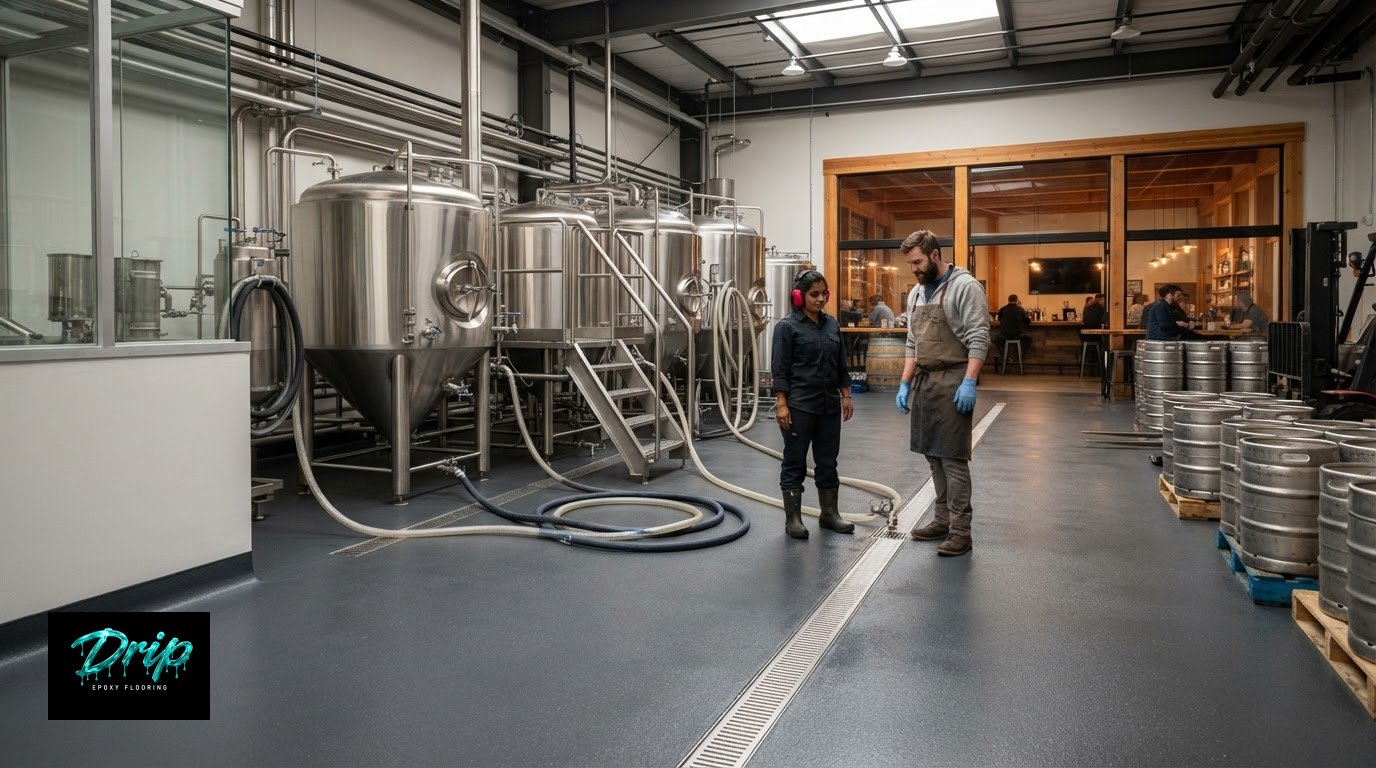
Can your production floor survive boiling washdowns, acidic wort spills, and steel keg impacts without blistering under pressure? When specifying brewery flooring solutions Chilliwack brewery owners and facility managers understand that standard floor coatings fail quickly against aggressive thermal shock and caustic sanitizing chemicals. Blistering resin and delaminating topcoats do not simply halt brewing production cycles. They also trap organic material, erode the concrete slab, and create slick surfaces that violate WorkSafeBC safety standards.
You will discover how to specify, prepare, and install industrial resinous flooring engineered for craft brewery washdowns, thermal shock, and front-of-house taprooms. This commercial guide walks you through every technical phase, from mechanical diamond grinding and moisture vapour transmission control to slip-resistant quartz flooring builds. You will learn how to satisfy Fraser Health and Canadian Food Inspection Agency sanitary regulations while establishing a clean aesthetic divide between your heavy production cellars and visitor taprooms.
Key Takeaways
- Identify how rapid thermal shock from boiling washdowns and caustic chemical exposure destroy standard concrete coatings in production areas.
- Evaluate durable resin chemistries and polyaspartic topcoat systems to handle severe abrasion resistance demands from steel keg handling.
- Discover proven brewery flooring solutions Chilliwack operations use to establish a hygienic, slip-resistant divide between cellars and public tasting rooms.
- Learn why mechanical diamond grinding concrete floor preparation is critical to stop moisture vapour transmission and coating delamination.
- Review essential local contractor credentials, WorkSafeBC safety standards, and project sequencing strategies that keep brewing production moving.
Table of Contents
- Operating Conditions That Dictate Brewery Flooring in Chilliwack
- Evaluating Resinous Flooring Systems: Performance Criteria for Breweries
- Zoned Flooring Configurations: Brewhouse Floors vs. Front-of-House Tasting Rooms
- Concrete Surface Preparation and Installation Sequencing in Chilliwack
- Selecting Your Brewery Flooring Contractor in the Fraser Valley
Operating Conditions That Dictate Brewery Flooring in Chilliwack
Commercial brewing subjects concrete slabs to extreme thermal, mechanical, and chemical stress. The daily operations of a modern brewery require intense cleaning cycles, point-load transfers, and constant moisture management. In the Fraser Valley, where groundwater tables remain high and winter temperatures drop rapidly, unsealed concrete absorbs moisture and chemicals until deep structural fracturing occurs. Evaluating specialized industrial epoxy flooring in Chilliwack protects your capital investment from premature failure caused by these aggressive environments.
Thermal Shock Resistance and Boiling Washdowns
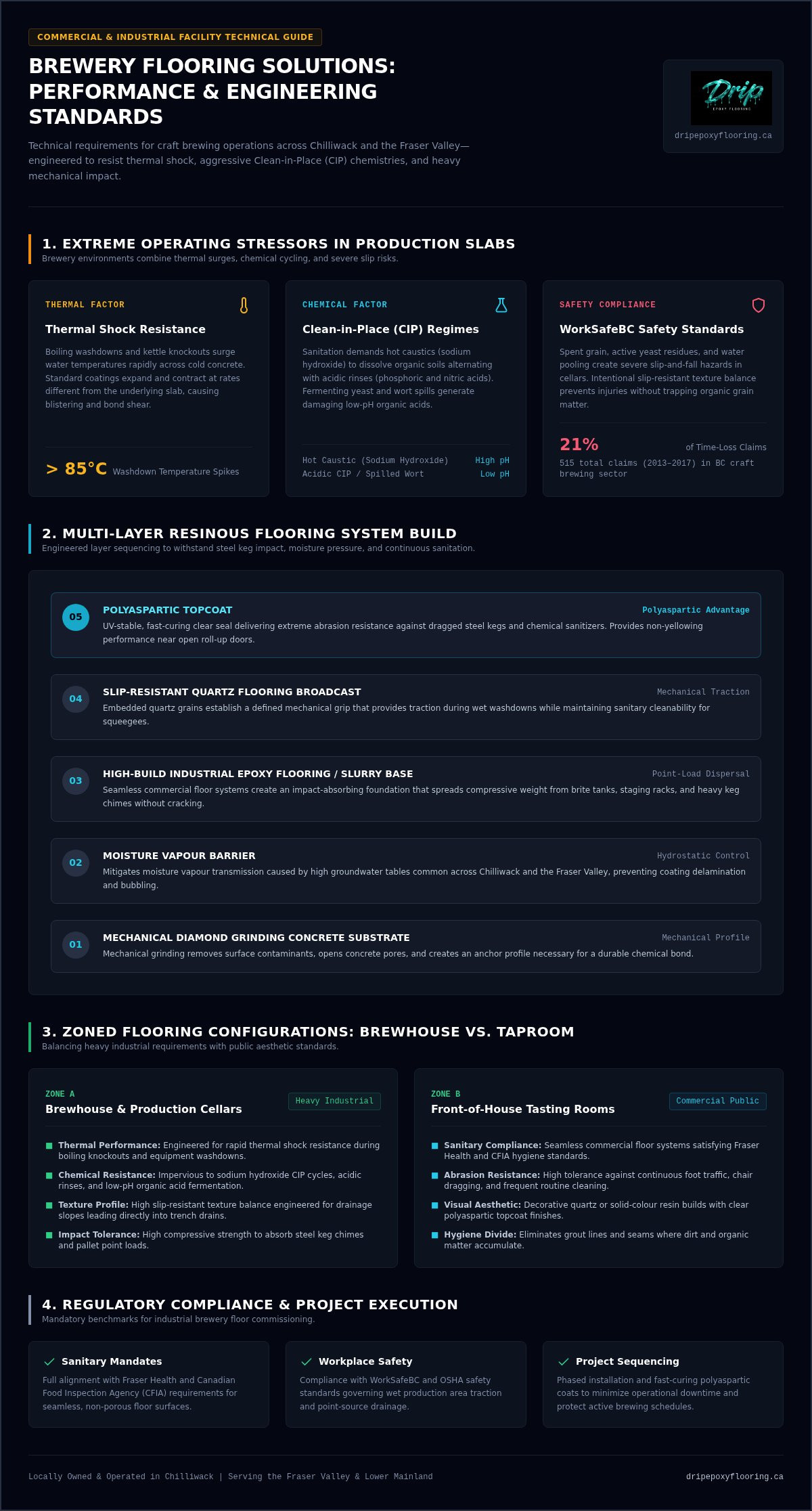
Thermal shock resistance is mandatory when hot water dumps strike cold concrete surfaces. During kettle knockouts and vessel sanitization, water temperatures can surge above 85 degrees Celsius within seconds. Standard epoxy coatings expand and contract at different rates than the concrete beneath them. This coefficient disparity shears the chemical bond, resulting in blistering, micro-cracking, and rapid delamination around brewhouse drainage zones and kettle skirts.
Chemical Exposure from Clean-in-Place (CIP) Regimes
Brewery sanitation depends on heavy-duty chemical cycling that quickly destroys unengineered coatings. Clean-in-place (CIP) regimens alternate between hot caustic solutions like sodium hydroxide to strip organic matter and acidic rinses such as phosphoric or nitric acids to clear mineral scale. Spilled wort and active yeast also ferment on concrete, generating low-pH organic acids. Seamless commercial floor systems eliminate joints, sealing your concrete against continuous chemical attack and preventing bacterial growth beneath the surface.
WorkSafeBC Slip-Resistance Mandates for Wet Production Areas
Between 2013 and 2017, WorkSafeBC recorded 515 time-loss claims in the craft brewing sector, with 21 percent caused directly by slips and falls. Wet brewer spent grain, yeast residues, and water make production areas hazardous. Meeting WorkSafeBC safety standards requires intentional engineering to strike the right friction balance:
- Mechanical traction: Installing an embedded aggregate profile maintains positive footing even under active runoff.
- Sanitary cleanability: Surfaces must avoid excessive roughness that traps spent grains or resists squeegee maintenance.
- Drainage pitch: Proper sloping ensures aggressive washdowns channel straight into trench drains instead of ponding.
Implementing targeted brewery flooring solutions Chilliwack operations rely on gives your facility a durable surface that withstands steel keg drops, resists aggressive CIP cycles, and protects cellar workers every shift.
Evaluating Resinous Flooring Systems: Performance Criteria for Breweries
Selecting the right resin chemistry demands a careful analysis of your facility's daily traffic, physical impact zones, and moisture profiles. Industrial brewing operations subject slab surfaces to continuous gouging from steel keg chimes, localized heat spikes, and heavy pallet traffic. Commercial polyaspartic flooring, high-build epoxies, and urethane systems each deliver distinct mechanical thresholds. Aligning these chemistries with your operational workflow ensures your production space stays functional and compliant with basic industrial benchmarks, such as OSHA regulatory compliance protocols.
Industrial Epoxy Flooring vs. Polyaspartic and Urethane Chemistries
High-build industrial epoxy flooring in Chilliwack acts as an impact-absorbing foundation, dispersing compressive point loads from full brite tanks and staging racks. Combining this base with a polyaspartic topcoat provides distinct advantages. The polyaspartic advantage includes rapid cure times, elevated abrasion resistance against dragging kegs, and non-yellowing UV stability near roll-up bay doors. For intense wet production zones subject to extreme thermal dumping, urethane cement systems offer specialized resilience, while epoxy-polyaspartic hybrids excel in dry packaging, milling, and canning halls.
Slip-Resistant Quartz Flooring Systems
In wet cellar areas, quartz flooring provides a reliable mechanical profile. Certified technicians broadcast ceramic-coated quartz granules directly into an industrial resin base, locking the aggregate in place with durable topcoats. This slip-resistant quartz flooring creates a uniform slip-resistant texture that preserves footing under running water, spent yeast, and foam. Daily sanitation remains straightforward: the rounded quartz profile sheds debris easily under commercial floor scrubbers and squeegees without degrading traction.
Moisture Vapour Barrier Integration for Slabs on Grade
Concrete slabs on grade across the Fraser Valley regularly contend with high groundwater tables and substantial hydrostatic pressure. Unmitigated moisture vapour transmission forces alkaline moisture upward through the concrete matrix, generating osmotic pressure that blisters impermeable resins. To prevent delamination, professional installations incorporate a dedicated epoxy moisture vapour barrier directly onto the mechanically profiled slab before applying decorative or high-wear intermediate builds.
- Urethane cement: Maximum thermal shock resistance and heavy organic acid tolerance for brewhouse boil decks.
- Slip-resistant quartz flooring: High traction with balanced cleanability for wet cellar walkways and CIP stations.
- Epoxy base with polyaspartic topcoat: Superior gouge resistance, rapid cure turnarounds, and UV stability for canning lines.
Matching your layout with durable brewery flooring solutions Chilliwack facilities require prevents premature coating failures. If you need a technical assessment of your slab condition, request an on-site evaluation and schedule a commercial floor review to plan your build correctly.
Zoned Flooring Configurations: Brewhouse Floors vs. Front-of-House Tasting Rooms
A craft brewery is not a uniform facility; it operates as two distinct operational worlds under one roof. Behind the swinging cellar doors, floors must handle boiling kettle runoffs, heavy pallet traffic, and constant chemical washdowns. In the tasting room, visitors expect a clean, stylish hospitality environment. Applying a single flooring material across both areas compromises either visitor appeal or production reliability. Designing tailored brewery flooring solutions Chilliwack operations need means creating intentional physical zones that separate harsh brewing operations from front-of-house guest spaces.
Production Zone Flooring: Brewhouse, Cellar, and Packaging Lines
Production areas require resilient, high-traction finishes that satisfy Canadian food safety standards and international hygiene guidelines comparable to FDA food safety regulations. Around boiling kettles, mash tuns, and fermentation cellars, quartz flooring provides the aggregate traction crew members need on wet slabs. Certified installers integrate seamless cove bases running 100 to 150 millimetres up the wall perimeter, sealing the floor-to-wall joint so wash water channels directly toward stainless trench drains without soaking sill plates or wall cavities.
Front-of-House Taprooms: Balancing Design and Durability
Your taproom demands high-end visual distinction capable of handling dirty boots, dragged barstools, and spilled stouts. Installing metallic flooring or decorative flake finishes delivers an industrial luxury aesthetic that anchors your brand experience. To prevent scuffing and dulling under relentless commercial foot traffic, these systems are sealed with a clear polyaspartic topcoat. The polyaspartic advantage provides UV colour stability near retail patio openings and makes daily sweeping and damp mopping fast for front-of-house staff.
Cold Storage and Keg Staging Environments
Walk-in cold boxes and keg staging bays face repeated mechanical shocks. Dropped steel keg chimes can fracture brittle surfaces, while near-freezing temperatures challenge material flexibility. Installing durable resin builds ensures your refrigerated storage withstands structural shock from rolling point loads and localized thermal drops:
- High-impact base coats: Dense epoxy bases absorb steel keg drop impacts without fracturing underlying concrete.
- Cold-temperature curing: Specialized polyaspartic formulations cure rapidly inside low-temperature cold rooms, avoiding refrigeration shutoffs.
- Seamless transitions: Bevelled transition thresholds prevent forklift tire gouging between refrigerated coolers and warm loading docks.
Zoning your brewery flooring solutions Chilliwack layout creates a functional boundary between heavy cellar work and public taproom hospitality, giving both areas the exact performance and aesthetic qualities they demand.
Concrete Surface Preparation and Installation Sequencing in Chilliwack
Every industrial coating is only as stable as the concrete beneath it. In high-humidity environments across Chilliwack and the Fraser Valley, applying resin over unprepared or smooth power-trowelled concrete guarantees bond failure. Adhesion requires an open, fractured concrete capillary network free from sealers, dairy fats, or brewing oils. Proper planning pairs meticulous mechanical profiling with tight installation controls to avoid compromising active brewing cellars.
Mechanical Diamond Grinding and Concrete Profiling
Mechanical diamond grinding opens tight concrete pores, strips weak cement laitance, and creates an anchor pattern matching International Concrete Repair Institute (ICRI) concrete surface profile (CSP) standards. Heavy-build production floors require a CSP 3 to CSP 5 profile for mechanical interlocking. Reviewing the fundamentals of professional concrete floor preparation services highlights why shortcutting preparation causes early delamination under hot washdowns.
Floor Pitch, Trench Drains, and Sanitary Cove Bases
Standing wastewater breeds wild yeasts and bacteria that fail health inspections. Before coating, technicians re-slope uneven slabs toward central stainless trench drains using polymer repair mortars. Installing integral, trowelled-in-place cove bases creates a continuous, rounded curve where the floor meets the wall. This seamless edge prevents dirty wash water from seeping into baseboard framing and drywall channels.
Project Sequencing and Fast-Cure Turnaround
Stopping production costs thousands in lost cellar volume. Coordinated project sequencing allows floor rebuilds during scheduled maintenance down-weeks. Installers use negative-air machines and industrial HEPA vacuums to capture silica dust, preventing airborne particulates from settling near active fermenters or sensitive canning line equipment.
- Substrate repair: Technicians route and inject semi-rigid epoxy into dormant control joints and structural floor cracks.
- Dust containment: Air-scrubbing negative-pressure zones completely isolate cellar processing equipment during grinding.
- Rapid return to service: Polyaspartic topcoat layers cure quickly, allowing foot traffic within hours and full equipment staging the next day.
Following a methodical preparation and containment plan delivers reliable brewery flooring solutions Chilliwack facilities can count on for decades. Connect with a qualified technical specialist today to request a project site assessment for your scheduled maintenance window.
Selecting Your Brewery Flooring Contractor in the Fraser Valley
Selecting the right trade contractor determines whether your resin floor lasts a decade or fails within six months. Commercial resin failure rarely stems from product defects; it almost always traces back to inadequate mechanical profiling, ignored substrate moisture, or poorly timed recoat windows. When evaluating brewery flooring solutions Chilliwack commercial buyers should look beyond basic business licenses and demand proven technical vetting protocols.
Technical Credentials and Proven Commercial Experience
Verify that on-site crews consist of factory-trained, certified installers rather than general construction subcontractors. Resin application requires real-time dew point tracking, concrete moisture testing, and precise aggregate dispersal. Demand verification of previous food-grade beverage projects, ensuring the crew regularly installs commercial epoxy flooring in Chilliwack while maintaining strict compliance with WorkSafeBC safety standards and provincial disposal regulations.
The Local Chilliwack Contractor Advantage
Partnering with a locally owned and operated team delivers distinct operational advantages. Fraser Valley building slabs sit above shallow alluvial water tables, which means local installers understand regional concrete moisture behaviour intimately. A local specialist conducts rapid site reviews, assesses substrate conditions firsthand, and provides immediate local support if future tank expansions or canning line reconfigurations require floor tie-ins.
Site Consultation and Next Steps
Before your initial site walk-through, compile critical operational variables so your contractor can specify the exact resin system and millimetre thickness required. Having these details ready ensures an accurate technical specification:
- Operating temperatures: Maximum washdown discharge temperatures and refrigerated cold-room zones.
- Chemical profiles: Specific concentrations of caustic washes and acid sanitizers used during CIP cleanings.
- Mechanical point loads: Operating weights of full brite tanks, pallet jacks, and forklift traffic paths.
- Maintenance timelines: Available production down-windows to schedule diamond grinding and fast-curing topcoats.
Specifying the right brewery flooring solutions Chilliwack operations need begins with accurate slab diagnostics. Connect directly with certified local professionals to inspect your concrete profile and request an on-site commercial brewery floor quote.
Protect Your Brewing Operations with Engineered Resinous Flooring
Specifying the right industrial resin system protects your concrete slab from boiling thermal shock, corrosive clean-in-place chemicals, and daily keg impacts. Designing zoned layouts separates slip-resistant quartz cellar decks from decorative taproom spaces, ensuring your facility maintains strict hygiene and WorkSafeBC slip-prevention standards without compromising aesthetic appeal. Proper mechanical diamond grinding guarantees the coating bonds permanently to the concrete below.
Partnering with a locally owned and operated business based directly in Chilliwack gives you access to certified installers who understand Fraser Valley substrate conditions. Every build adheres to WorkSafeBC safety standards, delivering industrial-grade systems engineered with high thermal shock resistance and dependable abrasion tolerance.
Investing in dependable brewery flooring solutions Chilliwack facilities trust keeps your cellar running smoothly for years to come. Take the next step in protecting your brewhouse investment. Request your tailored brewery flooring quote today to schedule an on-site technical slab evaluation.
Frequently Asked Questions
How long does a brewery floor installation take before brewing operations can resume?
Most commercial brewery installations take three to five days depending on slab condition, moisture profile, and square footage. Surface preparation with mechanical diamond grinding and joint repairs takes the first day. Multi-layer resin applications follow. By using commercial polyaspartic coatings for top layers, foot traffic can resume within hours of the final coat. Full chemical cure and equipment staging generally require 24 to 48 hours, keeping production downtimes tightly contained.
Can resinous coatings withstand boiling water dumps from brew kettles without peeling?
Yes, provided the system is specifically formulated for thermal shock resistance and anchored to an open concrete profile. Standard consumer epoxies crack and blister under sudden 85-degree washdowns because they expand differently than concrete. High-performance urethane concrete and thick-build industrial systems handle boiling water dumps without shearing their chemical bond. When specifying brewery flooring solutions Chilliwack brewhouses depend on thermal-cycling capabilities matched to kettle discharge points.
What is the difference between industrial epoxy flooring and slip-resistant quartz flooring?
Industrial epoxy flooring provides a smooth, high-build resin layer designed primarily for heavy compressive loads and general chemical protection. Slip-resistant quartz flooring incorporates ceramic-coated quartz granules broadcast directly into the resin matrix. This build produces a multi-dimensional mechanical texture that provides superior traction in constantly wet environments. While smooth epoxy works well in dry packaging lines, quartz systems protect personnel in wet cellars, milling areas, and brewhouse washdown bays.
Do you need a moisture vapour barrier under a brewery floor in Chilliwack?
Yes, applying an epoxy moisture vapour barrier is essential for ground-level concrete slabs across the Fraser Valley. Chilliwack's high water table produces constant hydrostatic pressure beneath unsealed concrete. As groundwater migrates upward through concrete capillaries, moisture vapour transmission pushes against impermeable topcoats, causing severe osmotic blistering and delamination. A dedicated vapour barrier locks deep slab moisture out, ensuring the protective resin layers remain bonded permanently.
How do you achieve an effective slip-resistant texture without making the floor impossible to clean?
The balance comes from selecting aggregate sizing and locking it with the proper topcoat thickness. Sharp or excessive aggregate traps spent grain and resists squeegees, while a glass-smooth floor violates WorkSafeBC safety standards. Installers broadcast rounded quartz granules evenly into the base coat, followed by a calibrated polyaspartic seal coat. This fills deep micro-crevices while leaving a pronounced texture that grips boot soles during active washdowns.
Can you install an integral cove base on brewery walls to meet sanitary washdown codes?
Yes, integral trowelled cove bases are standard practice to satisfy Fraser Health and CFIA food facility regulations. Installers mix epoxy mortar and trowel it directly from the concrete floor up the wall perimeter, creating a seamless radius of 100 to 150 millimetres. This smooth, curved transition eliminates 90-degree corners where dirty water and bacteria accumulate, allowing high-pressure washdowns to flow straight into floor drains without soaking framing.
What is the ideal floor finish for a public craft brewery tasting room?
Metallic epoxy flooring and decorative flake systems paired with a clear polyaspartic topcoat offer the optimal balance of style and durability. These systems provide an industrial luxury finish that elevates taproom aesthetics while resisting scuffs from dragged barstools, muddy boots, and beer spills. When planning complete brewery flooring solutions Chilliwack venues use decorative finishes in front-of-house hospitality rooms to establish a distinct, clean separation from heavy cellar zones.