heavy duty industrial flooring Langley · 14 min read ·
Heavy Duty Industrial Flooring in Langley: The 2026 Resource Guide
Many facility managers in the Fraser Valley believe a standard epoxy coat is sufficient for concrete protection, yet in Langley's moisture-prone environment, this often leads to premature failure and costly operational d
By Drip Epoxy Flooring · Chilliwack, BC
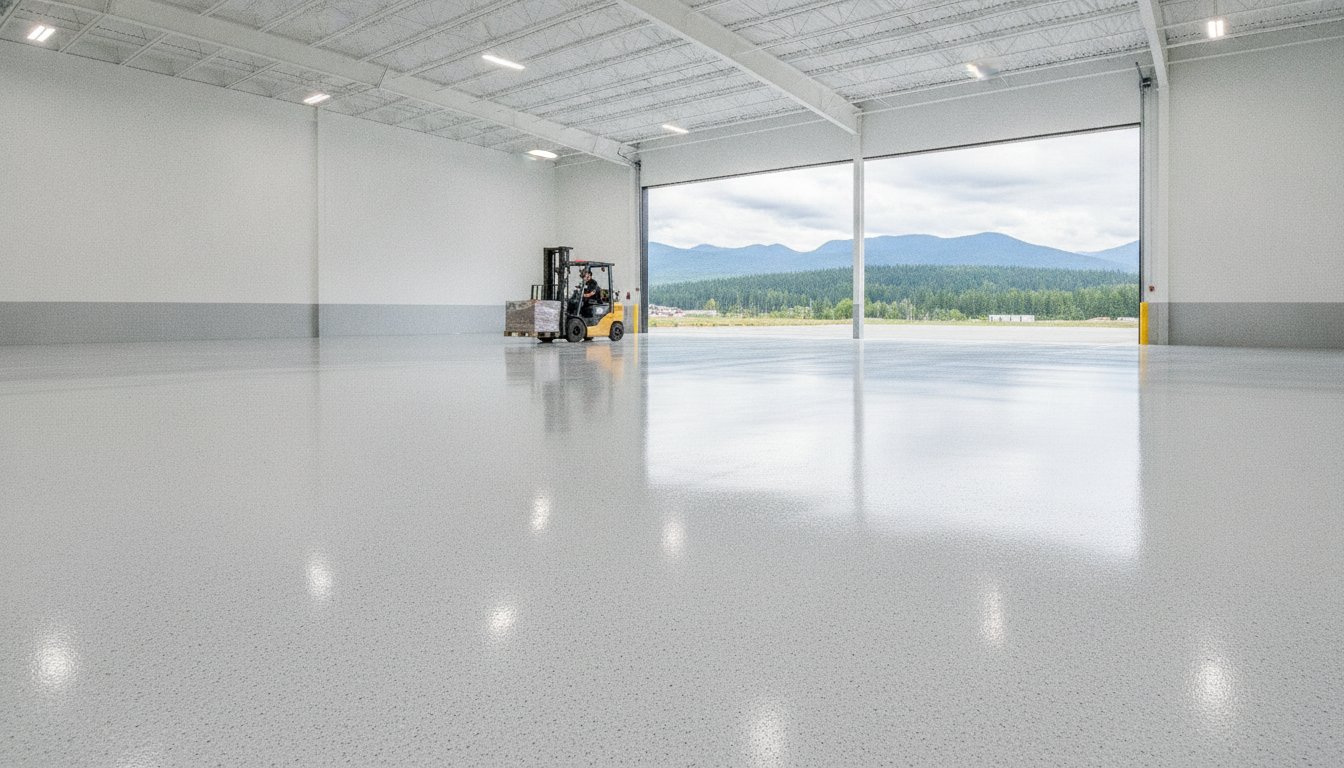
Many facility managers in the Fraser Valley believe a standard epoxy coat is sufficient for concrete protection, yet in Langley's moisture-prone environment, this often leads to premature failure and costly operational delays. If you've experienced the frustration of floor peeling or the safety hazards caused by chemical spills and heavy machinery impact, you understand that generic solutions simply don't hold up under industrial pressure. Investing in heavy duty industrial flooring Langley businesses can rely on requires a shift from temporary fixes to high-performance, engineered systems.
We recognize the need for a workspace that is both resilient and compliant with the latest 2026 WorkSafeBC OHS regulations. This guide details how to achieve a maintenance-free, seamless finish that enhances your property value while standing up to the rigours of daily warehouse operations. You'll discover the specific benefits of polyaspartic coatings and chemical-resistant quartz, alongside the meticulous preparation techniques required to ensure your floor remains a long-term asset rather than a recurring expense.
Key Takeaways
- Identify why the specific moisture conditions of the Fraser Valley require specialized coatings for facilities in Port Kells and Gloucester Industrial Estates.
- Compare the performance profiles of various systems to find the heavy duty industrial flooring Langley businesses need for rapid return-to-service and superior durability.
- Understand the critical role of mechanical diamond grinding in creating a permanent bond and preventing common industrial floor failures.
- Explore industry-specific solutions that meet 2026 food-grade compliance and provide resistance to harsh automotive chemicals like Skydrol.
- Learn the professional maintenance protocols that maximize your return on investment and preserve the high-end aesthetic of your facility.
Table of Contents
- Why Langley Industrial Facilities Require Specialized Floor Coatings
- Comparing Heavy Duty Systems: Polyaspartic vs. Quartz vs. Epoxy
- The Critical Role of Concrete Preparation in Langley
- Industry-Specific Requirements for Langley Businesses
- Maximizing ROI: Maintenance and Longevity of Industrial Floors
Why Langley Industrial Facilities Require Specialized Floor Coatings
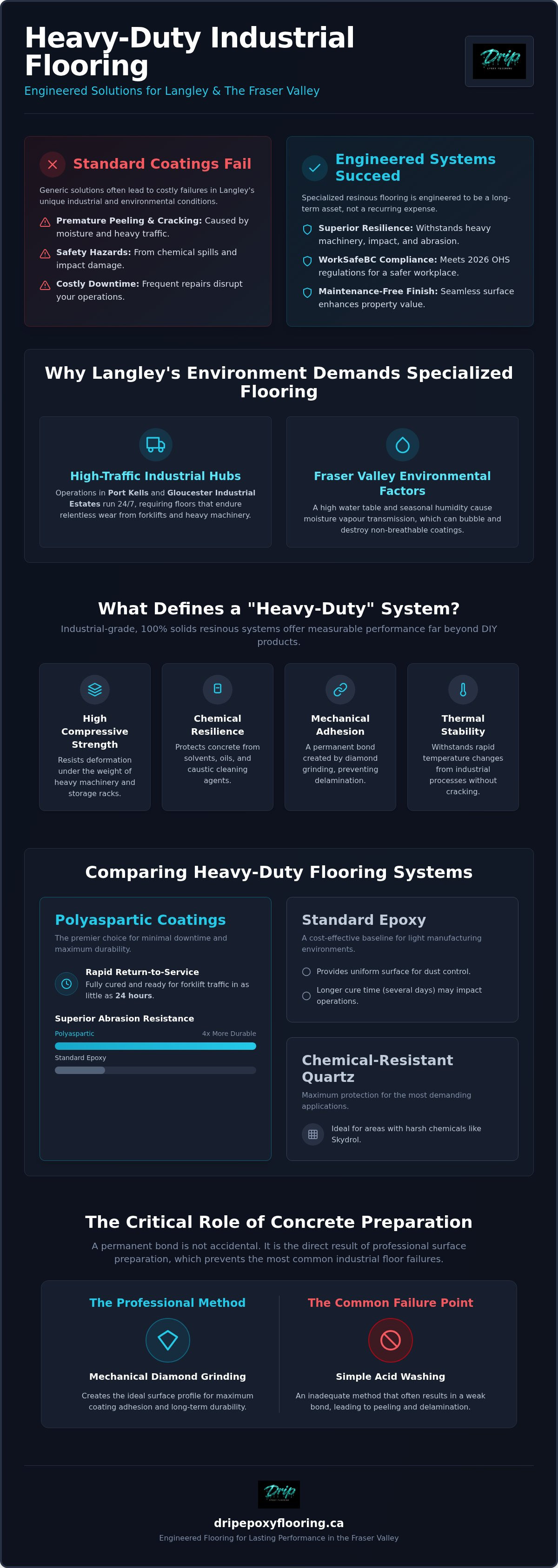
Langley serves as a primary logistical artery for the Lower Mainland, housing expansive operations within Gloucester Industrial Estates and Port Kells. These environments demand more than a cosmetic layer of paint; they require engineered systems capable of withstanding constant mechanical abuse. Standard hardware store floor paint lacks the cross-linking density to survive the abrasive friction of rubber tires and the crushing weight of fully loaded pallet jacks. Without a professional-grade resinous system, concrete surfaces quickly become pitted, dusty, and hazardous, leading to increased maintenance costs and potential safety violations.
The Gloucester and Port Kells Industrial Context
Operations in Langley's logistics hubs often run 24 hours a day, meaning flooring systems must endure relentless wear without the luxury of frequent downtime. High-volume shipping docks are particularly vulnerable, as the transition between trailers and the warehouse floor creates significant impact stress that can shatter brittle coatings. Implementing heavy duty industrial flooring Langley facilities can rely on ensures that these high-traffic zones remain intact under the most rigorous conditions. A seamless finish is also essential for dust mitigation in massive warehouses. Porous concrete naturally generates fine particulate matter that can damage sensitive electronics, contaminate products, and compromise the health of your labour force.
Environmental Factors in the Fraser Valley
The Fraser Valley's geographic profile introduces specific technical hurdles, most notably a high water table and significant seasonal humidity. These factors directly impact how coatings bond to concrete. Moisture vapour transmission refers to the process where water beneath a concrete slab migrates upward as a gas, exerting hydrostatic pressure that can cause non-breathable coatings to bubble and delaminate. Temperature fluctuations also cause concrete to expand and contract. A rigid, low-quality coating will crack under this movement, whereas a specialized industrial floor coating is designed with the tensile strength to move with the substrate while maintaining its structural integrity.
Defining "Heavy Duty" for Langley Businesses
There is a profound difference between residential DIY kits and the systems used for heavy duty industrial flooring Langley projects. While residential products are often thin, water-based epoxies with high solvent content, industrial-grade resinous systems are typically 100% solids materials. These professional systems are characterized by specific performance metrics:
- High Compressive Strength: The ability to resist deformation under the weight of heavy machinery and racking systems.
- Chemical Resilience: Protection against industrial solvents, oils, and caustic cleaning agents that would melt standard paint.
- Mechanical Adhesion: A permanent bond achieved through diamond grinding rather than simple acid washing.
- Thermal Stability: The capacity to withstand rapid temperature changes during industrial cleaning or manufacturing processes.
Choosing a system tailored to these local challenges is the only way to ensure a long-term return on your facility investment.
Comparing Heavy Duty Systems: Polyaspartic vs. Quartz vs. Epoxy
Solid-colour epoxy coatings represent the standard baseline for many light manufacturing facilities in the Fraser Valley. These systems provide a uniform, non-porous surface that effectively resists dust and minor chemical exposure while remaining cost-effective for large square footage. However, for heavy duty industrial flooring Langley projects that involve high-frequency forklift traffic or corrosive substances, more advanced resinous technologies are often required to prevent surface fatigue. Selecting the right system involves balancing the specific mechanical demands of your space with the operational reality of your facility's schedule.
Polyaspartic: The Solution for Minimal Downtime
Polyaspartic coatings have transformed industrial facility management by offering a return-to-service window as short as 24 hours. While standard epoxy may take several days to fully cure, polyaspartic systems allow Langley businesses to resume operations almost immediately after the final coat is applied. This material isn't only faster to install; it also provides roughly four times the abrasion resistance of traditional epoxy. It remains UV stable, ensuring the floor won't yellow or chalk near large bay doors or windows where sunlight exposure is high. For a deeper technical comparison of these resinous options, you can read our guide on Polyaspartic vs Epoxy: Best Garage Coating for BC Homes, which details how these materials perform in our specific regional climate.
Industrial Quartz for Extreme Environments
When an environment faces extreme impact or requires heavy wash-downs, quartz flooring systems are the superior choice. These systems utilize a multi-layered application process where decorative quartz sand is broadcast into high-solids resin, creating a profile that is much thicker than a standard coating. The resulting floor is incredibly dense and capable of absorbing the energy from dropped tools or heavy equipment without chipping. Because the finish is naturally textured, it inherently meets WorkSafeBC requirements for slip resistance in wet areas. This makes quartz the preferred solution for Langley breweries, mechanical rooms, and heavy wash-down bays where safety is non-negotiable.
Decorative flake systems balance this industrial strength with a professional, multi-coloured aesthetic that hides minor surface scratches and debris. These floors consist of a base coat, a full broadcast of vinyl flakes, and a high-performance topcoat, creating a thick wear layer that excels in high-traffic commercial zones. They're particularly effective in aviation hangars and showrooms where the brand's image must match the floor's mechanical performance. If you're unsure which system aligns with your facility's specific traffic patterns, you can speak with our technical team to review the performance data of each coating.
The Critical Role of Concrete Preparation in Langley
Industry data suggests that 90% of industrial floor failures are the direct result of inadequate surface preparation rather than material defects. For any heavy duty industrial flooring Langley project, the long-term bond between the resin and the substrate depends entirely on the quality of the mechanical profile created before the first drop of liquid is poured. Without meticulous preparation, even the most expensive polyaspartic or quartz systems will eventually peel or delaminate when subjected to the sheer forces of forklift traffic and heavy machinery.
Diamond Grinding vs. Acid Etching
Professional industrial contractors prioritize mechanical diamond grinding because it is the only reliable method for opening the "pores" of the concrete. While some budget-oriented services may suggest acid etching, this chemical process is insufficient for industrial environments. Acid etching only cleans the surface; it doesn't remove the weak top layer of concrete laitance or create the necessary Concrete Surface Profile (CSP) required for a permanent chemical bond. Using heavy-duty planetary grinders equipped with metal-bond diamonds ensures we reach the sound concrete beneath the surface, providing a textured anchor for the resin. You can learn more about our specific Professional Concrete Surface Preparation Services and how we tailor our grinding process to the hardness of your specific slab.
Moisture Testing and Mitigation
Langley's proximity to the Fraser River and its high water table makes moisture testing a non-negotiable step in the installation process. We utilize standardized testing methods, such as Calcium Chloride tests or In-situ Probes, to measure the moisture vapour emission rate (MVER) and relative humidity within the slab. If levels exceed the threshold for standard resins, we specify a high-moisture tolerant primer or a dedicated vapour barrier. A moisture barrier prevents osmotic blistering by creating an impermeable shield that stops the buildup of hydrostatic pressure from forcing the coating away from the concrete substrate. This step is essential for facilities in low-lying areas of Langley where ground moisture is a constant environmental factor.
Achieving a perfectly seamless finish also requires the systematic repair of existing structural issues. Before the coating application begins, every crack, spall, and joint must be cleaned and filled with high-modulus epoxy fillers. These repairs prevent moisture from seeping into the slab and ensure that the final heavy duty industrial flooring Langley businesses receive is a monolithic, hygienic surface. By addressing these foundational details, we transform a compromised concrete floor into a high-performance asset that meets the rigorous demands of modern manufacturing and logistics.
Industry-Specific Requirements for Langley Businesses
Every industrial sector in the Fraser Valley faces a unique set of operational stressors that dictate the chemistry of their floor coatings. While a logistics hub in Port Kells focuses on abrasion, a food processing facility near the Langley Bypass must prioritize hygiene and thermal resilience. Selecting heavy duty industrial flooring Langley businesses can trust involves matching these specific environmental challenges with the correct resinous system to ensure long-term performance.
For the food and beverage industry, compliance with CFIA and local health regulations is the primary driver. These facilities often undergo high-pressure, high-temperature washdowns that can cause rigid coatings to crack due to thermal shock. Our antimicrobial quartz and polyaspartic systems are engineered to expand and contract at rates similar to the concrete substrate, maintaining a seamless, bacteria-resistant barrier. Similarly, pharmaceutical and cannabis operations require clean-room standards where seamless floor-to-wall transitions, known as integral coving, eliminate 90-degree corners where contaminants could accumulate.
Compliance and Safety Standards
Meeting regulatory benchmarks is essential for operational continuity. Beyond food safety, many electronics manufacturing plants in Langley require Static Dissipative (ESD) flooring to protect sensitive components from electrostatic discharge. These specialized systems incorporate conductive elements to safely ground static electricity. If you are operating across the regional border, you may find our Commercial Polyaspartic Flooring in Abbotsford: The Ultimate Buyer’s Guide helpful for understanding how these standards apply to various facility types in the Fraser Valley.
Chemical and Impact Resistance
Automotive and aviation facilities demand a higher level of chemical resilience. Exposure to Skydrol, jet fuel, and corrosive brake fluids will quickly dissolve standard epoxy. In these environments, we utilize high-performance topcoats with superior cross-linking density to prevent staining and structural degradation. Our recent polyaspartic installations in local Langley warehouses have demonstrated that these high-build systems not only protect the concrete but also offer an "industrial luxury" aesthetic that enhances the professional image of showrooms and retail spaces. To ensure your facility meets these rigorous 2026 standards, you can contact our specialists for a site evaluation today.
Maximizing ROI: Maintenance and Longevity of Industrial Floors
Achieving a superior return on investment for heavy duty industrial flooring Langley projects requires a proactive approach to maintenance. While these systems are engineered for extreme resilience, their longevity is significantly influenced by post-installation care. A professionally installed resinous floor can last decades, but neglecting basic cleaning protocols or using improper chemicals can prematurely degrade the high-performance topcoat. Our team specializes in the heavy duty industrial flooring Langley facilities require to stay competitive and compliant over the long term.
Cleaning and Care Best Practices
Resinous surfaces are inherently non-porous, meaning contaminants remain on the surface rather than penetrating the substrate. For daily maintenance, we recommend using a pH-neutral cleaner mixed with warm water. It's vital to avoid soap-based cleaners that leave a cloudy film, as well as abrasive pads that can micro-scratch the finish over time. Waxing is entirely unnecessary for these systems and can actually create a safety hazard by making the floor excessively slippery. For high-stress zones like shipping docks or chemical storage areas, we suggest scheduling a professional inspection every 12 to 18 months to identify minor wear before it requires a significant repair.
Professional coatings offer substantial long-term savings compared to maintaining bare concrete. Unprotected concrete is prone to "dusting," which increases the wear on HVAC filters and sensitive machinery. By contrast, a seamless polyaspartic or quartz system protects the structural integrity of the slab, preventing the spalling and cracking that lead to expensive structural repairs. If the floor eventually shows signs of aesthetic wear after years of heavy service, a simple "refresh" topcoat can often restore the original lustre and slip resistance without the need for a full system replacement.
Your Langley Industrial Flooring Partner
Selecting a contractor with local expertise is critical for navigating the specific logistical and environmental challenges of the Fraser Valley. Drip Epoxy combines technical precision with a commitment to "industrial luxury," ensuring your facility looks as professional as it is durable. We understand that your floor is a foundational component of your business operations. Our meticulous application process and high-grade materials provide the security of a long-term solution rather than a temporary fix. To begin your facility transformation, you can request a professional site assessment for your Langley facility and receive a detailed evaluation of your concrete's current condition.
Securing the Future of Your Langley Facility
Transforming a high-traffic industrial space requires more than just a surface-level coating; it demands a system engineered for the specific environmental and mechanical stresses of the Fraser Valley. As we have explored, the foundation of any successful installation lies in professional diamond grinding and meticulous moisture mitigation. By selecting advanced polyaspartic or chemical-resistant quartz systems, you ensure your facility remains safe, compliant, and visually impressive for years to come. Investing in heavy duty industrial flooring Langley businesses can rely on is a strategic move that minimizes long-term maintenance costs while protecting your structural concrete.
Drip Epoxy Flooring is locally owned and operated in the Fraser Valley, bringing a deep understanding of regional climate challenges to every project. Our commitment to technical precision is backed by specialized diamond grinding equipment and a focus on high-performance materials that deliver a fast return-to-service. We take pride in delivering results that don't compromise on durability or professional aesthetics. If you're ready to upgrade your workspace with a seamless finish, Request a Quote for Heavy Duty Industrial Flooring today. We look forward to helping you transform your facility into a resilient, high-value asset.
Frequently Asked Questions
How long does an industrial epoxy floor take to cure in Langley?
Standard industrial epoxy systems typically require 24 to 48 hours for light foot traffic and up to seven days for a full chemical cure. However, polyaspartic systems offer a much faster return-to-service, often allowing full operational use within 24 hours of the final application. This rapid curing is particularly beneficial for Langley logistics hubs that cannot afford extended downtime. Ambient temperature and humidity in the Fraser Valley can influence these timelines.
Can industrial coatings be applied over old, oil-stained concrete?
Yes, industrial coatings can be successfully applied to oil-stained concrete provided the substrate undergoes rigorous mechanical preparation. We utilize professional diamond grinding to remove the contaminated top layer and apply specialized oil-tolerant primers that create a secure bond. Simply cleaning the surface is insufficient; the oil must be mechanically removed or neutralized to prevent the heavy duty industrial flooring Langley facilities require from delaminating over time.
What is the difference between industrial floor paint and a professional coating?
Industrial floor paint is a thin, solvent-based or water-based layer that dries through evaporation, whereas a professional coating is a high-solids resinous system that cures through a chemical reaction. Professional coatings are significantly thicker and offer superior compressive strength and chemical resistance. While paint will quickly flake under forklift traffic, a resinous system like epoxy or polyaspartic creates a permanent, monolithic bond with the concrete slab.
Is polyaspartic flooring better than epoxy for a Langley warehouse?
Polyaspartic flooring is often superior for Langley warehouses due to its exceptional abrasion resistance and rapid cure times. It is roughly four times more durable than standard epoxy and remains UV stable, which prevents yellowing in facilities with large bay doors. While epoxy remains an excellent, cost-effective baseline for many manufacturing spaces, polyaspartic is the preferred choice for 24/7 operations that demand maximum longevity and minimal service interruptions.
How do you handle moisture issues in Langley concrete floors?
We manage moisture issues by conducting standardized Calcium Chloride or In-situ Probe testing to determine the moisture vapour emission rate of the slab. If the results exceed safe thresholds, we install a dedicated moisture vapour barrier or a high-moisture tolerant primer. This prevents hydrostatic pressure from causing osmotic blistering, a common issue in Langley due to the region's high water table and damp environmental conditions.
Are these industrial floors slip-resistant for employee safety?
Yes, all our industrial systems can be engineered with specific textures to meet or exceed WorkSafeBC slip-resistance requirements. By incorporating broadcast quartz sand or specialized anti-slip additives into the topcoat, we create a surface that provides excellent traction even in wet conditions. This is essential for employee safety in Langley food processing plants, mechanical bays, and wash-down areas where liquid spills are a frequent occurrence.
What is the typical lifespan of a heavy duty industrial floor?
A professionally installed heavy-duty industrial floor typically has a lifespan of 10 to 20 years, depending on the volume of traffic and the rigour of the maintenance protocol. High-performance systems like quartz or polyaspartic are designed to withstand the abrasive forces of heavy machinery and pallet jacks without structural failure. Implementing the recommended daily cleaning schedules and periodic topcoat refreshes can further extend the life of the installation significantly.
Does Drip Epoxy provide services for new construction in Langley?
Drip Epoxy provides comprehensive coating services for new construction projects across Langley and the Fraser Valley. We coordinate with site managers to ensure that new concrete slabs are properly cured and mechanically prepared using diamond grinding before the resinous system is applied. This proactive approach ensures that the heavy duty industrial flooring Langley developers specify is installed correctly from the beginning, providing a durable foundation for the building's future tenants.