moisture vapor barrier for concrete · 15 min read ·
Concrete Moisture Vapour Barriers: Preventing Floor Failure
What if the most critical component of your new floor isn't the stunning metallic finish, but an invisible layer hidden beneath the surface? For property owners in the Fraser Valley, the decision to install a high-end co
By Drip Epoxy Flooring · Chilliwack, BC
What if the most critical component of your new floor isn't the stunning metallic finish, but an invisible layer hidden beneath the surface? For property owners in the Fraser Valley, the decision to install a high-end coating often comes with a lingering anxiety about the region's notorious dampness. You likely realize that even the most beautiful aesthetic is worthless if it doesn't adhere properly. The fear of seeing a significant investment bubble and peel is a valid concern for those who value quality and precision. It's frustrating to plan a space transformation only to worry that the ground itself might undermine your vision.
We believe that durability and luxury are inextricably linked. This guide explains how a professional-grade moisture vapor barrier for concrete acts as a vital foundation to protect your floors from the relentless BC climate. You will learn the science behind hydrostatic pressure and why meticulous preparation is the only way to achieve a floor that lasts for decades. We'll explore the technical standards required for success in Chilliwack and Abbotsford, ensuring you have the knowledge to secure a result that is as resilient as it is refined.
Key Takeaways
- Understand how a specialized moisture vapor barrier for concrete creates a permanent seal to prevent upward water movement through porous slabs.
- Discover why the Fraser Valley’s unique climate and high water table make moisture management a necessity for long-term floor durability.
- Learn why visual inspections are insufficient and why scientific testing is a mandatory step in professional concrete preparation.
- Identify how mechanical diamond grinding and precise chemical mixing ratios ensure your high-end epoxy coating adheres for decades.
- Realize the financial value of installing a vapour barrier as a structural insurance policy against expensive floor delamination and bubbling.
Table of Contents
What is a Moisture Vapour Barrier for Concrete?
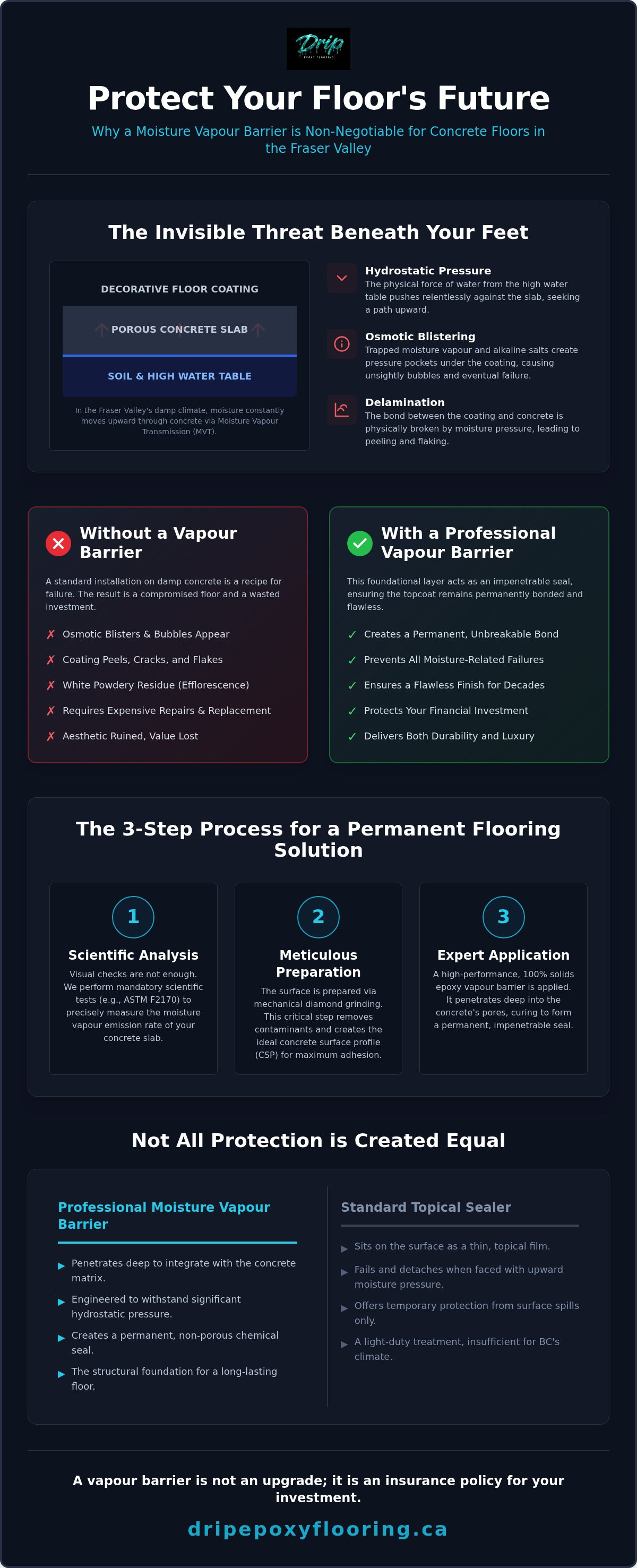
A moisture vapor barrier for concrete is a high-performance epoxy coating engineered specifically to penetrate deep into the capillary structure of a slab. It acts as the critical layer between raw concrete and decorative topcoats to prevent delamination. While it may look similar to a standard primer, its chemical function is fundamentally different. It creates a permanent seal that blocks the upward movement of water vapour, ensuring that the decorative finish remains bonded to the substrate regardless of underground conditions. Standard primers are often insufficient for slabs with high moisture emission rates because they lack the density and chemical resilience required to withstand the pressure of rising moisture. Without this foundational layer, the moisture continues its journey upward, eventually breaking the bond of the decorative coating and ruining the aesthetic result.
The Difference Between a Vapour Barrier and a Sealer
The distinction between a topical sealer and a professional-grade Vapor barrier lies in how they interact with the concrete. Surface sealers generally sit on top of the slab to protect against spills or dust. In contrast, vapour barriers integrate with the concrete matrix itself. Topical sealers often fail when faced with hydrostatic pressure; the moisture pushes from below until the sealer simply detaches from the surface. Professional-grade MVB systems utilize specialized epoxy resins with a high molecular density. These resins are designed to cure effectively even in the presence of moisture, creating a barrier that can withstand significant pounds of pressure per square foot. This industrial-grade protection is the foundation of what we define as industrial luxury, providing both strength and sophisticated style.
Why Vapour Barriers are Essential for Epoxy and Polyaspartic Floors
Installing a moisture vapor barrier for concrete is the only way to safeguard the aesthetic integrity of high-end resinous flooring. Without this protection, floors are susceptible to osmotic blistering. This process occurs when moisture trapped under the coating creates unsightly bubbles that eventually pop and lead to total floor failure. This protection is particularly vital for decorative flake systems and metallic finishes where visual perfection is the primary goal. By managing moisture at the source, these barriers ensure the long-term bond of the system. This meticulous approach protects your investment from the structural failures that often plague lower-quality installations, ensuring a finish that remains flawless for decades. It's the difference between a temporary fix and a permanent flooring solution.
The Science of Moisture Vapour Transmission (MVT) in BC
Concrete appears solid to the naked eye, but at a microscopic level, it functions like a hard sponge. Its porous matrix is filled with tiny capillaries that pull moisture from the soil through a process called capillary action. In the Fraser Valley, this natural phenomenon is intensified by a high water table and frequent heavy precipitation. Moisture Vapour Transmission (MVT) occurs as water travels through the slab in a gaseous state, moving from the high-humidity environment of the soil toward the lower humidity of your interior space. Even if a slab looks bone-dry on the surface, it may be emitting high levels of invisible vapour that can jeopardize any coating system.
Temperature fluctuations in cities like Chilliwack and Langley act as a thermal pump, accelerating the movement of these gases. When the air temperature changes, the pressure within the slab shifts, forcing vapour upward with surprising strength. Industry standards for Concrete moisture testing and mitigation confirm that surface appearance is never a reliable indicator of the internal relative humidity of a slab. Without a professional moisture vapor barrier for concrete, this invisible force remains a constant threat to the structural bond of your floor.
Hydrostatic Pressure and Osmotic Blistering
Hydrostatic pressure is the physical force exerted by liquid water against the bottom of your concrete slab. As this water turns to vapour and migrates upward, it often carries dissolved minerals and alkaline salts. This leads to efflorescence, which is the white powdery residue that crystallizes at the interface between the concrete and the epoxy coating. These salt crystals physically expand and break the bond of the resin, leading to osmotic blistering. You may recognize this failure by the appearance of small bubbles, cloudiness in the finish, or areas where the coating begins to flake and peel away in large sheets.
Local Climate Factors: Fraser Valley and Lower Mainland
Our region faces specific environmental challenges that property owners in drier climates don't have to consider. Sustained rainfall in Abbotsford and Mission leads to extreme soil saturation, which increases the volume of vapour attempting to escape through your garage or shop floor. Seasonal shifts in British Columbia can cause sudden, catastrophic floor failures in unprotected spaces as the ground expands and contracts. Our industrial epoxy flooring Chilliwack services are engineered to account for these specific local variables. If you're planning a project, it's essential to request a professional assessment to determine the moisture levels of your specific site before making an investment.
How to Test Concrete for Moisture Before Coating
Visual inspection is the most frequent point of failure in professional flooring projects. A slab may appear perfectly dry to the naked eye, yet contain significant volumes of water trapped deep within its porous matrix. This hidden moisture is a silent threat that can destroy a high-end finish within months of installation. Consequently, scientific testing is a mandatory component of professional concrete floor preparation services. We don't guess; we measure. Relying on data rather than assumptions is the only way to ensure the substrate is ready for a coating. Professional testing is also the only way to guarantee the warranty of a high-end floor and protect your long-term investment. When measurements exceed the industry threshold of 3 lbs per 1,000 square feet, a moisture vapor barrier for concrete is required to prevent future delamination.
DIY Plastic Sheet Test vs. Professional Meters
The 24-hour plastic tape test is a common baseline for many property owners. This involves sealing a square of clear plastic to the floor and checking for condensation or darkened concrete the next day. While this test indicates the presence of moisture, it is limited because it only identifies surface-level dampness. For a more comprehensive analysis, professionals utilize electronic impedance meters to gather instant surface readings across the entire floor. The most accurate data, however, comes from "in-situ" probes. These probes are inserted into pre-drilled holes in the slab to measure relative humidity (RH) at a depth of 40% of the thickness of the slab. This provides a precise understanding of the moisture levels that will eventually migrate upward under the pressure of the Fraser Valley's high water table.
ASTM F1869: The Calcium Chloride Test
The ASTM F1869 standard, commonly known as the calcium chloride test, remains the industry gold standard for determining the Moisture Vapour Emission Rate (MVER). This test involves placing a specific quantity of anhydrous calcium chloride under a sealed plastic dome for a duration of 60 to 72 hours. The salt absorbs any moisture emitted from the concrete surface during this window. By weighing the salt before and after the test, we calculate the exact pounds of moisture being released per 1,000 square feet. This quantitative data is essential for selecting the correct moisture vapor barrier for concrete. It allows us to determine if a standard system is sufficient or if a high-performance barrier is necessary to withstand extreme hydrostatic pressure. This methodical evaluation ensures that every project meets our rigorous standards for industrial-grade durability and luxury aesthetics.
Installation: Applying a Moisture Vapour Barrier Correctly
The application of a moisture vapor barrier for concrete requires a level of technical precision that goes far beyond standard painting or sealing. It begins with industrial-grade diamond grinding to strip away the weak surface layer of laitance and open the slab's internal capillary structure. This mechanical step is non-negotiable for achieving the deep penetration required for a permanent seal. Once the surface is ready, mixing ratios must be handled with extreme care. Professional-grade epoxies are chemically sensitive; even a 1% error in the resin-to-hardener ratio can lead to an incomplete cure, leaving the floor soft and vulnerable to future failure.
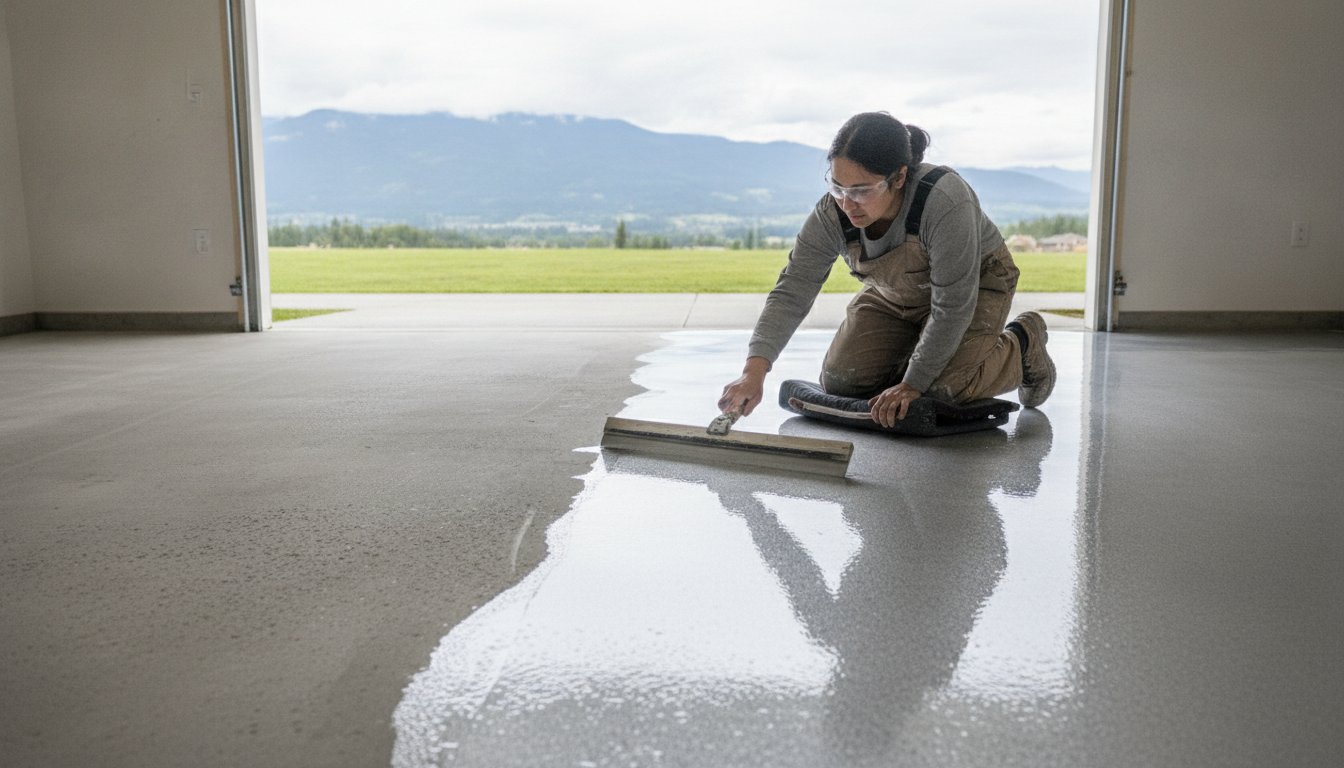
Technicians employ a "pour and squeegee" technique to ensure the material is forced into the concrete's open pores. This method is much more effective than rolling alone, as it uses physical pressure to drive the resin deep into the substrate matrix. This ensures the moisture vapor barrier for concrete becomes an inseparable part of the slab rather than a superficial film that could easily detach. Proper timing for the subsequent layers is equally important. The "tacky" window provides a short but vital period where the base coat can chemically fuse with the barrier. If you want a floor that combines industrial strength with premium aesthetics, request a professional installation quote to ensure your project is built on an expert foundation.
Mechanical Preparation: The Secret to MVB Success
Acid etching is a common shortcut, but it's fundamentally insufficient for moisture-prone slabs in the Fraser Valley. It lacks the power to create the necessary Concrete Surface Profile (CSP) of 2 or 3 required for industrial-grade adhesion. Diamond grinding is the only reliable method that provides a consistent, porous surface ready for chemical integration. Addressing structural vulnerabilities through concrete crack repair is also essential. If cracks aren't properly treated before the barrier is applied, they can act as chimneys for moisture, bypassing the seal and causing localized delamination in your decorative finish. This meticulous attention to detail prevents the failures commonly seen in DIY projects.
Application Windows and Re-coat Times
Curing times are heavily influenced by the specific temperature and humidity levels found in Abbotsford and Chilliwack. Generally, there's an 8 to 12 hour window for applying epoxy base coats over the moisture barrier to achieve a primary chemical bond. If this window is missed, the barrier will cure to a glass-like hardness that rejects new layers. In such cases, mechanical scuffing becomes mandatory to create a "profile" for the next coat to grip. Our methodical approach accounts for these local environmental variables, ensuring each layer of your floor is perfectly fused. This precision allows our systems to last for decades without the bubbling or peeling seen in amateur applications.
Is a Vapour Barrier Worth the Investment?
The financial logic of installing a moisture vapor barrier for concrete is straightforward when you consider the alternative. You must weigh the initial cost of the barrier against the catastrophic expense of remediating a failed floor. If a coating delaminates due to moisture, the entire system must be mechanically ground off, the slab must be re-prepared, and a new floor must be installed from scratch. This remediation process often costs significantly more than the original installation. For property owners in the Fraser Valley, where dampness is a constant environmental factor, the barrier provides essential peace of mind. It transforms a high-end aesthetic choice into a long-term structural asset that won't fail when the water table rises.
Commercial and industrial facilities never view this step as an optional upgrade. These organizations prioritize risk mitigation because they understand that moisture is the leading cause of resinous floor failure. A professional-grade barrier significantly extends the lifespan of high-end finishes, such as metallic epoxy flooring. These decorative systems rely on an unbreakable bond to maintain their depth and clarity over time. By neutralizing the threat of rising vapour, you ensure your space retains its industrial luxury appeal for decades rather than just a few seasons. It's the only way to guarantee that your investment remains as resilient as it is refined.
When You Can Safely Skip the Barrier
There are limited scenarios where a barrier might be considered unnecessary. Upper-floor condo units or second-storey commercial spaces don't face the same hydrostatic pressure as ground-level slabs. Additionally, some modern slabs are built with a verified, intact sub-slab polyethene barrier. However, these are exceptionally rare in older BC homes, where such barriers are often punctured during construction or were entirely absent from the original pour. In the Fraser Valley's unpredictable climate, "better safe than sorry" isn't just a cliché; it's a technical requirement for success. We always recommend scientific testing to confirm the slab's condition before making a final decision.
The Drip Epoxy Flooring Advantage: Meticulous Protection
Our commitment to technical excellence means we don't take shortcuts with your substrate. Drip Epoxy Flooring treats every residential garage floor as a high-stakes industrial project, applying the same rigorous standards of preparation and material selection. We believe that a floor is only as good as the science beneath it. By choosing a specialist who understands the unique challenges of the Lower Mainland, you're investing in precision and durability. Contact us for a free moisture assessment and quote to ensure your next project is built on a foundation of quality and professional-grade protection.
Securing the Future of Your High-End Floor
Securing the foundation of your space requires more than just a decorative finish; it demands a scientific approach to moisture management. You've learned that invisible vapour transmission is a constant threat in our damp climate, making professional testing and mechanical preparation non-negotiable for long-term success. By opting for a high-performance moisture vapor barrier for concrete, you're investing in an industrial-grade system that prevents the delamination and bubbling that often plague lower-quality installations. This critical layer ensures your floor remains a permanent asset rather than a temporary fix.
As local experts in the Fraser Valley, we prioritize meticulous diamond-grinding preparation to ensure every project meets our rigorous standards for industrial luxury. This methodical process ensures that your investment remains a source of pride for decades to come. Don't leave the longevity of your space to chance or DIY guesswork. We invite you to Request a Free Moisture Assessment and Epoxy Quote today to begin your transformation with confidence. Your vision deserves a foundation that is as resilient and sophisticated as the finish itself.
Frequently Asked Questions
Can I apply a moisture vapour barrier over painted concrete?
No, you cannot apply a moisture vapour barrier over painted concrete. These specialized coatings require direct access to the concrete’s capillary structure to function effectively. Any existing paint, sealer, or adhesive acts as a bond breaker, preventing the resin from penetrating the slab. In Chilliwack and Abbotsford, our team utilizes professional diamond grinding to remove all surface contaminants. This ensures the moisture vapor barrier for concrete integrates perfectly with the substrate for a permanent, industrial-grade bond.
How long does a concrete moisture barrier take to dry?
Most professional-grade moisture barriers reach a re-coat window within 8 to 12 hours. However, the exact drying time depends on the ambient temperature and humidity levels in the Fraser Valley. While the surface may feel dry to the touch sooner, the chemical curing process must reach a specific stage before we apply decorative base coats. We carefully monitor these environmental conditions to ensure the system achieves maximum density and chemical resilience before proceeding to the next layer.
Will a vapour barrier fix a basement that already has standing water?
A vapour barrier is not a solution for standing water or active leaks. These systems are designed to manage the migration of moisture in a gaseous state through the slab's pores. If your basement in Mission or Langley experiences liquid water ingress, you likely have a drainage or foundational issue that requires structural repair. Once the source of the liquid water is resolved, an MVB can then be used to protect your new floor from residual vapour transmission.
What is the difference between a vapour barrier and a damp-proof membrane?
The primary difference lies in the state of water they manage. A damp-proof membrane is typically a physical sheet or coating designed to stop liquid water from entering a structure. In contrast, a moisture vapor barrier for concrete is a chemical coating that blocks water in its gaseous form. While membranes are essential for foundational protection, our specialized epoxy barriers are required to protect resinous finishes from the internal relative humidity that naturally exists within the concrete slab.
Do new concrete slabs need a moisture barrier before epoxy?
Yes, new concrete slabs almost always require a moisture barrier if you plan to install epoxy shortly after the pour. Fresh concrete contains a significant volume of "construction water" that takes months to evaporate naturally. Even after the standard 28-day cure period, the moisture levels are often high enough to cause delamination. Professional testing is essential for new builds in Surrey and Coquitlam to determine if a barrier is necessary to protect the decorative finish.
Can I use a moisture vapour barrier as my final clear coat?
No, a moisture vapour barrier is not designed to serve as a final clear coat. These coatings are formulated for maximum adhesion and vapour suppression, often resulting in a finish that lacks UV stability and scratch resistance. Using them as a topcoat would lead to ambering and premature wear. Instead, they act as the foundational primer for high-performance systems like metallic or flake finishes, which are then protected by specialized, wear-resistant topcoats for a lasting luxury result.
Does a moisture barrier help with basement odours and musty smells?
Yes, a moisture barrier significantly reduces musty basement odours. These smells are typically caused by mold and mildew that thrive in the damp environment created by constant vapour transmission. By sealing the concrete pores and blocking the upward movement of moisture, you eliminate the damp conditions these organisms require to grow. This is especially beneficial for older homes in Chilliwack and Hope, where porous slabs often contribute to a persistent, damp scent in lower-level living spaces.
How much does a professional moisture vapour barrier installation add to the project time?
A professional moisture barrier installation typically adds approximately 24 hours to the total project timeline. This includes the time required for the specialized application and the necessary curing window before the next decorative layer can be applied. While this adds one extra day to the process, it is a vital investment in the floor's longevity. This methodical approach ensures that your space in the Lower Mainland is protected from the long-term risks of bubbling and peeling.