chemical resistant warehouse flooring Burnaby · 14 min read ·
Chemical Resistant Warehouse Flooring in Burnaby: 2026 Industrial Guide
Most industrial floor failures in British Columbia don't actually stem from heavy traffic; they're the result of invisible moisture vapour transmission and inadequate surface preparation. A warehouse floor in the Fraser
By Drip Epoxy Flooring · Chilliwack, BC
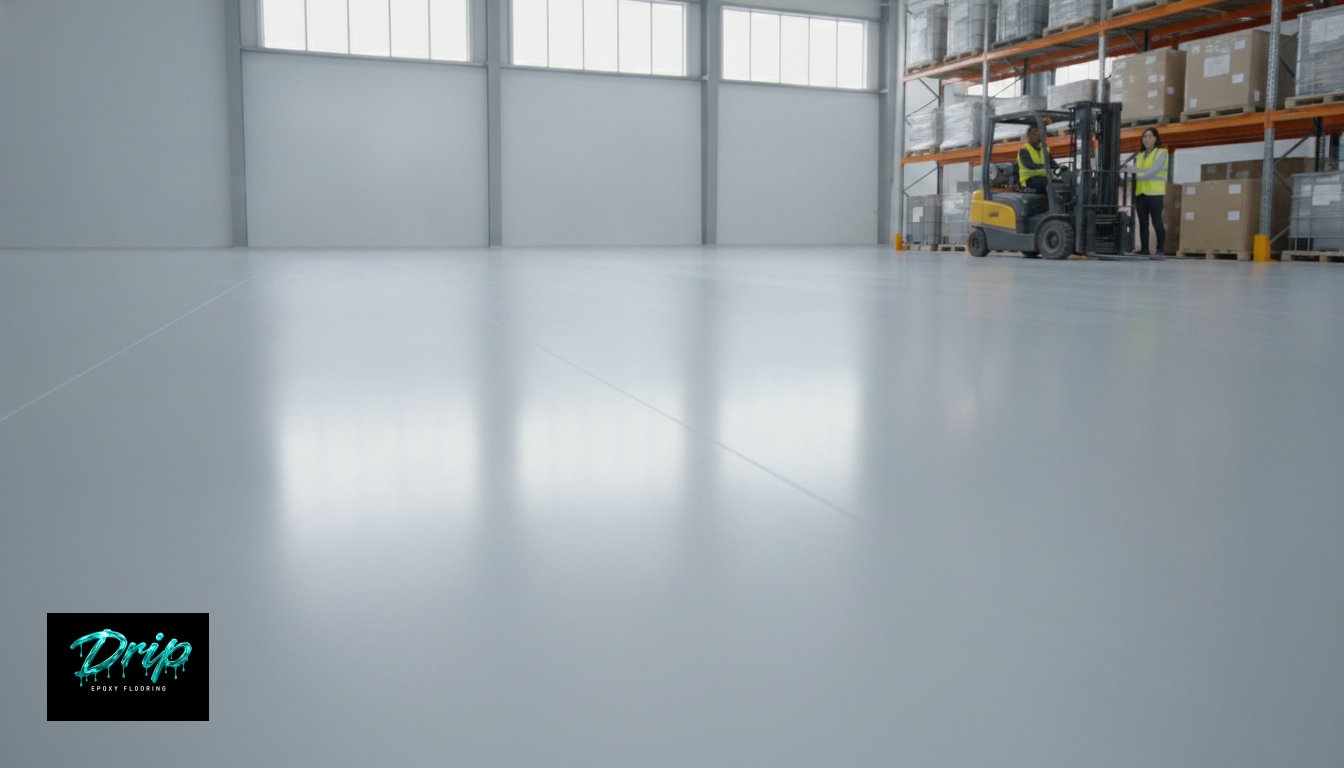
Most industrial floor failures in British Columbia don't actually stem from heavy traffic; they're the result of invisible moisture vapour transmission and inadequate surface preparation. A warehouse floor in the Fraser Valley is more than just a surface. It's a critical component of your facility's infrastructure that must withstand both chemical exposure and relentless coastal humidity. You likely recognize the frustration of seeing concrete dusting compromise your inventory or watching a coating delaminate because the slab could not breathe. Choosing the right chemical resistant warehouse flooring Burnaby industrial zones require means balancing technical performance with a fast return to service.
This 2026 guide provides the technical roadmap to mastering these requirements, ensuring your facility meets WorkSafeBC safety standards while resisting oils and solvents for years to come. We'll detail the precision of mechanical diamond grinding, the importance of specialized moisture barriers, and the specific resinous systems that deliver a seamless, easy to clean finish. By prioritizing professional standards and meticulous application, you can transform a vulnerable concrete slab into a high performance asset that supports your supply chain without the risk of operational lag.
Key Takeaways
- Learn why mechanical diamond grinding and specialized moisture vapour barriers are essential for preventing floor delamination in the Fraser Valley’s damp climate.
- Compare the performance of 100% solids epoxy and rapid-curing polyaspartic systems to select the most durable chemical resistant warehouse flooring Burnaby facilities require for long-term resilience.
- Understand how professional-grade industrial floor coatings eliminate concrete dusting, protecting sensitive electronics and food inventory from airborne particulate contamination.
- Discover how to integrate quartz or flake systems to achieve WorkSafeBC slip-resistance compliance while maintaining a high-end "industrial luxury" aesthetic for your workspace.
- Identify technical strategies for a fast return-to-service that minimizes operational downtime and maintains the integrity of your Burnaby supply chain.
Table of Contents
- The Heavy Demands of Warehouse Flooring in Burnaby
- Epoxy vs. Polyaspartic: Selecting the Right Resin for High-Traffic Zones
- Customizing for Chemical Resistance, Safety, and Aesthetics
- The Foundation of Durability: Mechanical Preparation and Moisture Barriers
- Partnering with Drip Epoxy for Your Burnaby Facility
The Heavy Demands of Warehouse Flooring in Burnaby
Burnaby's industrial landscape is uniquely demanding, characterized by high volume logistics hubs and precision manufacturing centres that operate around the clock. In these environments, bare concrete is under constant assault from the abrasive forces of heavy forklifts and pallet jacks. This friction eventually triggers the "concrete dusting" phenomenon, where the top layer of the slab disintegrates into a fine alkaline powder. For Burnaby facilities managing sensitive electronics or food grade inventory, this dust represents a significant contamination risk that can compromise product integrity and lead to costly equipment failures.
Chemical exposure adds another layer of complexity to floor maintenance. Local machine shops and distribution centres frequently deal with hydraulic fluids, coolants, and aggressive industrial cleaners. If these substances reach untreated concrete, they penetrate the porous surface, leading to deep seated staining and eventual structural weakening. Installing chemical resistant warehouse flooring Burnaby businesses can trust is a strategic necessity to prevent these liquids from migrating into the slab. High performance Epoxy resins and specialized coatings create an impermeable barrier that keeps contaminants on the surface for easy remediation.
Mechanical Stress and Point Loading
Warehouse floors must withstand extreme point loading, where the immense weight of a fully loaded forklift is concentrated onto a few square centimetres of the floor. Compressive strength is the most critical metric for any industrial system. Without it, the coating will crack under the pressure of heavy machinery. Industrial grade industrial floor coatings are engineered to prevent "hot tire pickup," a common failure where heated tires from delivery trucks bond to and pull up inferior floor paint. Selecting a system with superior abrasion resistance ratings ensures the surface remains intact during 24/7 logistics operations.
Environmental Factors in the Lower Mainland
Burnaby's proximity to the coast and the Fraser Valley's high humidity levels create specific challenges for floor adhesion. Concrete is naturally porous and acts like a sponge, holding moisture that can fluctuate with the weather. If a coating is applied without addressing moisture vapour transmission, the resulting pressure will cause the finish to bubble and delaminate. Temperature fluctuations also require the flooring system to have enough flexibility to expand and contract with the building. A seamless finish is essential here, as it eliminates the joints where moisture and bacteria tend to accumulate, ensuring better air quality and a more hygienic workspace.
Epoxy vs. Polyaspartic: Selecting the Right Resin for High-Traffic Zones
Choosing the ideal chemical resistant warehouse flooring Burnaby facility managers require involves a technical comparison between epoxy and polyaspartic resins. While both systems provide high performance, their chemical structures dictate how they react to specific environmental stressors. According to OSHA chemical hygiene recommendations, flooring in areas exposed to hazardous substances must be impermeable and slip-resistant. Your selection depends on your facility's unique operational needs, such as the types of chemicals used and the acceptable window for installation downtime.
100% Solids Epoxy: The Reliable Workhorse
For many large scale industrial applications, Solid Colour Epoxy Flooring remains the industry standard due to its exceptional durability and cost effectiveness. This specific system is a "high-build" resin. It's applied in thick layers that can effectively level pitted or aging warehouse concrete that has suffered from years of neglect. The mil thickness of the coating is directly proportional to its long term resilience; a thicker application provides a more robust barrier against heavy pallet jack abrasion and high pressure mechanical impacts. Epoxy is ideal for indoor zones where a dense, seamless surface is needed to resist oils and common industrial solvents.
Polyaspartic Technology: Performance at Speed
If operational downtime is your primary concern, Polyaspartic Flooring offers a distinct advantage with its rapid 24-hour return-to-service. Unlike traditional resins that may require several days to fully cure, polyaspartic systems allow Burnaby businesses to resume forklift traffic almost immediately after the final coat is applied. This technology is also inherently UV stable. In loading dock areas where sunlight frequently hits the floor, epoxy may eventually yellow or chalk, whereas polyaspartic maintains its clarity and colour. It also provides superior flexibility, which allows the coating to absorb impacts from dropped tools or heavy crates without cracking.
Both systems offer robust resistance profiles, though they excel in different scenarios. Epoxy is often preferred for its resistance to certain strong acids, while polyaspartic excels against petroleum based products and staining agents. Selecting the right chemistry ensures your floor survives the rigours of 2026 industrial demands. If you're ready to evaluate your facility's specific requirements, you can request a technical assessment to find the optimal resin for your workspace.
Customizing for Chemical Resistance, Safety, and Aesthetics
Safety in a modern warehouse environment is a multi-faceted engineering challenge. It's about more than just signage. In Burnaby, where logistics and manufacturing are primary economic drivers, compliance with WorkSafeBC slip-resistance standards is a non-negotiable requirement for facility managers. Beyond local mandates, adhering to the principles found in OSHA Regulation 1910.22 ensures that walking-working surfaces remain free of corrosion and hazardous spills. The chemical resistant warehouse flooring Burnaby professionals install utilizes high-traction aggregates to maintain safety even when the surface is exposed to oils or moisture.
Quartz and Flake Systems for Extreme Resilience
Quartz Flooring is the premier choice for facilities dealing with heavy chemical loads or frequent wash-downs. These systems use a double-broadcast of coloured quartz sand to create a dense, slip-resistant matrix that is virtually indestructible. For areas requiring a professional look alongside ruggedness, multi-layered flake systems offer a decorative finish that successfully hides minor surface imperfections. These systems provide a consistent, easy to clean texture that stands up to the constant movement of pallet jacks and heavy machinery.
Industrial Luxury and Branding
The rise of "Industrial Luxury" in Burnaby has transformed how showrooms and boutique manufacturing spaces are designed. It's no longer enough for a floor to be tough; it must also reflect the brand's identity. Metallic Flooring provides a high-end, three-dimensional aesthetic that is particularly popular in automotive workshops and tech-focused warehouses. We can realize custom colour matching to align your facility's aesthetics with your corporate branding, creating a cohesive and impressive environment for both employees and visiting clients.
Functional customization also includes the integration of safety yellow line striping and hazard zone markings directly into the resinous coating. Unlike surface-applied paint that peels or wears away under forklift traffic, these resin-based markings are permanent and easy to sanitize. Additionally, the high gloss finish of modern industrial coatings significantly improves light reflectivity. By bouncing light off the floor, large warehouses can reduce their reliance on overhead fixtures, which often leads to measurable savings on annual energy costs while improving overall visibility for workers.
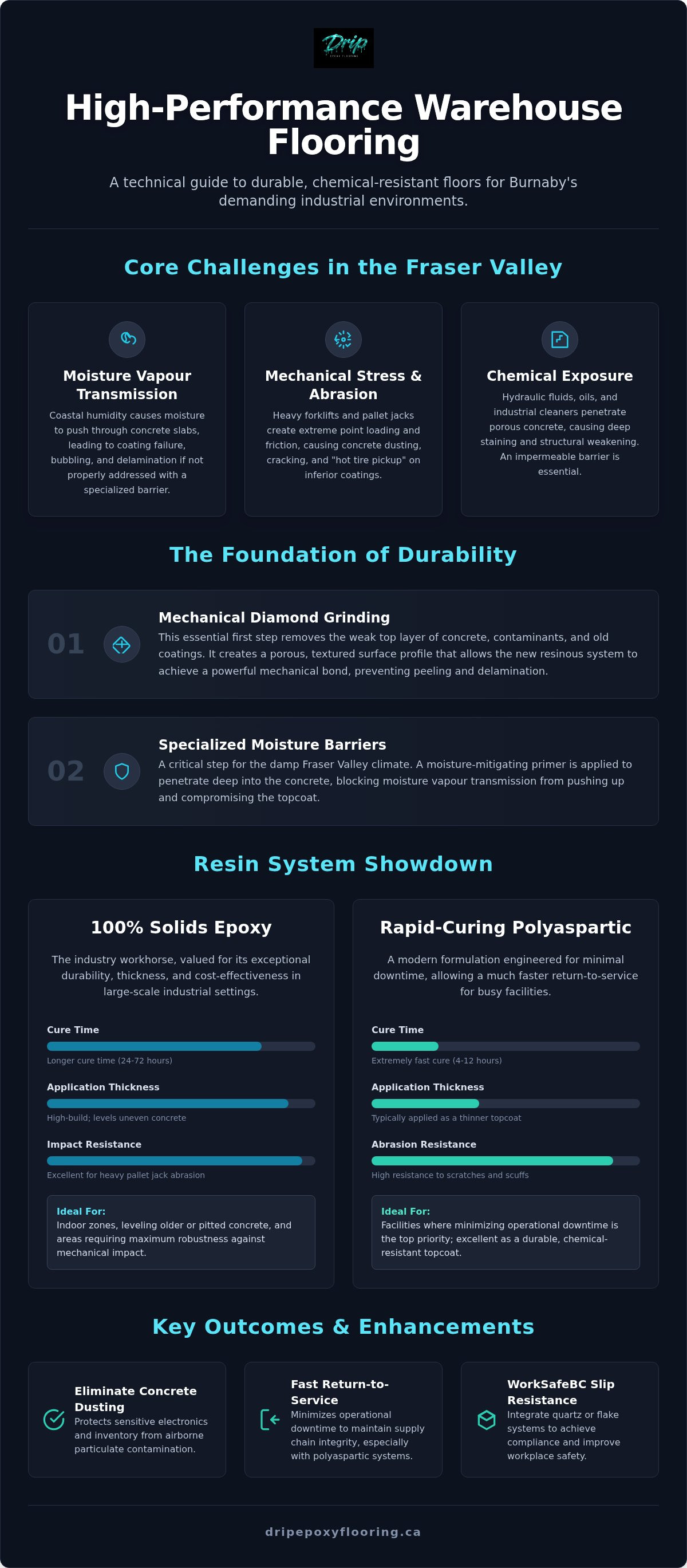
The Foundation of Durability: Mechanical Preparation and Moisture Barriers
The technical success of chemical resistant warehouse flooring Burnaby projects depends entirely on the quality of the bond between the resin and the concrete slab. Even the most advanced polyaspartic or epoxy system will fail if it's applied to a surface that hasn't been properly engineered to receive it. In the Lower Mainland, where older warehouse slabs often carry decades of oil saturation and deep seated contaminants, preparation is the most labour intensive and critical phase of the installation. We prioritize mechanical precision to ensure the finished floor remains an asset rather than a liability.
Diamond Grinding vs. Acid Etching
While retail level kits often suggest acid etching, this chemical approach is insufficient for industrial environments. Acid etching only cleans the very top layer of concrete and often leaves behind moisture and neutralized salts that interfere with adhesion. Professional diamond grinding is the only reliable method for achieving the correct Concrete Surface Profile (CSP). By mechanically removing the "laitance" (the weak, milky top layer of concrete), grinding opens the pores of the slab, allowing the resin to penetrate deep into the substrate for a permanent mechanical bond. You can learn more about this process in our guide to Professional Concrete Floor Preparation Services.
Moisture Vapour Remediation in BC
Burnaby's geography, particularly in areas near the Fraser River or low lying industrial zones, presents a significant risk for hydrostatic pressure. This phenomenon occurs when moisture vapour travels upward through the concrete slab, eventually building enough pressure to blow the coating off the surface. Signs of moisture drive include white powdery deposits (efflorescence) or small blisters in existing paint. For any 2026 industrial project, testing for moisture vapour transmission is a non-negotiable step. We utilize specialized moisture vapour barrier primers that are chemically engineered to withstand high levels of moisture drive, ensuring long term success in Burnaby's high water table industrial areas.
Beyond moisture, a truly seamless surface requires the meticulous repair of spalls, cracks, and failing expansion joints. These defects are filled with high modulus epoxy fillers that mirror the slab's strength, preventing the coating from telegraphing imperfections. Throughout the application, we also monitor ambient humidity and slab temperature. If the dew point is too close to the surface temperature, moisture can condense on the slab and ruin the bond. This level of technical oversight is what separates a professional industrial installation from a temporary fix. To ensure your facility is ready for a high performance upgrade, you can request a technical moisture assessment and quote from our local team.
Partnering with Drip Epoxy for Your Burnaby Facility
Selecting a contractor for your facility's infrastructure is a decision that impacts your operational efficiency for years. At Drip Epoxy Flooring, we position ourselves as more than just a service provider; we are specialised craftsmen who understand the specific technical demands of chemical resistant warehouse flooring Burnaby industrial sectors require. Unlike general contractors who may offer flooring as a secondary service, our focus is exclusively on high performance resinous systems. We reject the use of retail level kits, which often lack the solids content and chemical cross linking necessary to survive the rigours of a 2026 warehouse environment. Instead, we utilise industrial grade materials engineered for maximum longevity and resilience.
Serving Burnaby and the Lower Mainland
Our deep roots in the region allow us to provide a level of personalised support that national franchises simply cannot match. While our primary focus is on the Burnaby industrial zones, our local service areas extend across the Lower Mainland, including Surrey, Langley, Abbotsford, and Coquitlam. This local presence ensures that we understand the specific environmental challenges of the Fraser Valley, from high humidity to fluctuating water tables. By choosing a locally owned expert for your Industrial Epoxy Flooring, you benefit from a partner who is readily available for site visits, technical consultations, and long term maintenance support.
We realise that downtime is the enemy of productivity. Our methodical approach to project management is designed to minimise disruptions to your supply chain. We coordinate every phase of the installation, from the initial diamond grinding to the final topcoat application, with surgical precision. This ensures a fast return to service, allowing your facility to resume operations without unnecessary lag. Our goal is to deliver a surface that looks as good as it performs, bridging the gap between rugged industrial utility and high end aesthetic appeal.
Request Your Free Industrial Consultation
The journey toward a more resilient facility begins with a comprehensive technical assessment. We don't believe in one-size-fits-all solutions. Our quote process involves on site moisture testing and a thorough evaluation of your slab's current condition. Based on these data points, we design a customised flooring strategy that addresses your specific chemical stressors and traffic patterns. We invite facility managers to browse our Epoxy Floor Samples to see the various textures and finishes available for their space. When you are ready to secure your facility's future, you can Request a Free Quote for Your Warehouse Flooring Project to begin your transformation.
Engineering Resilience for Your Burnaby Infrastructure
Investing in a professional floor system is a commitment to your facility's long term operational health. The technical success of your project hinges on meticulous mechanical preparation and a deep understanding of local environmental stressors. By prioritizing professional diamond grinding and moisture vapour remediation, you eliminate the risks of delamination and concrete dusting that plague untreated slabs. Whether you require the rapid return to service of a polyaspartic system or the high build durability of 100% solids epoxy, the right chemical resistant warehouse flooring Burnaby professionals install will transform your workspace into a high performance asset.
Drip Epoxy remains dedicated to providing industrial grade polyaspartic and epoxy systems that meet the rigorous standards of today's supply chains. We're proud to serve Burnaby, Surrey, and the entire Fraser Valley with a focus on technical precision and quality. When you're ready to upgrade your facility, Request a Free Quote for Your Warehouse Flooring Project to begin your consultation. We look forward to helping you realize a cleaner, safer, and more durable industrial environment that supports your business for years to come.
Frequently Asked Questions
How long does a professional warehouse floor coating last in a high-traffic Burnaby facility?
A professionally installed system typically lasts 10 to 15 years in high-traffic environments. Longevity depends on the initial mil thickness and the consistency of your maintenance schedule. Every project includes mechanical diamond grinding to ensure a permanent bond. By preventing concrete dusting and providing a sacrificial wear layer, these systems protect your structural slab from the abrasive forces of 24/7 logistics operations.
What is the best chemical resistant flooring for a warehouse with heavy forklift use?
For facilities with heavy forklift traffic, 100% solids epoxy or quartz flooring systems provide the necessary compressive strength. These materials are designed to withstand extreme point loading without cracking or peeling. Quartz systems are particularly effective as the premier chemical resistant warehouse flooring Burnaby businesses choose for high-impact zones. The integrated aggregate increases both the slip resistance and the overall thickness of the protective barrier.
How much downtime should our facility expect during the installation process?
Most installations require a window of two to four days. If your Burnaby facility requires a rapid return to service, polyaspartic coatings allow for heavy traffic in as little as 24 hours. Traditional epoxy systems generally need 48 to 72 hours to achieve a full chemical cure. We realize that minimizing downtime is vital, so we organize our application phases to align with your production schedule.
Can industrial epoxy be applied over old, oil-stained concrete in a Burnaby shop?
Industrial coatings can be applied to older slabs after meticulous surface preparation. We use professional diamond grinding to remove the top layer of contaminated concrete, exposing clean, porous pores. For deep-seated stains, we utilize specialized oil-tolerant primers that create a chemical bond despite previous saturation. This process ensures the new coating won't delaminate even in demanding machine shops or automotive repair centres across the Lower Mainland.
Is a moisture vapour barrier necessary for warehouse floors in the Fraser Valley?
A moisture vapour barrier is nearly always necessary for warehouse floors in the Fraser Valley. Burnaby’s geography and high water table create significant hydrostatic pressure that pushes moisture through the concrete. Without a dedicated barrier primer, this vapour drive causes coatings to blister and fail. We include moisture testing in our consultation to ensure your floor remains stable and resilient against the region's damp climate.
What is the difference between industrial-grade epoxy and a DIY warehouse kit?
Industrial-grade resins are 100% solids, providing a thick, durable film that DIY kits cannot match. Retail products are often water-based and thin, lacking the chemical cross-linking required to survive forklift traffic or harsh solvents. Professional systems also include mechanical preparation, which is the only way to achieve a permanent bond. We prioritize high-performance materials that offer long-term value over budget-driven, temporary fixes found in home improvement stores.
How do we maintain and clean a new industrial polyaspartic floor coating?
Maintaining your new floor is simple thanks to the seamless, non-porous surface. We recommend using a soft-bristle broom or a microfibre mop with a pH-neutral cleaning solution. For larger Burnaby warehouses, mechanical scrubbers with soft pads are highly effective. Regular cleaning prevents the buildup of abrasive grit that can dull the glossy finish. This methodical care ensures your floor retains its high-end aesthetic and professional standards for years.
Are these coatings resistant to harsh industrial solvents and battery acids?
Our chemical resistant warehouse flooring Burnaby systems are specifically formulated to withstand exposure to harsh industrial solvents and battery acids. During the design phase, we evaluate the specific chemicals used in your facility to select the optimal resinous topcoat. This customization ensures the surface won't soften or stain when exposed to aggressive fluids. The result is a secure environment that remains easy to clean and fully compliant with safety regulations.