chemical resistant industrial floors · 14 min read ·
Chemical Resistant Industrial Floors: The 2026 Reference Guide
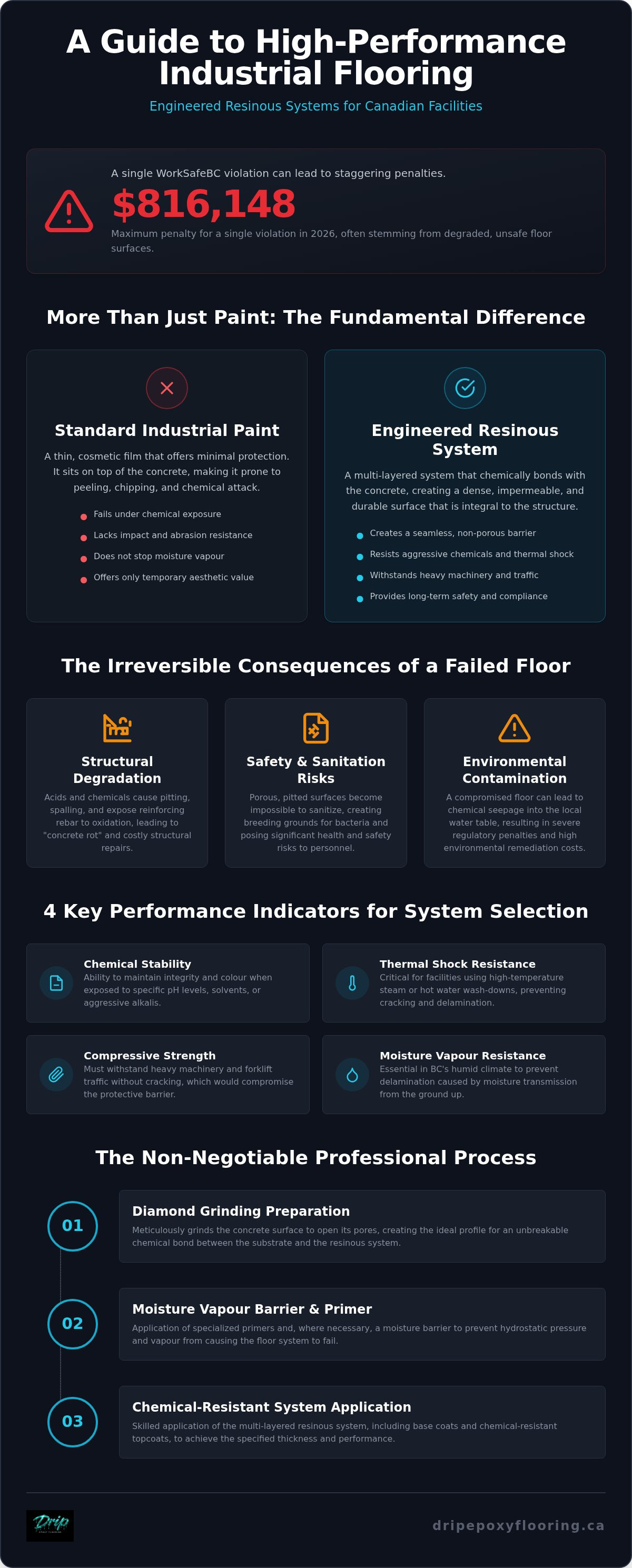
A single WorkSafeBC violation in 2026 can result in a penalty as high as $816,148, a staggering figure that often stems from neglected infrastructure like degraded, unsafe walking surfaces. You likely realize that your f
By Drip Epoxy Flooring · Chilliwack, BC
A single WorkSafeBC violation in 2026 can result in a penalty as high as $816,148, a staggering figure that often stems from neglected infrastructure like degraded, unsafe walking surfaces. You likely realize that your facility floor is far more than a simple foundation; it's a critical asset that must uphold your operational safety and environmental compliance under extreme stress. It's frustrating to watch a significant investment succumb to premature failure because of chemical pitting or moisture vapour issues that weren't properly addressed during the specification phase.
This guide allows you to master the technical requirements and material science behind high-performance chemical resistant industrial floors specifically engineered for the unique demands of the Canadian landscape. We'll explore the sophisticated resinous systems, the necessity of professional diamond grinding preparation, and the latest 2026 BC Building Code updates. By understanding these variables, you can ensure your facility maintains a durable, low-maintenance surface that protects both your personnel and your bottom line from the costs of unexpected downtime.
Key Takeaways
- Distinguish between basic industrial coatings and engineered resinous systems that create a truly impermeable barrier against corrosive substances.
- Identify the optimal chemical resistant industrial floors for your facility by analyzing specific pH levels, chemical concentrations, and the expected duration of exposure.
- Evaluate the performance differences between traditional epoxy systems and rapid-curing polyaspartic coatings to balance durability with operational uptime.
- Recognize why professional diamond grinding and moisture vapour barriers are non-negotiable steps for securing a high-performance bond in British Columbia’s humid climate.
- Apply a structured framework to ensure your facility flooring meets strict Canadian safety standards while reducing long-term maintenance labour.
Table of Contents
Defining Chemical Resistant Industrial Floors: More Than Just Paint
Many facility managers mistakenly equate high-performance floor coatings with standard industrial paint. While paint offers a thin, cosmetic film, chemical resistant industrial floors are engineered, multi-layered resinous systems designed to chemically bond with the concrete substrate. These systems create a dense, non-porous matrix that acts as an impermeable shield. This level of protection is essential because concrete is naturally porous. Without a robust barrier, corrosive liquids migrate through the slab, leading to structural instability and "concrete rot" that's incredibly expensive to remediate.
High-performance Seamless polymer flooring solutions differ from retail-grade products through their chemical composition and application thickness. A standard thin-film epoxy often fails when exposed to aggressive solvents or concentrated acids because it lacks the cross-linking density required to resist molecular penetration. In contrast, professional industrial epoxy flooring involves meticulous diamond grinding to open the concrete's pores, followed by specialized primers and chemical-resistant topcoats. This process ensures the floor doesn't just sit on top of the concrete but becomes an integral part of the building's infrastructure. It's a transformation that delivers "industrial luxury," where a facility projects an image of precision while maintaining extreme durability.
The Consequences of Concrete Corrosion
When chemicals penetrate a concrete slab, the damage is often irreversible. Acids react with the alkaline components of the concrete, causing pitting, spalling, and eventually exposing the reinforcing rebar to oxidation. Beyond structural concerns, degraded floors create significant safety risks. Pitted surfaces become breeding grounds for bacteria and are nearly impossible to sanitize effectively. In the Fraser Valley, where environmental stewardship is paramount, a compromised floor can lead to chemical seepage into the local water table. This doesn't just damage the environment; it leads to severe regulatory penalties and high costs for environmental remediation.
Primary Performance Indicators
Selecting the right system requires looking beyond simple aesthetics. True chemical resilience is measured by several key indicators that define how the floor will perform under daily operational stress:
- Chemical Stability: The material's ability to maintain its integrity and colour when in contact with specific pH levels or aggressive alkalis.
- Thermal Shock Resistance: This is critical for BC food processing plants that use high-temperature steam cleaning or hot water wash-downs.
- Compressive Strength: The floor must withstand heavy machinery and forklift traffic without cracking, which would allow chemicals to reach the substrate.
- Moisture Vapour Resistance: Addressing the transmission of moisture from the ground is vital for preventing the coating from delaminating in humid environments.
Focusing on these performance markers ensures that your investment provides long-term value rather than a temporary fix. It's about creating a workspace that is both resilient and safe.
The Chemistry of Resilience: Comparing Material Systems
Selecting the appropriate resinous system is a precise exercise in material science. Not all chemical resistant industrial floors are created equal; the molecular structure of the binder determines how the surface reacts to specific corrosive agents. While aesthetic appeal is a secondary benefit, the primary objective is to create a stable, non-reactive surface. High-performance polymers must withstand the specific pH levels of your facility's waste streams without degrading or losing their bond to the substrate. Precision matters here.
Epoxy: Versatility and Bond Strength
For many manufacturing plants in Langley and Surrey, 100% solids epoxy serves as the essential workhorse. This system provides exceptional bond strength and resistance to a wide array of alkalis and mild inorganic acids. Unlike solvent-based alternatives, 100% solids epoxy contains no volatile organic compounds that evaporate during the curing process. This results in a much denser, thicker film that resists mechanical wear. However, standard epoxies have specific vulnerabilities. They can soften when exposed to high-concentration organic acids or extreme temperatures, which is why identifying your specific chemical profile is the first step toward a successful installation.
Polyaspartic and Urethane: High-Performance Alternatives
When operational downtime must be minimized, polyaspartic coatings offer a compelling alternative. These systems cure significantly faster than traditional epoxy, often allowing BC businesses to resume full production in less than 24 hours. Speed matters for production. Beyond rapid return-to-service, polyaspartics provide superior UV stability and resistance to "hot tire pickup," making them a preferred choice for automotive and aerospace facilities. For environments where safety is as critical as durability, these systems are often engineered to meet National Floor Safety Institute standards for slip resistance. Maintaining a Coefficient of Friction rating of R10 to R12 is the industry benchmark for safety in areas prone to moisture and grease.
For the most demanding environments, urethane concrete and quartz-reinforced systems provide a secondary layer of mechanical defense. Urethane concrete is the gold standard for facilities facing thermal shock, such as those utilizing steam cleaning or frequent hot-water wash-downs. By incorporating high-purity quartz, installers can increase the system's impact resistance and abrasion tolerance, creating a surface that withstands the heavy labour of industrial production. If you are uncertain which chemical profile matches your facility's daily exposure, requesting a technical assessment can help prevent a costly material mismatch.
Critical Applications for BC Industrial Sectors
The industrial landscape across British Columbia is undergoing a significant transformation, with modern facilities moving away from purely functional spaces toward environments that embody "industrial luxury." This shift is particularly evident in sectors like cannabis cultivation and craft brewing, where the facility's appearance must reflect the premium nature of the product. Achieving this balance requires chemical resistant industrial floors that provide laboratory-grade performance without sacrificing the sophisticated aesthetic that investors and regulators expect to see in a world-class operation.
The Craft Brewery and Distillery Standard
Brewing and distilling environments are uniquely punishing on floor substrates. These facilities face constant exposure to organic acids from product spills and aggressive caustic cleaners used during intensive "clean-in-place" (CIP) cycles. For businesses seeking Industrial Epoxy Flooring in Chilliwack, the specified system must offer a seamless, antimicrobial finish that complies with strict CFIA standards. Slip resistance is a non-negotiable requirement in these wet processing centres. By utilizing specialized aggregates, installers create a surface that remains safe even when yeast, hop residues, or water are present, ensuring operational safety during high-pressure production shifts.
Agriculture and Chemical Storage
In the agricultural hubs of Abbotsford and the wider Fraser Valley, floors must withstand prolonged contact with corrosive fertilizers, pesticides, and concentrated nutrients. These substances are highly reactive and can quickly compromise the structural integrity of untreated concrete. High-performance resinous systems act as a critical secondary containment layer for hazardous materials, preventing environmental contamination. This protection is vital for maintaining compliance with BC environmental regulations and protecting the local water table from chemical seepage. The resulting surface is not only durable but also remarkably easy to decontaminate, reducing the long-term labour required for facility maintenance.
Beyond agriculture, the automotive and aviation sectors require resilience against specialized fluids such as Skydrol and hydraulic oils. These chemicals are notorious for stripping standard industrial paints and causing delamination. A meticulously engineered floor ensures that hangars and service bays remain pristine under heavy impact and constant fluid exposure. Similarly, pharmaceutical labs depend on high-purity, non-porous surfaces to maintain sterile environments. In these settings, the floor serves as the foundation for precision work, where even the slightest microbial growth or chemical reaction could compromise sensitive research or production batches.
A Framework for Selecting the Right Flooring System
Specifying chemical resistant industrial floors requires a methodical analysis of environmental stressors rather than a "one-size-fits-all" approach. A failure to accurately map these variables often results in premature coating delamination or substrate degradation, leading to costly repairs. To ensure your facility floor remains a long-term asset, you must evaluate the intersection of chemical exposure, mechanical load, and operational constraints.
The selection process follows five critical steps:
- Step 1: Identify Chemical Profiles. Document every substance used in your facility, focusing specifically on pH levels and chemical concentrations.
- Step 2: Determine Exposure Duration. Differentiate between areas prone to occasional splashes and those subject to constant immersion or "puddling" where chemicals sit on the surface.
- Step 3: Assess Temperature Variables. Consider whether the floor will face ambient temperatures or thermal shock from hot liquid spills and high-pressure steam cleaning.
- Step 4: Evaluate Mechanical Requirements. Factor in the point loads from heavy forklift traffic, pallet jacks, and potential impact from dropped tools or heavy machinery.
- Step 5: Factor in Downtime. Align the material choice with your available installation window; polyaspartic systems cure in hours, while traditional epoxies may require several days.
The Chemical Concentration Matrix
The concentration of a chemical significantly alters its corrosive potential. A flooring system that remains stable under exposure to 10% sulphuric acid may fail catastrophically when the concentration increases to 50%. You must also account for synergistic effects, where the combination of two relatively benign chemicals creates a highly aggressive compound during a spill. A "chemical resistant" label is effectively meaningless without specific testing data documenting the resin’s performance against precise concentrations and exposure durations.
Aesthetic vs. Functional Priorities
While performance is paramount, modern BC facilities often seek a balance between durability and "industrial luxury." You don't have to sacrifice style for strength. Choosing between solid colour, quartz, or decorative flake systems allows you to customize the floor's slip resistance and visual impact. For example, quartz-reinforced systems provide exceptional mechanical grip and chemical resilience, while decorative flake systems are ideal for high-traffic corridors and labs where a premium appearance is required. You can Browse Epoxy Floor Samples to see how these different textures and finishes integrate into a professional facility design.
To ensure your investment meets both safety and durability requirements, get a professional floor assessment tailored to your facility's specific chemical profile.
The Role of Professional Surface Preparation in BC
The longevity of chemical resistant industrial floors is determined long before the first litre of resin is poured. Even the most sophisticated polymer systems will fail if the underlying concrete hasn't been meticulously prepared to accept a permanent bond. In industrial environments, surface preparation isn't merely a preliminary step; it's the most critical phase of the installation process. Without a high-quality mechanical bond, the corrosive agents discussed in previous sections can eventually find their way beneath the coating, leading to delamination and structural decay.
Many general contractors still rely on acid etching, but this method is fundamentally insufficient for high-performance industrial applications. Etching often fails to remove deep-seated contaminants and introduces unwanted moisture into the slab. Furthermore, it cannot create the specific mechanical "tooth" required for heavy-duty resins to anchor deeply into the concrete. Professional installers prioritize mechanical preparation because it ensures the substrate is clean, dry, and profiled to exact industry standards.
Mechanical Diamond Grinding
Creating the ideal Concrete Surface Profile (CSP) requires heavy-duty diamond grinding equipment. This process effectively removes laitance, which is the weak, milky layer of cement dust and water that rises to the surface during the concrete curing process. By grinding away this brittle layer, we expose the stronger aggregate beneath, providing a porous surface that allows resins to penetrate and lock into the slab. This level of precision is what defines Professional Concrete Floor Preparation Services as the foundation of a resilient facility. It transforms a standard slab into a receptive canvas for high-performance coatings.
Moisture Mitigation in the Fraser Valley
Facilities across the Lower Mainland and Fraser Valley face unique challenges due to our damp, coastal climate. High water tables and consistent humidity often lead to Moisture Vapour Transmission (MVT), where moisture moves upward through the concrete slab. If this vapour is trapped beneath a non-porous coating without a proper barrier, it creates osmotic pressure that leads to blistering and bond failure. Implementing a dedicated moisture vapour barrier is a non-negotiable requirement for ensuring long-term durability in our region. This technical necessity is a core focus in our Industrial Concrete Coatings in Surrey: The 2026 Buyer’s Guide, which details how to protect your investment against local environmental stressors.
A truly seamless chemical barrier also requires careful attention to detail at transitions. This involves installing integrated cove bases and ensuring precision around floor drains. By wrapping the flooring system up the wall, you eliminate 90-degree corners where chemicals and bacteria often congregate. This creates a bathtub-like effect that simplifies wash-downs and ensures that every square centimetre of your facility remains protected, compliant, and aesthetically consistent with the standards of industrial luxury.
Securing the Future of Your Facility Infrastructure
Ensuring the longevity of your workspace requires more than just selecting a durable coating; it demands a precise alignment of material science and meticulous execution. You've learned that chemical resistant industrial floors are engineered systems that must account for specific pH levels, thermal shock, and the unique moisture challenges of the Lower Mainland. By prioritizing professional diamond grinding and selecting a resinous system tailored to your facility's corrosive profile, you protect your investment from premature failure and costly downtime.
Drip Epoxy Flooring is locally owned and operated in Chilliwack, specializing in high-performance resinous systems designed for Canada's harshest environments. We take pride in serving industrial leaders across Langley, Surrey, and the entire Lower Mainland with a focus on precision and durability. Our team understands that a well-executed floor is the foundation of a safe, productive, and compliant operation. If you're ready to transform your facility with a solution that balances industrial-grade reliability with a premium finish, we're here to guide the process.
Request a Free Industrial Flooring Quote in the Fraser Valley today and invest in a surface built for the long term.
Frequently Asked Questions
What is the most chemical resistant floor coating for industrial use?
Urethane concrete's widely considered the gold standard for extreme chemical resistance, particularly against concentrated acids and thermal shock. Novolac epoxy systems also provide superior protection against aggressive solvents. The optimal choice depends on the specific chemical profile and concentration levels present in your facility. Professional installers in the Fraser Valley typically assess these variables to ensure the specified binder can withstand the precise corrosive agents used in your production cycles.
How long does it take to install a chemical resistant floor in a warehouse?
A typical installation for chemical resistant industrial floors generally spans two to five days, depending on the system complexity and substrate condition. Mechanical preparation and moisture testing occupy the first day, followed by the application of primers and specialized chemical-resistant layers. While traditional epoxies require longer cure times, rapid-curing polyaspartic systems can significantly compress this timeline. This allows businesses in Langley or Surrey to resume operations with minimal downtime.
Can I apply chemical resistant epoxy over existing floor paint?
You can't apply high-performance chemical resistant coatings over existing floor paint or retail-grade sealers. Professional resinous systems require a direct mechanical bond to the concrete substrate to prevent delamination under chemical or physical stress. Our team utilizes diamond grinding to strip away old paint and contaminants, creating an open Concrete Surface Profile. This process ensures the new system anchors deeply into the slab, providing the resilience required for industrial environments in Abbotsford.
Are chemical resistant floors slippery when wet?
Resinous floors can be slippery when wet, but we integrate specialized aggregates to enhance traction and safety. For facilities in Burnaby dealing with frequent liquid spills, we specify systems that meet R10 to R12 slip-resistance benchmarks. By adjusting the texture of the topcoat, we provide a surface that balances ease of cleaning with the necessary grip to protect personnel from slip hazards in high-moisture processing areas where safety is paramount.
What is the difference between chemical resistance and chemical proof?
Chemical resistance refers to a material's ability to withstand exposure for a specific duration without structural damage, whereas "chemical proof" implies total immunity. In industrial settings, floors are designed for resistance, meaning they protect the substrate during a defined cleanup window. No floor's entirely proof against every substance indefinitely. Understanding the concentration and contact time of chemicals in your Chilliwack facility is essential for selecting a system that provides adequate protection for your slab.
How do I maintain and clean a chemical resistant industrial floor?
Maintaining a chemical resistant floor involves regular sweeping and mopping with pH-neutral cleaners to remove abrasive debris. While these surfaces are engineered for durability, allowing corrosive chemicals to "puddle" for extended periods can eventually stress the topcoat. For heavy-duty facilities in the Lower Mainland, we recommend using a soft-bristled auto-scrubber for large areas. You should avoid using highly acidic or alkaline cleaning agents that aren't specifically approved for your particular resinous system.
Does the Canadian Food Inspection Agency (CFIA) require specific industrial flooring?
The Canadian Food Inspection Agency (CFIA) requires flooring in food processing facilities to be non-porous, seamless, and easy to sanitize. Chemical resistant industrial floors meet these standards by eliminating grout lines and joints where bacteria or contaminants can accumulate. We often install integrated cove bases to create a bathtub-like seal at the wall transitions. This ensures your facility in Mission or Agassiz remains compliant with federal hygiene and safety regulations during inspections.
What happens if a chemical resistant floor is scratched or gouged?
If a chemical resistant floor is deeply scratched or gouged, the breach should be repaired promptly to prevent liquids from reaching the concrete. While the systems are highly abrasion-resistant, extreme mechanical impact can occasionally damage the surface. Most resinous coatings are "patchable," allowing for localized repairs that restore the impermeable barrier. Regular inspections of high-traffic zones in your Hope facility help identify these issues before they lead to substrate corrosion or bond failure.