low maintenance commercial flooring · 14 min read ·
Low Maintenance Commercial Flooring in BC: The 2026 Facility Manager’s Guide
How much of your annual operational budget is being wasted on the repetitive cycle of stripping and waxing VCT floors? For facility managers across the Fraser Valley, the constant battle against staining, cracking, and o
By Drip Epoxy Flooring · Chilliwack, BC
How much of your annual operational budget is being wasted on the repetitive cycle of stripping and waxing VCT floors? For facility managers across the Fraser Valley, the constant battle against staining, cracking, and operational downtime often feels like an unavoidable cost of doing business. You already know that traditional surfaces struggle to withstand the rigours of high-traffic retail or industrial environments without demanding frequent, costly intervention. Choosing the right low maintenance commercial flooring isn't just an aesthetic preference; it's a strategic necessity for 2026.
This guide will show you how to break the maintenance cycle by implementing high-performance, seamless flooring solutions designed to maintain a professional finish for over a decade. We'll explore how industrial-grade epoxy and polyaspartic systems simplify your cleaning protocols to a basic mop and bucket routine while increasing property value. You'll also learn how these advanced coatings align with the latest BC Building Code updates and national accessibility standards, ensuring your facility remains safe, compliant, and resilient against the unique moisture challenges of the British Columbia climate.
Key Takeaways
- Learn how to calculate the true lifecycle cost of your facility's surfaces and why high-performance resinous systems outperform traditional VCT over a 10-year period.
- Discover why seamless, non-porous resinous coatings represent the gold standard for low maintenance commercial flooring by eliminating the joints and seams where bacteria and grime accumulate.
- Identify the specific environmental factors, including moisture vapour transmission and local humidity, that dictate the success of a flooring installation in the Fraser Valley.
- Use our selection checklist to match your facility’s unique traffic patterns and chemical exposure levels with the most resilient industrial-grade polyaspartic or epoxy systems.
- Understand the critical role of professional diamond grinding and meticulous surface preparation in ensuring a lifelong bond and a professional finish.
Table of Contents
- The Maintenance Trap: Why Traditional Commercial Flooring Costs More Over Time
- The Science of Seamlessness: Why Resinous Coatings Define Low Maintenance
- Comparing Low Maintenance Commercial Flooring Options
- Selection Checklist: Matching the Floor to Your BC Industry
- Maximizing Your Investment with Drip Epoxy Flooring
The Maintenance Trap: Why Traditional Commercial Flooring Costs More Over Time
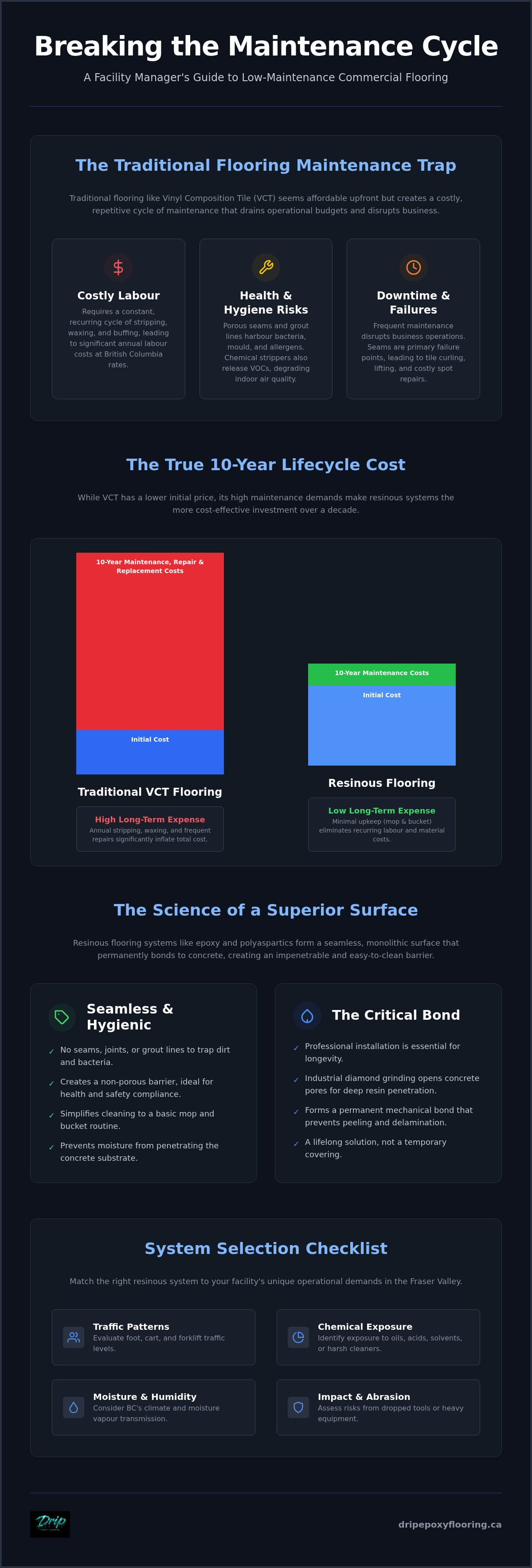
Many facility managers in Abbotsford or Langley choose Vinyl Composition Tile (VCT) or commercial carpet based on the initial price per square foot. This decision often overlooks the long-term financial burden of labour-intensive upkeep. While these materials appear cost-effective during the construction phase, they quickly become a liability due to the constant requirement for specialized cleaning and restoration. In busy Lower Mainland hubs, the downtime required for these maintenance cycles disrupts operations and eats into profit margins. True low maintenance commercial flooring requires a shift in perspective, moving away from temporary fixes toward permanent, high-performance systems that eliminate the need for annual resurfacing.
The Real Cost of Stripping and Waxing
Maintaining the professional appearance of VCT requires a recurring cycle of stripping, waxing, and buffing. This process demands significant annual man-hours, which, at current BC labour rates, represents a substantial operational drain. Beyond the financial cost, the chemical strippers used in this process often release volatile organic compounds (VOCs) that degrade indoor air quality. For facilities operating in enclosed spaces, this creates a recurring health concern for employees and visitors. The environmental impact is also noteworthy, as the frequent disposal of chemical-laden wastewater and the periodic replacement of worn-out tiles contribute to a larger ecological footprint that modern sustainability standards aim to avoid.
Seams: The Secret Enemy of Facility Managers
Traditional flooring systems rely on seams, joints, or grout lines, all of which are primary failure points in any commercial environment. In the humid climate of British Columbia, moisture infiltration at these seams is common, leading to adhesive failure and the eventual curling or lifting of tiles. These gaps don't just look unprofessional; they serve as a harbour for bacteria, mould, and allergens that are nearly impossible to eliminate with standard cleaning protocols. Seamless polymer flooring eliminates these vulnerabilities by creating a monolithic surface bonded directly to the substrate. This lack of joints is essential for meeting modern health and safety compliance, as it removes the areas where grime and pathogens typically accumulate. By choosing a system without seams, businesses can ensure their facility remains hygienic and structurally sound for years without the constant threat of localized repairs.
The Science of Seamlessness: Why Resinous Coatings Define Low Maintenance
True durability in a commercial environment isn't just about the top layer; it's about the molecular bond between the coating and the concrete substrate. Resinous systems create a monolithic, non-porous surface that effectively transforms a porous concrete slab into an impenetrable barrier. This technical approach aligns with the technical standard for resinous flooring, ensuring that the installation meets rigorous industrial requirements. By eliminating the physical gaps found in tile or plank systems, these coatings remove the structural vulnerabilities that lead to long-term maintenance headaches. A professionally installed resinous floor functions as a single, continuous unit that resists the mechanical stresses of a busy facility.
The longevity of this system depends entirely on the initial surface preparation. Unlike DIY kits that often peel after a single season, professional installations involve industrial diamond grinding to open the concrete's pores. This mechanical process creates a "profile" that allows the resin to penetrate deep into the slab, forming a permanent mechanical bond. This meticulous preparation is what allows a facility to transition to a low maintenance commercial flooring model, as the risk of delamination or bubbling is virtually eliminated from the start.
Epoxy vs. Polyaspartic: Choosing the Right Chemistry
While epoxy is a staple for its incredible bond strength, polyaspartic flooring offers specific advantages for modern BC businesses. Polyaspartic coatings are UV stable, which means they won't yellow or chalk when exposed to sunlight through large storefront windows or warehouse bay doors. They also feature rapid cure times, often allowing for a full return to service within 24 hours. This minimizes the business interruption that typically plagues renovation projects. For zones with heavy equipment or constant pallet jack traffic, the high impact resistance of these advanced polymers ensures the surface remains unmarred by chips or cracks.
The Non-Porous Advantage
The primary benefit of a resinous system is its closed-loop surface. Because the material is non-porous, it cannot absorb oils, road salts, or harsh chemicals used in automotive and industrial shops. This chemical resistance simplifies the cleaning process, allowing staff to utilize a basic "mop and go" protocol rather than dealing with deep-scrubbing or specialized equipment. Resinous flooring is a chemically bonded, seamless shield for concrete. This protection ensures that even the most stubborn spills remain on the surface for easy removal. If you're ready to see how these systems can transform your facility's daily operations, you can request a technical assessment for your specific space.
Comparing Low Maintenance Commercial Flooring Options
Selecting a surface for a high-traffic facility involves balancing immediate capital expenditure against long-term operational costs. While VCT and tile are common, commercial epoxy flooring provides a superior response to the specific environmental pressures found in British Columbia. Our local climate, characterized by high humidity and the frequent tracking of road salts during winter months, requires a surface that remains chemically inert and physically resilient. Resinous systems deliver this by creating a barrier that is fundamentally different from traditional materials that rely on mechanical fasteners or topical waxes.
Resinous Coatings vs. Traditional Hard Surfaces
Traditional tile installations are a recurring maintenance challenge for restaurants and commercial kitchens due to the porous nature of grout lines. These joints absorb grease and organic matter, requiring aggressive scrubbing that eventually degrades the bond; this creates a cycle of repair that resinous systems avoid. In contrast, quartz-reinforced coatings offer superior slip-resistance ratings that outperform standard tile in wet environments. Even polished concrete, often touted as a maintenance-free option, remains vulnerable to acidic spills and salt pitting. Unlike polished concrete, which requires regular resealing to stay non-porous, a truly low maintenance commercial flooring solution remains impenetrable throughout its entire thickness.
Lifecycle Value Analysis
Evaluating the value of a flooring system requires looking past the first year of service. Over a 10-year period, the reduced requirement for specialized cleaning crews and the elimination of stripping budgets justify the initial investment in resinous coatings. This is the essence of "Industrial Luxury," where the high-end aesthetic of metallic flooring meets the uncompromising strength of an industrial-grade shield. These metallic finishes provide a sophisticated, marbled look that hides minor wear while maintaining the same chemical resistance as solid-colour systems.
Achieving this level of performance starts with Professional Concrete Floor Preparation Services. Without this foundational diamond grinding, even the most advanced resins cannot deliver their full lifecycle potential. By investing in the correct chemistry and meticulous preparation upfront, BC business owners secure a one-and-done solution that preserves property value and operational efficiency. This approach eliminates the need for the frequent, disruptive renovations that characterize cheaper, traditional flooring choices.
Selection Checklist: Matching the Floor to Your BC Industry
Selecting the ideal system requires a precise analysis of your facility's unique environmental stressors. Choosing a low maintenance commercial flooring solution involves more than just picking a topcoat; it requires evaluating traffic patterns, chemical exposure, and substrate conditions. In the Fraser Valley, local facility managers must prioritize moisture vapour transmission (MVT) assessments. High water tables in regions like Chilliwack and Abbotsford often lead to hydrostatic pressure beneath concrete slabs. If this moisture isn't managed with a specialized primer, it can lead to delamination and coating failure, regardless of the material's quality.
Safety compliance is another critical factor, especially during the British Columbia rainy season. Constant moisture tracked into a building creates significant slip hazards. Integrating slip-resistance additives, such as aluminium oxide or quartz sand, ensures your floor remains safe without compromising the ease of cleaning. For environments where aesthetics and durability must coexist, decorative flake flooring is an excellent choice. The multi-layered flake system provides a textured finish that effectively hides minor scratches and tracked-in debris, making it the ultimate "one-and-done" solution for busy spaces.
Retail and Showroom Considerations
Retail environments require a balance between brand identity and operational efficiency. Chilliwack boutiques and high-end showrooms often opt for metallic epoxy to achieve a sophisticated, marbled aesthetic that reflects light beautifully. This "Industrial Luxury" provides a premium look while remaining completely non-porous and easy to sanitize. If you are looking for specialists who understand these high-end requirements, consulting Metallic Epoxy Floor Installers in BC can help you define the right finish for your brand.
Warehousing and Industrial Environments
In the industrial hubs of Surrey and Abbotsford, the focus shifts toward compressive strength and extreme chemical resistance. These floors must withstand the relentless weight of forklifts and pallet jacks without cracking. Integrating safety markings and line striping directly into the resinous coating eliminates the need for repainting worn lines every few months. For a deeper look at industry-specific requirements, our guide to Industrial Concrete Coatings in Surrey provides technical specifications for heavy-duty applications. To ensure your facility meets the 2026 BC Building Code standards for safety and resilience, you can request a professional site evaluation today.
Maximizing Your Investment with Drip Epoxy Flooring
Transitioning to a low maintenance commercial flooring model requires more than just high-quality resins; it demands a partner who understands the technical nuances of the Lower Mainland's environment. Drip Epoxy Flooring differentiates itself through a commitment to precision and long-term performance. We don't just apply a coating; we engineer a system that bonds permanently to your concrete substrate. This approach ensures that your facility avoids the common failures associated with improper preparation, such as peeling or bubbling, providing a reliable surface that stands the test of time and heavy operational use.
Local expertise matters when dealing with the unique climate of the Fraser Valley. Our team understands how local humidity levels and temperature shifts affect cure times and material performance. By choosing a specialist who prioritizes technical standards over quick fixes, you secure a "one-and-done" solution that eliminates the need for future costly interventions. We focus on delivering a transformation that enhances both the safety and the professional aesthetic of your space, ensuring your investment pays dividends in reduced labour costs for years to come.
Our Professional Installation Process
Our methodology begins with heavy-duty diamond grinding to mechanically open the concrete pores, creating the ideal profile for chemical adhesion. This step is non-negotiable for achieving a lifelong bond. In the Fraser Valley, where high humidity and fluctuating water tables are constant factors, we perform rigorous moisture testing before every installation. This data-driven approach allows us to select the appropriate moisture-mitigating primers to prevent future delamination. We prioritize safety and sustainability by utilizing low-VOC, high-solids materials that meet strict indoor air quality standards, allowing for a safer return to service for your staff and clients.
Start Your Transformation Today
Transitioning your facility to a high-performance system doesn't have to result in extended operational delays. Our local expertise in Chilliwack, Abbotsford, and Langley allows us to manage project timing effectively, accounting for BC's specific climate conditions to ensure optimal cure times. You can explore our epoxy floor samples to see the wide range of aesthetic possibilities, from industrial-grade flake systems to sophisticated metallic finishes. Whether you're managing a warehouse in Burnaby or a retail showroom in Chilliwack, we provide the technical guidance needed to secure your investment.
To move forward with your facility upgrade, the first step is a professional assessment. You can book your free on-site consultation and quote to receive a detailed breakdown tailored to your specific industry requirements. Securing a commercial flooring quote from a specialized team ensures that your new surface will deliver the professional appearance and durability your business demands for the next decade and beyond.
Future-Proof Your Facility with Seamless Resilience
Transitioning to a high-performance resinous system represents a strategic shift from recurring operational costs to long-term facility efficiency. By eliminating the vulnerable seams and porous grout lines that define traditional surfaces, you ensure your space remains hygienic and resilient against the unique moisture challenges of the British Columbia climate. Choosing low maintenance commercial flooring isn't just about easier cleaning protocols; it's about securing a durable, professional finish that preserves your property's value for a decade or more.
As a locally owned Chilliwack specialist, Drip Epoxy Flooring provides the technical expertise and industrial-grade diamond grinding preparation required to deliver a permanent, maintenance-free bond. We serve the entire Lower Mainland, helping businesses achieve a level of "Industrial Luxury" that balances sophisticated aesthetics with uncompromising durability. Our meticulous approach ensures your new surface is engineered to withstand the rigours of your specific industry while meeting all 2026 safety and compliance standards.
Take the first step toward a more efficient facility today. Get a Free Quote for Your Low Maintenance Commercial Floor and discover the lasting benefits of a professionally installed, seamless surface. We look forward to helping you transform your commercial space into a resilient, high-performance environment.
Frequently Asked Questions
How do I clean low maintenance commercial epoxy floors?
To clean low maintenance commercial flooring, you simply need a soft broom and a mop with a pH-neutral cleaning solution. Because the surface is non-porous and monolithic, dirt and grime cannot penetrate the finish. In regions like Abbotsford and Langley, where winter road salts are frequently tracked indoors, a quick rinse with clean water is usually enough to restore the shine. You'll never need to use the aggressive chemical strippers required for traditional tile.
Is epoxy flooring too slippery for a commercial entrance in BC?
Professional resinous coatings are not inherently slippery when correctly specified with slip-resistance additives. During the rainy season in the Lower Mainland, we integrate materials like aluminium oxide or quartz into the topcoat to provide essential traction. This ensures your commercial entrance remains safe for pedestrians while maintaining its high-end aesthetic. We customize the level of texture based on your specific traffic patterns and the likelihood of moisture exposure in your Chilliwack or Surrey facility.
How long does a professional commercial floor coating last?
A professionally installed commercial floor coating typically lasts between 10 and 20 years, depending on the volume of heavy equipment and foot traffic. The longevity of the system is rooted in the quality of the initial surface preparation. By utilizing industrial diamond grinding to open the concrete pores, we create a permanent mechanical bond. This "one-and-done" approach prevents the delamination and peeling often seen in budget-driven applications, providing a reliable surface for the long term.
Can resinous flooring be installed over existing tile or concrete?
Resinous flooring can be installed over existing concrete and, in some specific cases, over soundly bonded tile. The success of the application depends entirely on the substrate's structural integrity and the thoroughness of the mechanical preparation. We use heavy-duty grinding equipment to remove any existing contaminants or loose materials. This process ensures the new coating adheres perfectly, transforming an old, high-maintenance floor into a seamless, high-performance system that meets modern BC Building Code standards.
What is the difference between shop-bought epoxy and professional coatings?
Shop-bought epoxy kits are usually water-based with low solids content, leading to a thin, brittle finish that easily peels under vehicle or foot traffic. Professional-grade coatings utilize 100% solids epoxy or polyaspartic resins, which offer significantly higher impact and chemical resistance. Professional installations also include industrial diamond grinding, a step rarely achievable with DIY tools. This difference in chemistry and preparation is why specialized low maintenance commercial flooring lasts decades rather than just a single season.
How much downtime should I expect during a commercial installation?
Downtime varies by the type of system selected, but many polyaspartic installations allow for a full return to service within 24 to 48 hours. Traditional epoxy systems may require slightly longer cure times, typically ranging from three to five days depending on the facility's temperature and humidity levels. We coordinate project timing meticulously across the Lower Mainland to minimize disruption to your business operations, ensuring your facility is back online as quickly as possible.
Are these floors resistant to road salt and winter chemicals used in BC?
These floors are exceptionally resistant to road salt, de-icing chemicals, and the harsh winter brine used on BC highways. Because the resinous coating is chemically inert and non-porous, these substances remain on the surface rather than penetrating and pitting the concrete slab. This protection is vital for facilities in Hope or Agassiz, where winter conditions can be severe. A simple cleaning protocol removes these residues easily, preventing the structural damage commonly associated with untreated concrete.
Do I ever need to wax or buff a polyaspartic floor?
You do not need to wax or buff a polyaspartic floor to maintain its professional appearance. The high-gloss or satin finish is a permanent characteristic of the cured resin, which is designed to resist dulling and abrasions over time. This eliminates the labour-intensive maintenance cycles required for VCT or polished concrete. For facility managers in Burnaby or Coquitlam, this means a significant reduction in long-term maintenance budgets while ensuring the space always looks its best.