industrial floor coatings Mission BC · 14 min read ·
Industrial Floor Coatings in Mission, BC: The 2026 Buyer’s Guide
Did you know that nearly 80% of all industrial floor coating failures are caused by improper surface preparation rather than the material itself? In the damp climate of the Fraser Valley, Mission facility managers freque
By Drip Epoxy Flooring · Chilliwack, BC
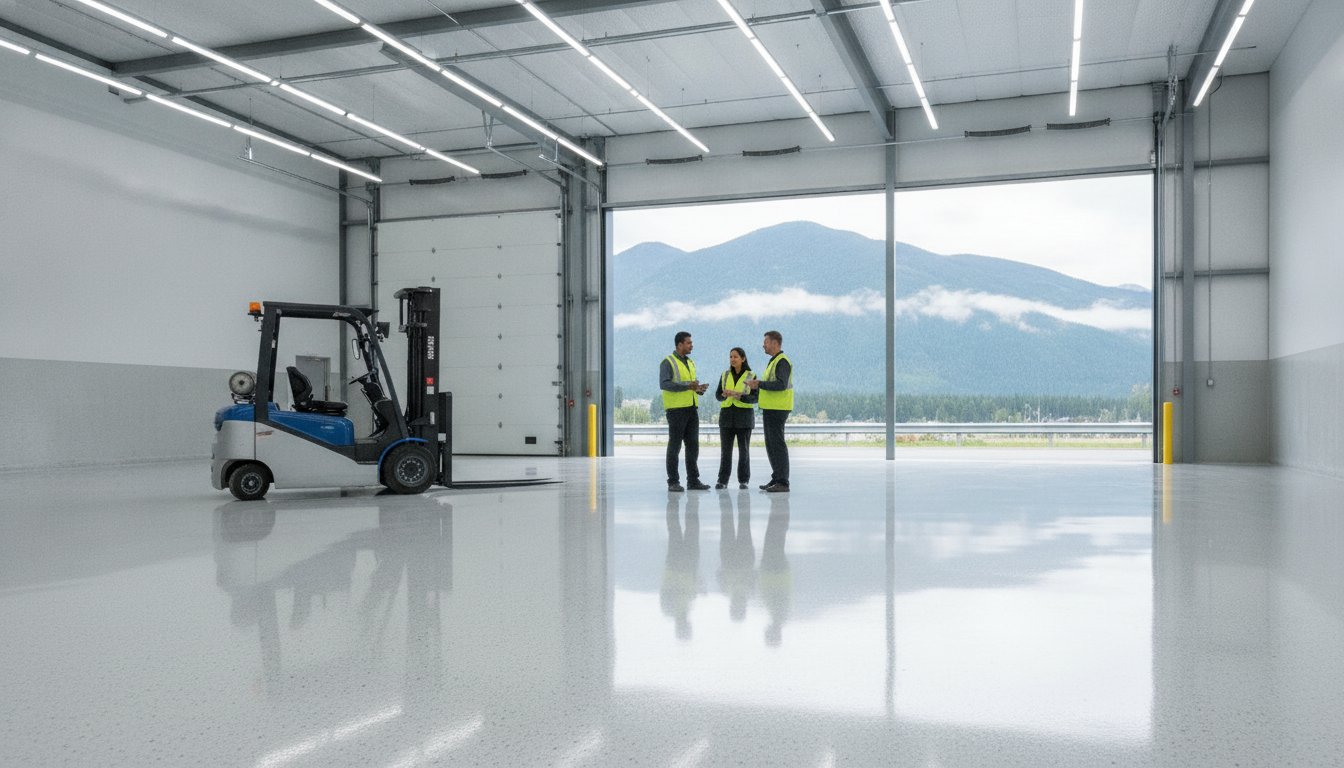
Did you know that nearly 80% of all industrial floor coating failures are caused by improper surface preparation rather than the material itself? In the damp climate of the Fraser Valley, Mission facility managers frequently face the frustration of coatings that peel or bubble due to persistent moisture vapour. You've likely dealt with the stress of high downtime during installation or the unsightly reality of oil staining in your production areas. It's a significant investment, and you deserve a surface that stands up to the heavy-duty demands of your industry.
This 2026 buyer's guide is designed to help you select the most durable, chemical-resistant, and moisture-tolerant industrial floor coatings Mission BC businesses can rely on for years to come. We'll examine the technical necessity of mechanical diamond grinding, the superior resilience of quartz and metallic systems, and how a moisture-first engineering approach prevents delamination. By the end of this guide, you'll understand how to achieve a seamless, safety-compliant floor that delivers a genuine long-term ROI without the need for frequent, costly repairs.
Key Takeaways
- Learn why mechanical diamond grinding is the essential first step to prevent coating failure caused by the Fraser Valley's high moisture vapour levels.
- Compare the performance characteristics of epoxy, polyaspartic, and quartz systems to determine which best suits your facility's chemical and impact requirements.
- Discover how prioritizing long-term durability over the lowest initial quote minimizes business downtime and maximizes your return on investment.
- Understand the technical selection process for industrial floor coatings Mission BC facilities need to remain safety-compliant and resistant to heavy machinery wear.
- Gain insights into why localized expertise from a Chilliwack-based centre ensures your flooring system is engineered specifically for the Mission industrial climate.
Table of Contents
The Industrial Flooring Landscape in Mission, BC
Mission's industrial sector is undergoing a significant transformation. From the bustling corridors near Lougheed Highway to the strategic waterfront developments, the demand for high-performance industrial floor coatings Mission BC facilities require has never been higher. Standard concrete fails in these environments. It's porous and brittle, often lacking the resilience to withstand the constant pressure of heavy machinery and forklift traffic. Over time, untreated concrete begins to "dust," which creates air quality issues and structural degradation. Modern facilities are now adopting the "industrial luxury" trend. This means floors are expected to provide extreme durability while maintaining a polished, professional aesthetic that reflects a company's commitment to quality.
Mission Climate Factors: Vapour and Moisture
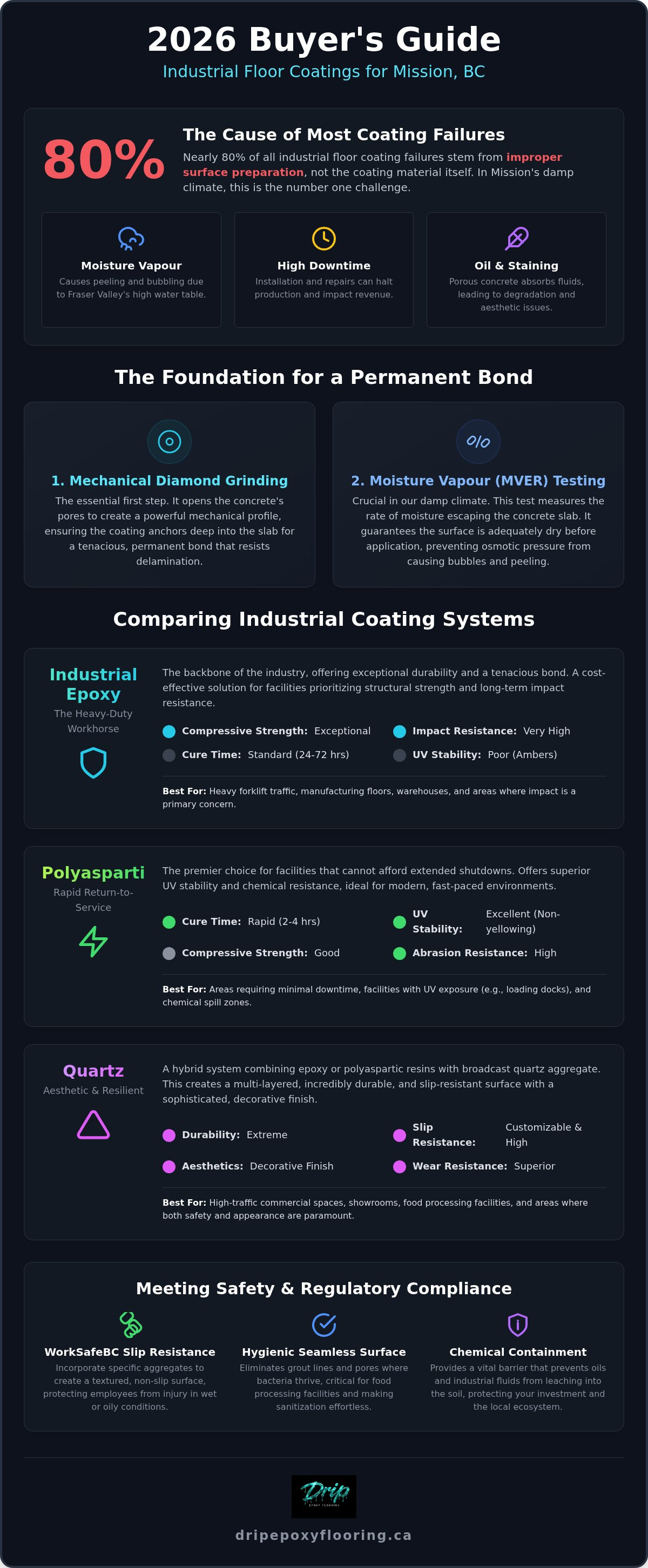
The Fraser Valley's geographic profile presents unique challenges for concrete longevity. Because Mission is situated near the river with a high water table, concrete slabs often act like sponges, absorbing ground moisture that eventually tries to escape as vapour. This process creates intense osmotic pressure. When a low-quality or poorly installed coating is applied, this pressure forces the resin to delaminate, leading to unsightly bubbling and peeling. We mitigate this risk by performing rigorous moisture vapour emission rate (MVER) testing before any Seamless polymer flooring systems are installed. Ensuring the slab is dry and properly profiled is the only way to guarantee a permanent bond in our damp climate.
Regulatory Compliance for Local Facilities
Maintaining a safe working environment is a legal necessity under WorkSafeBC guidelines. Local plants must prioritize slip resistance to protect employees from workplace injuries, especially in wet or oily conditions. Our commercial epoxy flooring solutions incorporate specific aggregates to meet these safety benchmarks. Additionally, food processing facilities in the region must adhere to strict hygiene standards. A seamless surface eliminates the grout lines and pores where bacteria thrive, making the floor easy to sanitize and keep compliant. Proper chemical containment is also vital for environmental protection. It ensures that oils or industrial fluids don't leach into the Mission soil through porous concrete, protecting both your investment and the local ecosystem. For businesses looking to upgrade, our industrial epoxy flooring options provide the necessary barrier against these daily operational hazards.
Comparing Industrial Coating Systems: Epoxy, Polyaspartic, and Quartz
Selecting the ideal industrial floor coatings Mission BC facilities require involves balancing high-performance results with specific operational constraints. Facility managers often face a trade-off between rapid installation cure times, chemical resistance levels, and the initial project investment. A hybrid approach is frequently the most effective strategy for modern warehouses. This involves utilizing a high-build epoxy primer for its superior mechanical bond to the concrete, followed by a polyaspartic topcoat for its rapid cure and resilience against chemical spills or abrasion. Customization options are vast, ranging from utilitarian solid colours to sophisticated decorative quartz systems designed for high-traffic zones.
Industrial Epoxy: The Heavy-Duty Workhorse
Industrial epoxy remains the backbone of the flooring industry. It offers exceptional compressive strength, which is vital for facilities utilizing heavy forklifts or pallet jacks on a daily basis. When applied after professional diamond grinding, the resin creates a tenacious bond that resists delamination even under extreme stress. If your primary concern is structural durability and long-term impact resistance, Industrial Epoxy Flooring provides a cost-effective solution that stands the test of time.
Polyaspartic Coatings: Rapid Return-to-Service
For facilities that cannot afford extended shutdowns, polyaspartic coatings are the premier choice. These systems can cure in as little as 2 to 4 hours, allowing for a rapid return-to-service that minimizes production delays. Beyond speed, they offer excellent UV stability. This prevents the "ambering" or yellowing effect often seen near loading dock doors where sunlight hits the floor surface. You can learn more about these fast-curing systems in our guide to Commercial Polyaspartic Flooring in Abbotsford.
Quartz and Flake Systems: Slip Resistance and Durability
Safety is paramount in production zones where liquids or oils are present. Quartz flooring systems involve broadcasting specialized aggregate into the wet resin to create a safe, textured surface. This is particularly beneficial for wet environments where maintaining traction is a constant challenge. These systems help Mission facilities align with OSHA safety standards regarding slip-resistant floor surfaces. For retail or high-traffic commercial spaces that require both visual appeal and grit, consider reading the Quartz Flooring: BC Retail Buyer’s Guide. If you are unsure which system fits your specific facility, you can request a professional assessment to determine the most durable path forward for your space.
Evaluating ROI: Cost vs. Longevity for Mission Businesses
When investigating industrial floor coatings Mission BC, businesses often focus on the initial capital expenditure. However, the "cheapest quote" frequently masks significant long-term risks. A low-cost installation often bypasses critical steps like deep mechanical preparation or the use of high-solids resins, which leads to delamination within eighteen months. When a floor fails, the cost of repair isn't just the price of new materials. It includes the logistical nightmare of moving heavy machinery, halting production, and potentially losing revenue during the shutdown. True value is found in the lifecycle of the system rather than the sticker price.
Calculating ROI requires a shift from viewing flooring as a one-time expense to seeing it as an operational asset. High-performance materials, such as polyaspartic or quartz systems, might require a higher initial investment, but they dramatically reduce downtime. While a standard epoxy might take several days to cure, advanced systems allow for a return to service in hours. Over a ten-year horizon, a professionally installed floor that lasts twenty years provides a much lower annual cost than a budget coating that requires resurfacing every three or four years.
The Real Cost of Floor Failure
Peeling or bubbling floors do more than just look unprofessional; they create significant safety hazards that can lead to failed safety audits. If a floor begins to flake, those particles can contaminate production lines, which is a critical failure in food-grade or precision manufacturing environments. DIY kits or "big box" alternatives simply don't have the chemical cross-linking density required to handle the shear forces of a turning forklift. Investing in "Industrial Luxury" also yields intangible benefits. A clean, high-gloss, and well-maintained facility helps attract premium tenants and improves employee morale by providing a bright, safe workspace.
Maintenance and Cleaning Protocols
One of the most immediate financial benefits of professional industrial floor coatings Mission BC is the reduction in cleaning labour. Seamless surfaces don't trap dust, oils, or bacteria in pores or grout lines. To preserve the topcoat's lustre, it's vital to standardize cleaning routines with pH-neutral agents. Using harsh, incompatible chemicals can degrade the resin's molecular structure over time, leading to premature dulling. Before selecting a finish, it's helpful to review Epoxy Floor Samples to visualize how different textures and colours will integrate with your facility’s existing maintenance capabilities. This foresight ensures your flooring remains a durable, easy-to-clean asset rather than a recurring maintenance headache.
The Installation Process: Precision Preparation
Precision preparation is the single most critical factor in the longevity of any flooring system. In the industry, it's widely recognized that surface preparation accounts for approximately 80% of a successful installation. Without a meticulously prepared substrate, even the highest-quality industrial floor coatings Mission BC facilities invest in will eventually fail. The goal is to transform a smooth, contaminated concrete slab into a clean, "profiled" surface that allows the resin to achieve a deep mechanical bond. This process involves more than just cleaning; it's about engineering the foundation for a permanent finish.
Managing dust and debris is a primary concern for active Mission industrial environments. We utilize industrial-grade HEPA-filtered vacuum systems connected directly to our grinding equipment to ensure that concrete dust is contained at the source. Quality control during this phase is rigorous. We perform standardized tests to verify concrete hardness using the Mohs scale, measure ambient temperature to ensure proper chemical cross-linking, and confirm that moisture levels are within acceptable limits before the first drop of resin is applied.
Mechanical Diamond Grinding vs. Shot Blasting
Choosing the correct preparation method depends on the concrete's current condition and the required Concrete Surface Profile (CSP). Mechanical diamond grinding is the gold standard for most industrial projects because it effectively removes surface laitance, old oils, and failed previous coatings while leaving a uniform texture. Shot blasting is reserved for heavy-duty profiling or when the concrete requires a more aggressive "open" pore structure. You can explore the technical differences in our guide to Professional Concrete Floor Preparation Services. Both methods are designed to expose the "meat" of the concrete, ensuring the coating becomes an integral part of the slab rather than a superficial layer.
Phasing and Logistics
We understand that Mission businesses cannot afford prolonged operational disruptions. Our team coordinates closely with facility managers to schedule installations during planned shutdowns or weekends. To maintain a safe environment in occupied buildings, we prioritize the use of low-VOC resins that minimize odours and air quality concerns. The final inspection is a methodical walkthrough to ensure every square foot meets our professional standards. Once the final topcoat is applied, we provide a clear return-to-service timeline, typically allowing for foot traffic within hours and heavy machinery within 24 to 48 hours depending on the system selected. To ensure your project starts with the correct technical foundation, you should schedule a site assessment and moisture test with our specialist team today.
Why Drip Epoxy Flooring is Mission’s Industrial Choice
Mission facility managers require more than just a general contractor; they need a specialist partner who understands the local environmental variables of the Fraser Valley. Drip Epoxy Flooring serves the region from our Chilliwack centre, providing localized expertise that national providers often lack. We understand the specific challenges of the high water table near the Mission waterfront and the heavy-duty requirements of shops along the Lougheed Highway corridor. Our commitment to quality means we never utilize residential-grade shortcuts or DIY-style kits. Instead, we focus on the high-performance industrial floor coatings Mission BC businesses need to maintain operational efficiency. Our quoting process is completely transparent, ensuring you receive a thorough breakdown of costs with no hidden fees or unexpected surcharges.
Our track record of transforming Mission warehouses and production shops is built on a foundation of technical precision. We've seen how standard concrete fails under the shear force of turning forklifts and the corrosive nature of industrial chemicals. By choosing a specialist, you're investing in a surface engineered for "industrial luxury" that balances extreme durability with a high-end aesthetic. This professional finish does more than just protect the slab; it enhances the overall value of your facility and creates a safer, more productive environment for your staff.
Our Commitment to Quality and Precision
Every project begins with a rigorous site assessment. We don't just look at the surface; we investigate the slab's integrity and moisture vapour emission rates to prevent future delamination. This meticulous approach allows us to identify specific challenges, such as previous coating failures or deep oil contamination, before they become costly issues. We also realize that your facility is an extension of your brand identity. We offer custom colour and finish matching to ensure your floor aligns perfectly with your corporate aesthetic and safety marking requirements. For a personalized consultation regarding your facility's needs, you can Contact Drip Epoxy Flooring to discuss your specific requirements with an expert.
Get Started with Your Mission Project
Initiating your flooring transformation is a straightforward, professional process. When you request a free industrial floor assessment, our specialists visit your site to perform the necessary tests and measurements. To prepare for your initial consultation, it's helpful to have your facility's approximate square footage, a history of any previous floor repairs, and your primary operational goals ready for review. This information helps us engineer a system tailored to your specific traffic patterns and chemical exposure levels. Don't settle for a temporary fix when you can invest in a permanent solution that delivers a genuine return on investment. Book your free industrial floor quote today!
Secure the Future of Your Industrial Facility
Mission's industrial landscape demands flooring that transcends basic utility. By prioritizing mechanical diamond grinding and performing rigorous moisture testing, you ensure that your investment remains resilient against the unique humidity challenges of the Fraser Valley. Whether you require the rapid cure times of a polyaspartic system or the extreme impact resistance of a quartz broadcast, selecting the correct industrial floor coatings Mission BC specialist is the definitive step toward operational longevity.
As a locally owned and operated provider in the Fraser Valley, Drip Epoxy Flooring specializes in the technical precision required for high-performance bonding. We provide free on-site quotes and moisture testing to identify potential slab issues before they lead to delamination. Our focus is on delivering a seamless, safety-compliant environment that reflects the professional standards of your business. Take the first step toward a more durable workspace today. Request a Free Industrial Floor Assessment for Your Mission Facility and discover the difference that meticulous preparation and industrial-grade materials can make for your facility's future.
Frequently Asked Questions
How long does an industrial floor coating take to cure in Mission, BC?
Cure times for industrial floor coatings Mission BC businesses vary significantly based on the chemical composition of the resin. A standard industrial epoxy system typically requires 24 hours for foot traffic and up to 72 hours for heavy forklift use. In contrast, polyaspartic coatings offer a rapid return to service, often allowing foot traffic within 4 hours. Because Fraser Valley humidity can influence cure rates, we monitor ambient conditions throughout the entire application process to ensure structural integrity.
Can you apply epoxy over old, oil-stained industrial concrete?
Successful application over oil-stained concrete is possible only if the substrate undergoes rigorous mechanical preparation. We utilize diamond grinding to remove the contaminated surface layer and expose clean, porous concrete. If deep saturation is present, we apply specialized oil-tolerant primers that create a chemical bond despite the presence of residual hydrocarbons. Simply applying resin over stains without these preparatory steps will inevitably lead to delamination and a complete failure of the flooring system.
What is the difference between industrial floor paint and a professional coating?
Industrial floor paint is a thin, single-component material that dries through evaporation, making it susceptible to peeling under heavy loads. Professional coatings are high-solids, two-part resinous systems that cure through a precise chemical reaction. This process creates a thick, resilient barrier that is chemically bonded to the concrete. While paint offers a temporary aesthetic change, professional-grade coatings provide the compressive strength required to withstand forklift traffic and constant industrial abrasion without flaking.
How do you handle moisture vapour issues in Fraser Valley facilities?
Managing moisture is a priority in the damp Fraser Valley climate to prevent osmotic pressure from destroying the bond. We perform moisture vapour emission rate (MVER) testing on every project to determine the slab's internal humidity level. If readings exceed the manufacturer's threshold, we install a dedicated moisture vapour barrier primer. This specialized layer blocks rising vapour and ensures the topcoats remain securely attached to the substrate despite the region's high water table.
Are your industrial coatings slip-resistant for wet environments?
Every industrial system we install can be customized with specific slip-resistant aggregates to ensure employee safety. By broadcasting materials such as quartz or aluminum oxide into the wet resin, we create a textured surface that provides essential traction in wet or oily environments. These finishes help local facilities maintain compliance with safety regulations and reduce the risk of workplace accidents, making them an ideal choice for food processing plants and mechanical workshops.
How do I clean and maintain my new industrial epoxy floor?
Maintenance for a resinous floor is remarkably straightforward because the surface is non-porous and seamless. We recommend daily dust mopping to remove abrasive grit that can dull the finish over time. For deeper cleaning, utilize a pH-neutral detergent and a soft-bristle scrubber or mop. It is vital to avoid harsh acids or solvent-based cleaners, as these chemicals can degrade the molecular structure of the topcoat and diminish the floor's long-term lustre and protective capabilities.
Do you offer low-VOC options for facilities that need to remain occupied?
We prioritize the use of high-solids, low-VOC resins to accommodate facilities that must remain operational during the installation process. These advanced materials emit minimal odours, ensuring that air quality remains safe for employees in adjacent areas. This approach allows Mission businesses to upgrade their flooring without the need for a total facility shutdown, providing a professional solution that balances high-performance results with the practical realities of a functioning industrial or commercial workspace.
What is the typical lifespan of a polyaspartic coating in a high-traffic warehouse?
A professionally installed polyaspartic coating can last 20 years or more in a high-traffic warehouse environment. This longevity is due to the material's superior flexibility and resistance to impact compared to traditional epoxy systems. While the initial investment for polyaspartic is higher, its resilience against UV yellowing and heavy machinery wear ensures a much lower lifecycle cost. Regular maintenance and proper cleaning protocols are essential to achieving the maximum lifespan from these high-performance industrial surfaces.