UV Stable
Polyaspartic resists yellowing from sunlight better than conventional epoxy, making it especially useful near garage doors, storefront glazing and bright interiors.

Performance · Chilliwack, BC
Polyaspartic coatings are valued for fast cure times, strong abrasion resistance and excellent UV stability. In garages and commercial spaces, they are often used as the protective topcoat over epoxy or decorative flake systems because they hold colour well and return to service quickly.
We install polyaspartic flooring in Chilliwack for residential, commercial and light industrial projects where long-term protection, easy maintenance and exposure to daylight are important parts of the specification.
Why it lasts
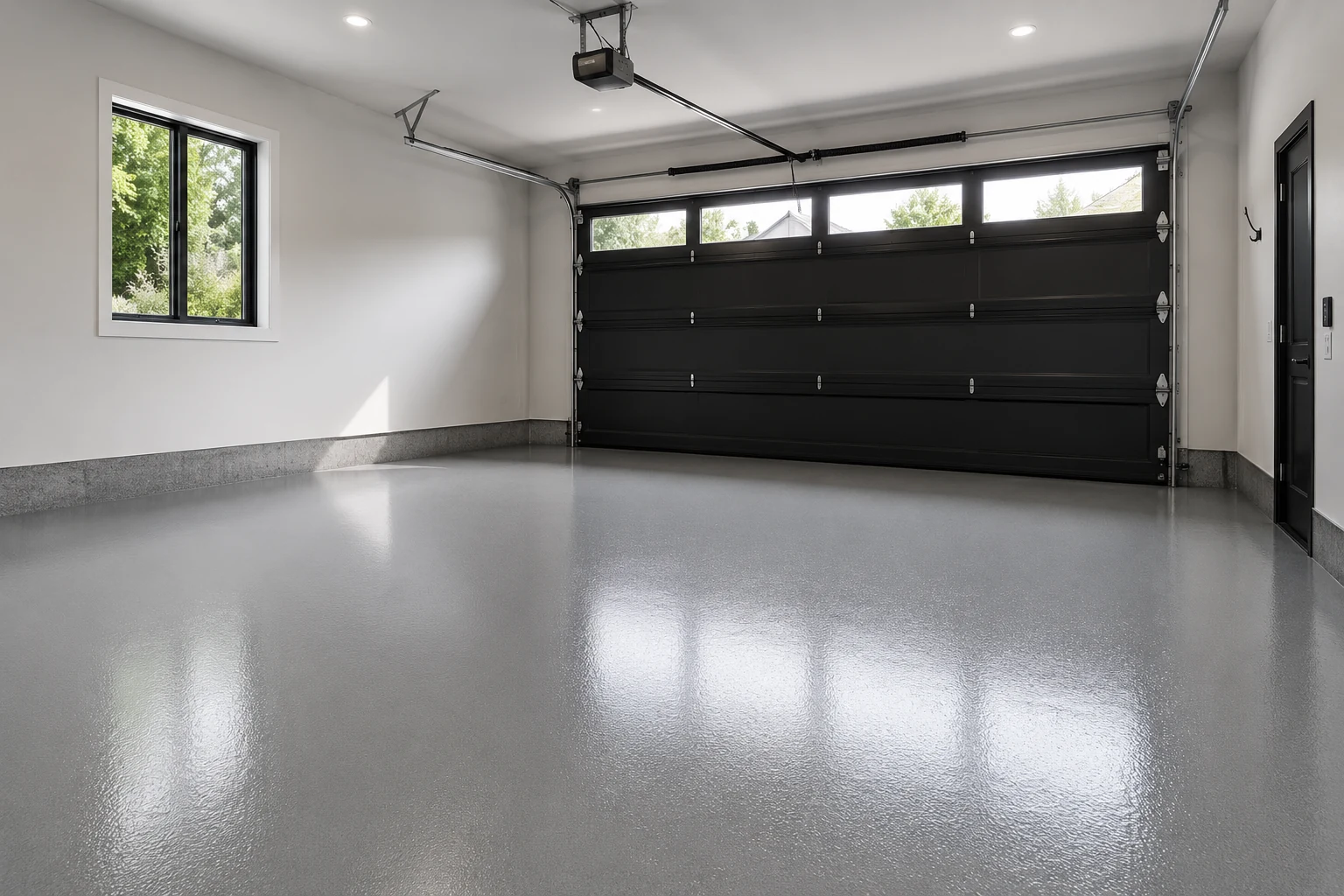
Polyaspartic resists yellowing from sunlight better than conventional epoxy, making it especially useful near garage doors, storefront glazing and bright interiors.
Fast cure characteristics can reduce downtime compared with many traditional coating systems when site conditions and the full build-up allow it.
A properly specified polyaspartic topcoat provides durable protection against daily wear, vehicle traffic and routine cleaning.
The sealed surface is non-porous and simple to sweep, mop and clean compared with unfinished concrete.
Epoxy and polyaspartic are not always competing products. In many professional floor systems, epoxy provides the body and adhesion while polyaspartic provides the final protective layer. That combination takes advantage of what each material does best.
For decorative flake floors, the polyaspartic topcoat locks the broadcast into place, gives the floor its finished sheen and protects colour where daylight reaches the surface.
Polyaspartic systems work well in residential garages, workshops, retail stores, showrooms, automotive spaces, breweries, restaurants, mechanical rooms, warehouses and many other commercial environments.
The correct build-up depends on what the floor will experience. A garage exposed to hot tires and sunlight has different needs than a back-of-house commercial room exposed to cleaning chemicals and rolling equipment.
A fast-curing topcoat cannot compensate for poor preparation. We mechanically diamond grind the concrete, repair defects and prepare the slab before applying primer, body coats or polyaspartic protection.
That mechanical profile gives the coating a proper surface to bond to. Acid washing or simply rolling a coating onto smooth concrete does not create the same foundation.
Polyaspartic can protect decorative flake, quartz and other resinous systems, and it can also be used in clean solid-colour applications where the specification suits the project. Gloss level, texture and traction can be adjusted around the environment.
If you are comparing epoxy and polyaspartic, the better question is usually how the complete system should be built. We recommend the combination that fits the slab, traffic, exposure and downtime available.
Our Installation Process
Four stages, in order, on every project. Nothing optional.
01
We mechanically diamond grind the concrete to remove contaminants and open the surface profile. This is the step that decides whether a floor lasts, and it is never substituted with an acid wash or a chemical etch.
02
Cracks, joints, spalls and surface imperfections are repaired before any coating is installed. Defects left in the slab telegraph through the finish, so they are resolved first.
03
Industrial-grade epoxy and polyaspartic systems are applied to specification — correct primer, correct build thickness, correct recoat window, monitored throughout.
04
Every floor is inspected for consistent coverage, cure and finish before handover, along with the care guidance that keeps it performing.
Common questions
Something not covered here? Call and ask — we would rather answer it before the quote than after.
604-991-8069Request a free quote
Related services
Residential systems built around preparation, flake and durable topcoats.
Compare timing, finish and system-fit considerations.
Durable seamless systems for busy business environments.
Heavy-duty coating systems for demanding facilities.